
Dr. Lynn Locklear Nehemiah’s journey of discovery to learn her enslaved ancestors’ stories and honor their legacies led her to an overgrown hillside at Sacred Heart Cemetery in Bowie, Maryland.
On a day of volunteer service to mark the Dr. Martin Luther King Jr. holiday in 2023, she joined fellow descendants, Sacred Heart parishioners, Catholic University students and community members to clear brush and debris on that hillside where archaeological surveys uncovered what are believed to be the unmarked graves of hundreds of people who had been enslaved at the White Marsh plantation operated by the Jesuits’ religious order in that area before emancipation.
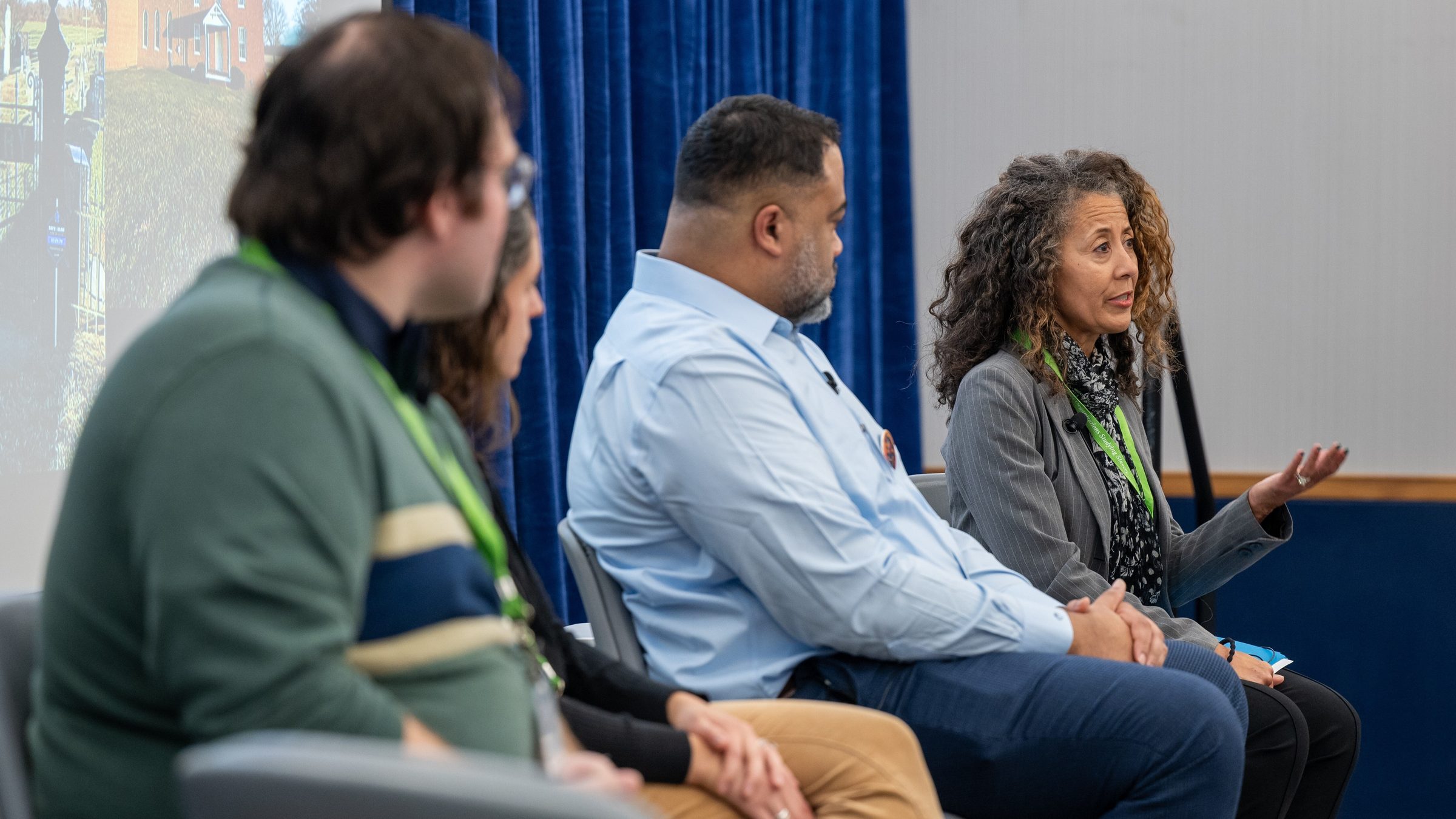
“I believe that God reveals in order to heal,” Locklear Nehemiah, a retired dentist, said during a panel discussion on Nov. 14, 2025 at the CROSS (Catholic Religious Organizations Studying Slavery) conference at Georgetown University.
CROSS was established in 2021 by representatives of the Archdiocese of St. Louis and the Jesuit Slavery, History, Memory and Reconciliation Project. The group’s website notes that “recognizing that slavery is a sin, it is our mission to promote open and honest access to the historical record in order to achieve a more comprehensive and truthful telling of enslavement within the Catholic Church in the United States.”
The 2025 conference in Washington, D.C., had as its theme “Catholic Archives and Slavery: Research, Collaboration and Hope,” and it drew representatives of Catholic religious orders, dioceses and educational institutions, along with descendants and other participants.
Georgetown University which hosted the gathering has been at the center of the U.S. Catholic Church’s acknowledgement and reckoning of its involvement with slavery. In 1838, the Maryland Society of Jesus, the Jesuits, sold 272 enslaved men, women and children to Louisiana sugar plantation owners, and that sale helped ensure the financial survival of Georgetown College, now the university.
The sponsors for the CROSS conference included Georgetown University’s Center for the Study of Slavery and its Legacies, the Archdiocese of St. Louis and the Roman Catholic Archdiocese of Washington. CROSS works in concert with the United States Conference of Catholic Bishops’ Subcommittee for the Promotion of Racial Justice and Reconciliation.
Remembering unsung heroes
In her talk during a panel discussion on “Understanding Catholic History and Catholic Cemeteries through Archaeology,” Locklear Nehemiah noted she was anxious to participate in that cemetery clean-up, because through her research, she learned that Harry Mahoney, her fourth great-grandfather, was born and enslaved at White Marsh in the late 1700s. Another of her ancestors, Louisa Mahoney Mason, Harry’s daughter, was listed in the 1838 bill of sale but escaped into the woods and remained in Maryland, while her siblings and their families were trafficked to the Louisiana plantations.
Locklear Nehemiah’s seventh great-grandmother, Ann Joice, was a free Black woman who arrived in the Maryland colony in the late 1600s as an indentured servant, but her contract was burned and she was enslaved by Catholic gentry there, and the story of her stolen freedom was passed on to generations of her family.
The stories of Ann Joice and Harry Mahoney and their families appear prominently in the book “The 272: The Families Who Were Enslaved and Sold to Build the American Catholic Church” written by Rachel L. Swarns, a journalism professor at New York University and a contributing writer for The New York Times who gave a keynote address at the CROSS conference.

Locklear Nehemiah, who serves as the vice-president of the White Marsh Historical Society and co-chair of the Sacred Heart Cemetery Committee, described her experience at the cemetery clean-up in poetic terms.
“Entering the grounds of White Marsh on that bright, crisp winter day was like stepping into a vortex where the past and the present collide. The community had gathered, whites and Blacks, descendants, students, parishioners, archaeologists and folks simply wanting to give back, all joined in one accord, to take back territory,” she said.
Reflecting on that place where some of her enslaved ancestors were likely buried, she added, “The land cries out. Unnamed fieldstones standing as messengers, voices in the wilderness, calling to generations yet unborn: ‘We were here. We once walked the ground you now walk. You carry our DNA, our hopes, our dreams, our legacy. Do not forget us. For you are us. You are not separate. You do not stand alone.’”
In addition to her work preserving the history of White Marsh, Locklear Nehemiah also serves on Loyola University of Maryland’s Slavery and Reconciliation Task Force and Implementation Team and is a member of the East Coast Jesuit Antiracism Sodality.
She noted that as the nation prepares to celebrate its 250th anniversary in 2026, such efforts can foster “healing, redemption and community,” turning “forgotten graves into gardens of honor and dignity.” Knowing their ancestors’ names and stories, she said, helps bring about a “restoration of lineage, a now-unbroken chain harkening back to the building of this nation.”
“These are the unsung heroes whose toil and labor are the very cornerstone that those we refer to as founding fathers rejected. The land tells a story, clues to a not-so-distant past, beckoning us to look again, to dig, to unearth the artifacts and buried stories that bring texture, color and vitality to the lives too many have forgotten,” Locklear Nehemiah said.

‘Restoring my ancestor’s memory’
Also speaking on that panel were Kevin Porter, a descendant of enslaved ancestors who serves as the president of the White Marsh Historical Society; and Dr. Laura Masur, an assistant professor of anthropology at The Catholic University of America who led the archaeological field work on the grounds of Sacred Heart Cemetery and at the sites of former Jesuit plantations in Maryland.
Noting his ancestry, Porter said he was always intrigued by stories from his grandmother and other family elders. “I wanted to know who we were, where we came from, and where the name Queen came from. Were we descended from royalty?” he asked. Ultimately, he learned about his ancestors being enslaved at Jesuit-owned plantations, on the state’s Eastern Shore and at other Maryland locations including White Marsh, and some were part of the infamous 1838 sale.
Tracing his grandmother’s history, including through a DNA test, led him “back to a place called White Marsh. I discovered that her grandparents, her grandfather was born and raised on a plantation, her grandparents were married there, all her aunts and her mother, her aunts and her uncles, were baptized in that chapel, and she had ancestors buried there.”
Visiting the cemetery at Sacred Heart Parish, Porter ventured into the nearby woods on the hillside and found “thick bunches of overgrown vegetation.”
While Porter couldn’t find any grave markers of his enslaved ancestors, he found the headstone of a white ancestor who had been revealed through DNA testing – Joshua Clarke, the overseer at the White Marsh plantation. Porter learned that Clarke was “involved in the 1838 sale, he shipped the last remaining enslaved from the plantations to the brig at Alexandria,” including members of the Queen family, and from that Virginia port they were transported to the Louisiana plantations, where they worked in grueling conditions and were separated for generations from their Maryland family members.
After Porter found Joshua Clarke’s headstone, he cleaned it, a gesture that many people have asked him about.
“Restoring his memory is restoring my ancestor’s memory,” Porter said. He added, “When I was there, I prayed for him and forgave him. His DNA still flows through my veins. I still have DNA connections with all his descendants. While unfortunately I wasn’t able to find the headstones for my ancestors, I can use his to tell our story… We can’t reckon with history until we deal with the history we’re addressing.”
Guided by descendants
Dr. Laura Masur from Catholic University noted that before beginning the archaeological field work at the sites of the former Jesuit plantations, “one of the first things we did, before we even submitted our grant proposal, was to reach out to members of the descendant community.”
She said the collaboration, recommendations and participation of the descendant community was crucial.
Masur noted how the location of what is believed to be an 18th century chapel was discovered at the site of the Jesuits’ former St. Inigoes plantation in Southern Maryland.
“It was actually a descendant who put her shovel in the ground, and within five minutes found these brick foundations which eluded archaeologists for decades,” she said.
In the archaeological excavations at St. Inigoes and in Newtowne, the archaeologists utilized ground-penetrating radar and magnetometry (the study of magnetic fields) to find the locations of possible slave quarters there. The descendants had emphasized that they wanted “to find the home sites where their ancestors lived,” Masur said.
Another priority of the descendant community, she said, was to find out where their ancestors were buried. When she visited the White Marsh site on the hillside by Sacred Heart Cemetery, she was joined by Kevin Porter, and she realized that “yes, there are graves in the woods. And so this started a really long-term project of trying to find respect for and map in these ancestral sites.”
In addition to using ground-penetrating radar and cadaver-sniffing dogs there, Masur had her Catholic University students carefully map out the location of each stone on the hillside, which she said was a really steep location, “but a peaceful place to be laid to rest.”
Some of the fieldstones were surrounded by flowers including lilies of the valley, periwinkle and daffodils, which could be grave offerings first planted centuries ago, she said.
“While we can say we mapped in over a 1,000 potential grave markers on the hillside, these fieldstone markers, we’re not 100 percent certain about all of them,” Masur said.
She noted that as they surveyed those potential grave markers, they also mapped out the inscribed stone grave markers at Sacred Heart Cemetery, and discovered a vestige of the segregation that unfolded in the years after emancipation – the burials for white and Black Catholics were done in separate areas.
Masur said it was gratifying to work with descendants and other community members on these projects.
“During these projects, our goal was to learn about the past. We’re using archaeological methods to really try and understand these silences in the archival records. But we are also working for reconciliation,” she said. Later, she added, “We are all working together as a community to achieve a unified goal. This is our community.”

CROSS conference highlights
Other highlights of the CROSS conference included:
- Participants visited archives at Georgetown University to view original materials documenting the Maryland Province of the Society of Jesus and the university’s historical ties to slavery, and the lives of enslaved people who lived on the Jesuit plantations in Maryland, labored on Georgetown’s campus and worshiped at nearby Holy Trinity Church.
- Professor Adam Rothman, the director of Georgetown’s Center for the Study of Slavery and its Legacies, led a walking tour of sites on the university’s campus connected to the school’s historical ties to slavery.
- During a tour of Georgetown Visitation Preparatory School in Washington, participants learned about how enslaved people lived and labored at Georgetown Visitation from its founding in 1799 through the end of slavery in Washington in 1862, and they saw the site of living quarters for the enslaved.
- In a session on pilot projects, Tricia Pyne, the director of the Associated Archives at St. Mary’s Seminary and University in Baltimore, gave a presentation on recovering the history of Black Catholics from the records of the Archdiocese of Baltimore.
- A session on community archives examined the kinds of research that can be done at archives at Catholic universities, parishes and high schools.
- Archbishop Shelton J. Fabre of Louisville served as the main celebrant of a Mass for CROSS conference participants at the Dahlgren Chapel of the Sacred Heart at Georgetown University.
- The speakers in a session on bringing archival material into the classroom to facilitate historical understanding included Edward Donnellan Jr., a social studies teacher at Gonzaga College High School in Washington; and Elizabeth Silver, a history teacher at Georgetown Visitation who serves as the coordinator of the History of Enslaved People Program there.
Further research and discovery
Stephanie A.T. Jacobe, the director of Archives for the Archdiocese of Washington, moderated the panel on Catholic cemeteries and archaeology. She noted that the archdiocese has 25 cemeteries with marked graves that date before 1870, and about 44 that date before the founding of the archdiocese in 1939, “probably all of which have unmarked graves. That will take some research and discovery over the course of several years,” she said.
Jacobe noted that “in addition to cemeteries, we’re also looking at making our sacramental records accessible. We’re going to put together resources for Catholic schools and education, resources for parishes, and continue our outreach to the descendant community that we have built up.”
The archivist noted that the Catholic Church’s connection to slavery in the Washington area stretches to the beginning of the Maryland colony and does not only include the Jesuits, but also other religious orders, parishes, priests and Catholic plantation owners.

The fourth member of that panel was Garrett Ternent, a graduate student in public anthropology at American University and an assistant archaeologist at St. Mary’s College in St. Mary’s City who has done archaeological field work at Chapel Point State Park in Charles County, searching for clues into the native people who lived in that area for thousands of years before the Jesuits established St. Thomas Manor, a plantation and mission in that region of Southern Maryland.
Before beginning that survey, Ternent had several meetings with members of the Piscataway Indian Nation and the Piscataway-Conoy Tribe, to consult with them and hear their oral histories.
“This work wouldn’t have been possible without the participation of the Piscataway. This work is really for them,” he said.
‘Trauma we’re still going through’
A question-and-answer session following the remarks by the panelists drew comments by some descendants attending the conference, including Julie Hawkins Ennis, who had co-chaired a descendants’ gathering in Southern Maryland in 2023. Her enslaved ancestors connected to the 1838 sale include the Adams, the Barnes and the Hawkins.
She noted how her family has deep Catholic roots, and when she found out about the Jesuits’ involvement with slavery, her son was a student at Gonzaga College High School in Washington which like Georgetown University is sponsored by that religious order, and her daughter was a student at Georgetown Visitation Preparatory School in the city sponsored by the Visitation sisters, which also has an historic connection to slavery.
“I was devastated. I cried, cried, because that (our Catholic faith) was all we knew… and when I found that out, I almost pulled my kids out of Catholic school, I was that upset about it,” she said.
Hawkins Ennis, who is retired from the U.S. Department of Homeland Security, noted that her ancestry also links her to white Catholic families including the Jamesons and Edelens in Southern Maryland, and she has joined them at reunions.
Concluding her remarks, she said, “Just recognize this is trauma that we’re still going through deeply. It’s there, whether you like it or not. It’s up to you all to stop the racism and all the hate going on, because truth be told, we’re your cousins.”

‘Knowing and sharing the truth’
Before the panel discussion, Washington Auxiliary Bishop Roy E. Campbell Jr. – who also serves as the president of the National Black Catholic Congress – welcomed participants and thanked them for their work, and he noted how important it was for descendant communities to know about and honor their forebears.
“We all recognize that slavery is a sin, and we all know that our country was founded in a large part, its economic success, on the backs of those individuals who were enslaved. And that work needs to be uncovered, not just to honor those who were wrongly put into servitude, but to recognize the gifts that they had given in the founding and in the development and in the life of our country,” he said.
Bishop Campbell also noted, “We must know our past in order to know how to proceed into our future… We have a lot invested as individuals, as a community, as a society, in knowing the truth, living the truth, (and) sharing the truth with others, so that we can all go together forward in what we need to do to honor those who helped in so many ways, without any recognition in the development of our country and the society we have today, but also to carry on the legacy of what they did in faith. Because it was faith that kept them persevering on under the strain of the servitude that they were left in.”
The next day, Bishop Campbell was the main celebrant at a Black Catholic History Month Mass at Sacred Heart Church in Bowie that was part of a program called “On Holy Ground: Pilgrimage of Remembrance,” where people walked through Sacred Heart Cemetery and joined a circle of remembrance there.
At that Black Catholic History Month event on Nov. 15, the Archdiocese of Washington outlined a new initiative, “Honoring Those Who Were Enslaved: Do Justice, Love Goodness and Walk Humbly,” with an action plan that includes providing access to sacramental and other records to assist descendants of the enslaved in discovering their family history, and funding a public monument to commemorate contributions of enslaved peoples to the Catholic Church in Maryland.
‘Wisdom in the soil and memory in the dust’
In an email interview, Dr. Lynn Locklear Nehemiah said their enslaved ancestors’ faith is an inheritance that descendants can draw strength from.
“I believe it was their spirituality and faith that sustained them and shaped their character,” she said, adding, “I see the threads of faith and moral conviction in many of the descendants that I have met.”
Reflecting on the legacy of her ancestors, including some who may be buried in unmarked graves on that hillside in Bowie, she said, “Since childhood I have always been drawn to know God more deeply. I believe that faith and belief in God's love, power and faithfulness as we walk with Him as disciples is part of my spiritual legacy. I believe that prayers and faithfulness to God has generational impact.”
During the panel discussion at the CROSS conference, Locklear Nehemiah paid tribute to those ancestors, saying, “There is wisdom in the soil and memory in the dust, and in remembering we come to know ourselves, who we have been, who we are and who we aspire to become.”