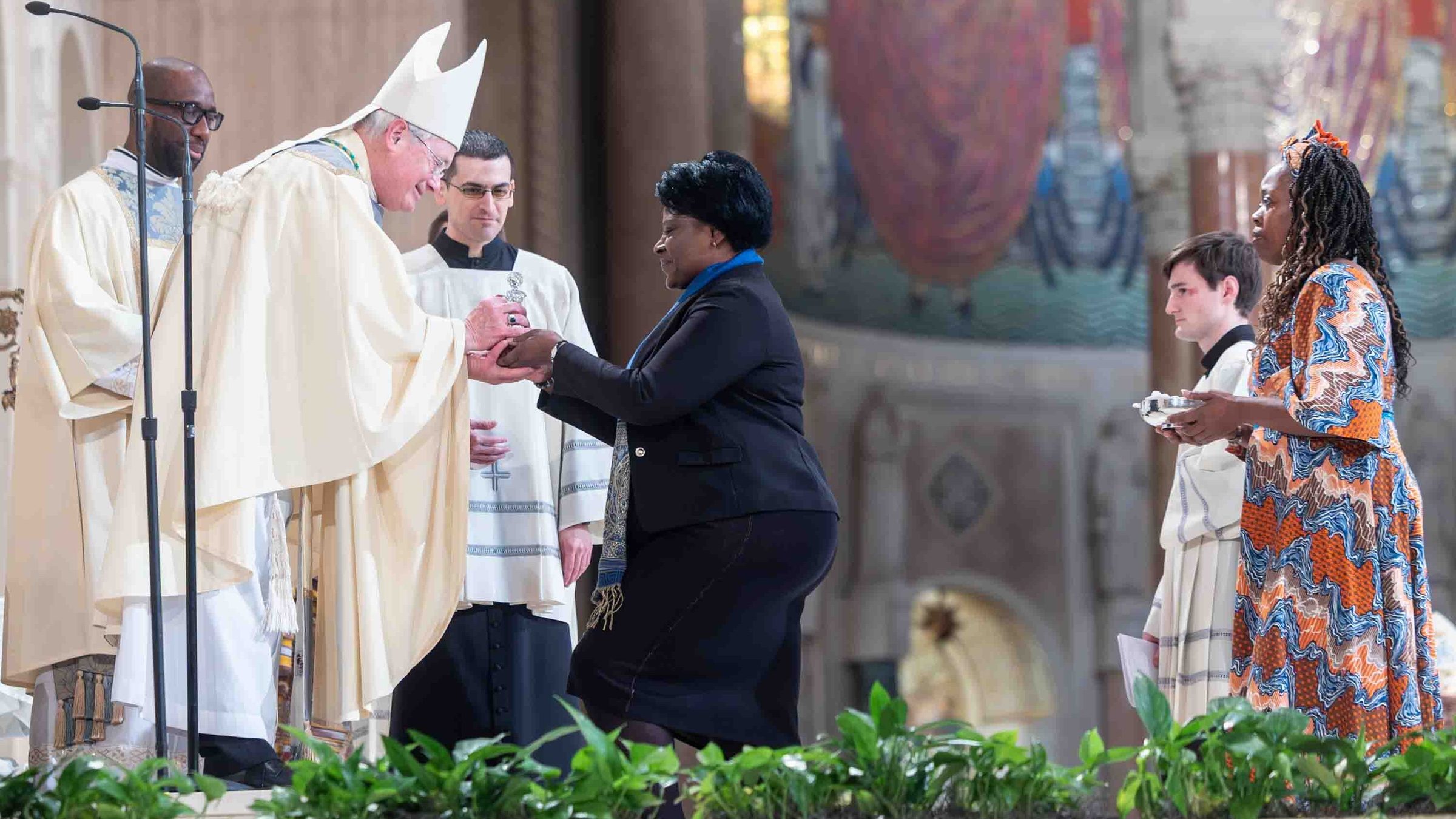

Celebrating the shared gifts of faith between Catholics in Africa and the United States, a Mass for Solidarity with the Bishops and Faithful of Africa was held on Feb. 4, 2026 at the Basilica of the National Shrine of the Immaculate Conception in Washington, D.C.
The Mass for Solidarity was celebrated two days after the signing of a document, “Brothers and Sisters in Hope,” by Bishop A. Elias Zaidan of the Maronite Eparchy of Our Lady of Lebanon in Los Angeles who serves as chairman of the Committee on International Justice and Peace of the United States Conference of Catholic Bishops, and by Bishop Stephen Dami Mamza of the Diocese of Yola in Nigeria, who serves as the chair of the Justice, Peace and Development Commission for the Symposium of Episcopal Conferences of Africa and Madagascar.
Bishop David J. Malloy of Rockford, Illinois, was the main celebrant of the Mass, and the concelebrants included Bishop Zaidan and Bishop Mamza, who was the homilist at the Mass; and Washington Auxiliary Bishop Evelio Menjivar-Ayala.
In his homily, Bishop Mamza noted that his Diocese of Yola in Nigeria was one of the main areas overrun by Boko Haram militants between 2014 and 2017.
“The Boko Haram insurgency led to my deep involvement in taking care of the internally displaced persons who ran for their lives to Yola, the state capital, looking for shelter,” he said, adding, “I want to use this opportunity to thank the universal Church for the show of solidarity we enjoyed from different parts of the world at the peak of the Boko Haram insurgency.”
Bishop Mamza noted how critical support was provided by the Hungarian government, and by Catholic institutions in Germany that gave assistance to help rebuild churches, schools, parish houses and hospitals destroyed by Boko Haram. He thanked Catholic Relief Services of the United States, which along with other international humanitarian agencies offers “services to everybody irrespective of religious affiliation.”

The bishop – who serves as the first vice president of SECAM, representing Africa’s English-speaking countries – noted how in that day’s Gospel reading from Mark 6:1-6, Jesus was not treated with honor by people in his hometown of Nazareth, who lacked faith in him.
The danger today, he said, is not recognizing “the Spirit speaking through voices that sound different from our own.”
“Africa and the United States come from different histories, cultures, and ecclesial experiences. Africa often brings to the Church a faith that is vibrant, communal, and resilient in the face of poverty, conflict, and persecution,” Bishop Mamza said, adding, “The Church in the United States brings gifts of theological scholarship, institutional resources, and long experience engaging pluralistic societies.”
The bishop said he hoped that the Solidarity Mass would be an act of faith, reflecting a Church willing to recognize Jesus in one another.
“Brothers and sisters, today Christ stands in our midst – African and American, north and south, rich and poor – not as a stranger, but as Lord,” he said.
Emphasizing how the Church in the United States and the Church in Africa are united in Christ, Bishop Mamza said, “They are two lungs of the same Body, breathing the same Spirit... When African bishops speak courageously about war, poverty, corruption, or threats to human dignity, their voices echo in American dioceses. When American bishops defend the sanctity of life, advocate for migrants, or confront the culture of individualism, their witness strengthens the Church in Nigeria, Ghana, Kenya, Congo, and beyond. We are, in truth, co-workers in the vineyard of the Lord.”
That solidarity, he said, is founded on faith, not economics or politics.
Pointing to the gifts of faith shared by Catholics in Africa and the United States, Bishop Mamza said, “The Church in Africa is a wellspring of youthful vibrancy, missionary energy, and evangelical joy. The Church in the United States brings deep intellectual tradition, resources for formation, and a long-standing commitment to global mission.”


The bishop emphasized that “when African dioceses send missionary priests to serve American parishes, the Gospel is enriched. When American dioceses offer scholarships, training, and material support to African seminaries and schools, the Gospel is advanced. When bishops from both continents stand together for peace, human dignity, and the sanctity of life, the Gospel is made visible to a world desperate for hope… This solidarity gives visible witness to unity across cultures, races and economic realities.”
That solidarity begins with listening, Bishop Mamza said, adding that in “an age of polarization, the unity of bishops is a prophetic sign.”
“African bishops call the global Church to remember the poor, to defend the family, and to root moral teaching in lived experience rather than abstraction. American bishops call the Church to engage culture with clarity, to protect religious liberty, and to uphold the dignity of migrants, refugees, and the unborn. Each has something essential to say. Each has something essential to hear,” he said.
Bishop Mamza said that solidarity also extends to the Church’s mission.
“Together, bishops must confront global poverty and the exploitation of Africa’s resources” and together promote peace in the face of violence, resist ideologies undermining human dignity, and defend life from conception to natural death, he said, adding, Together, they must evangelize a world increasingly skeptical of truth but longing – deeply longing –for God.”
That solidarity, the bishop said, is rooted in Christ’s hope, the theme of the recent Jubilee Year that formed the focus of the U.S. and African bishops’ joint statement.
“The African Church teaches us hope through perseverance – hope in the face of persecution, disease, and conflict. The American Church teaches us hope through renewal – hope amid secularism, moral confusion, and social division,” he said.
In his homily, Bishop Mamza noted an African proverb, “If you want to walk far, walk together.”
Quoting from the bishops’ “Brothers and Sisters in Hope” statement, Bishop Mamza said, “The faithful of the U.S. and Africa are gifts to one another. Together, we call for robust lifesaving and life-affirming U.S. assistance to the continent, grounded in thoughtful partnership, and pray for the flourishing of an ever-deeper fraternity.”
The joint statement was issued at a time when the United States Agency for International Development has been dismantled, cutting a key source of food, educational and health care assistance to developing nations, and as western countries including the United Kingdom, Germany and Canada have also significantly reduced their international humanitarian assistance. In a recent study, the medical journal Lancet estimated that the sharp reduction in aid provided by those programs could lead to millions of deaths in upcoming years.
The bishops’ statement noted, “In the context of a significant reduction in U.S. international assistance programs, we offer a vision of hope in Jesus Christ, source of our hope… We assert that international assistance is an important means of promoting human dignity, protecting human life, and pursuing the international common good, helping both Africans and Americans live in security and peace.”

At the Mass, Bishop Malloy said the joint statement reflected the “heart and soul” of the solidarity between the bishops and lay faithful of Africa and the United States.
Welcoming people to the Mass for Solidarity, Msgr. Walter R. Rossi, the National Shrine’s rector, noted the liturgy would be followed by a procession to the basilica’s Chapel to Our Mother of Africa. He prayed that Mary, the Mother of Africa, will “hear the drumbeat of your prayers.”

The music at the Mass for Solidarity with the Bishops and Faithful in Africa was led by members of the Choeur de Marie Reine du Monde (French for “the Choir of Mary Queen of the World”) from St. Camillus Parish in Silver Spring, Maryland. That choir provides music in French with a West African influence at Sunday Masses there.
At the Mass for Solidarity, the choir sang traditional African hymns, including in Lingala, a Bantu language spoken in the Democratic Republic of the Congo and in other African nations; and in the Bété and Baoulé languages spoken in the Ivory Coast.
A prayer at the Mass was offered for those who work in humanitarian assistance, that they “may hear the call of Christ to love one another in their life-saving and life-affirming work.” Later a prayer is Swahili asked that people “hear the cry of the poor, the cry of the earth, the cry for truth, and the cry for justice. Let us remain steadfast in faith and witness the love of Christ to those most in need, wherever they may be.”


After the Mass, the bishops and priests and the women religious and lay people in attendance processed downstairs to the Chapel to Our Mother of Africa, where they prayed a Litany of the Saints of Africa, including to St. Augustine and St. Monica, St. Charles Lwanga, St. Josephine Bakhita and St. Martin de Porres.
Then they recited a Prayer for the Holy Men and Women of African Descent Awaiting Canonization, including six Black Catholics from the United States being considered for sainthood: Venerable Mother Mary Lange, who founded the Oblate Sisters of Providence, the first Catholic order of African American women religious, in Baltimore; Venerable Father Augustus Tolton from Chicago, the first Catholic priest in the United States known to be Black; Servant of God Julie Greeley from Denver and Venerable Pierre Toussaint from New York City, who were known for their works of charity; Venerable Henriette Delille, foundress of the Sisters of the Holy Family in New Orleans; and Servant of God Sister Thea Bowman, a dynamic Catholic evangelist and educator from Mississippi.
They concluded with a Prayer to Our Mother of Africa, who is depicted in a bronze sculpture in the chapel holding Jesus, her divine Son.


Afterward in an interview, Mary Kiganda from St. Nicholas Parish in Laurel, Maryland, who is from Uganda and led the congregation in singing the responsorial psalm, said solidarity between African and U.S. Catholics is important.
“If we don’t stand up for justice as a Church, we fail humanity,” she said, adding, “We are brothers and sisters as a Church.”
That point was echoed by Martial Kawunde, a member of St. Mary’s Parish in Landover Hills, Maryland, who read a prayer at the Mass and whose family also has roots in Uganda. The Mass for Solidarity, he said, “shows a connected effort between the community and the continent, and it strengthens the faith within the African community.”
Kawunde – who is a communications major at Morgan State University in Baltimore – said, “Coming together to care for one another shows we’re one community and one humanity.”
Link to related article: