

Bells rang out over the hilltop town of Assisi on the night of March 22 as Franciscan friars closed the monthlong public veneration of the bones of St. Francis of Assisi, which drew more than 370,000 pilgrims from around the world to pray before the beloved saint.
Cardinal Matteo Zuppi of Bologna, who is president of the Italian bishops' conference, presided over the closing Mass in the Basilica of St. Francis of Assisi.
"In these extraordinary days, we have experienced moments of profound communion, during which countless men and women have been able to encounter the spirit of St. Francis, finding in him an inexhaustible source of light and hope in such a difficult time for our world," Cardinal Zuppi said in his homily.
"St. Francis takes us by the hand and helps us to look at reality with authentically Christian eyes."
The veneration, which ran from Feb. 22 to March 22, marked the first time in 800 years that the mortal remains of St. Francis had been exposed for an extended public display. It is part of the Catholic Church's yearlong observance of the 800th anniversary of the saint's death in 1226.
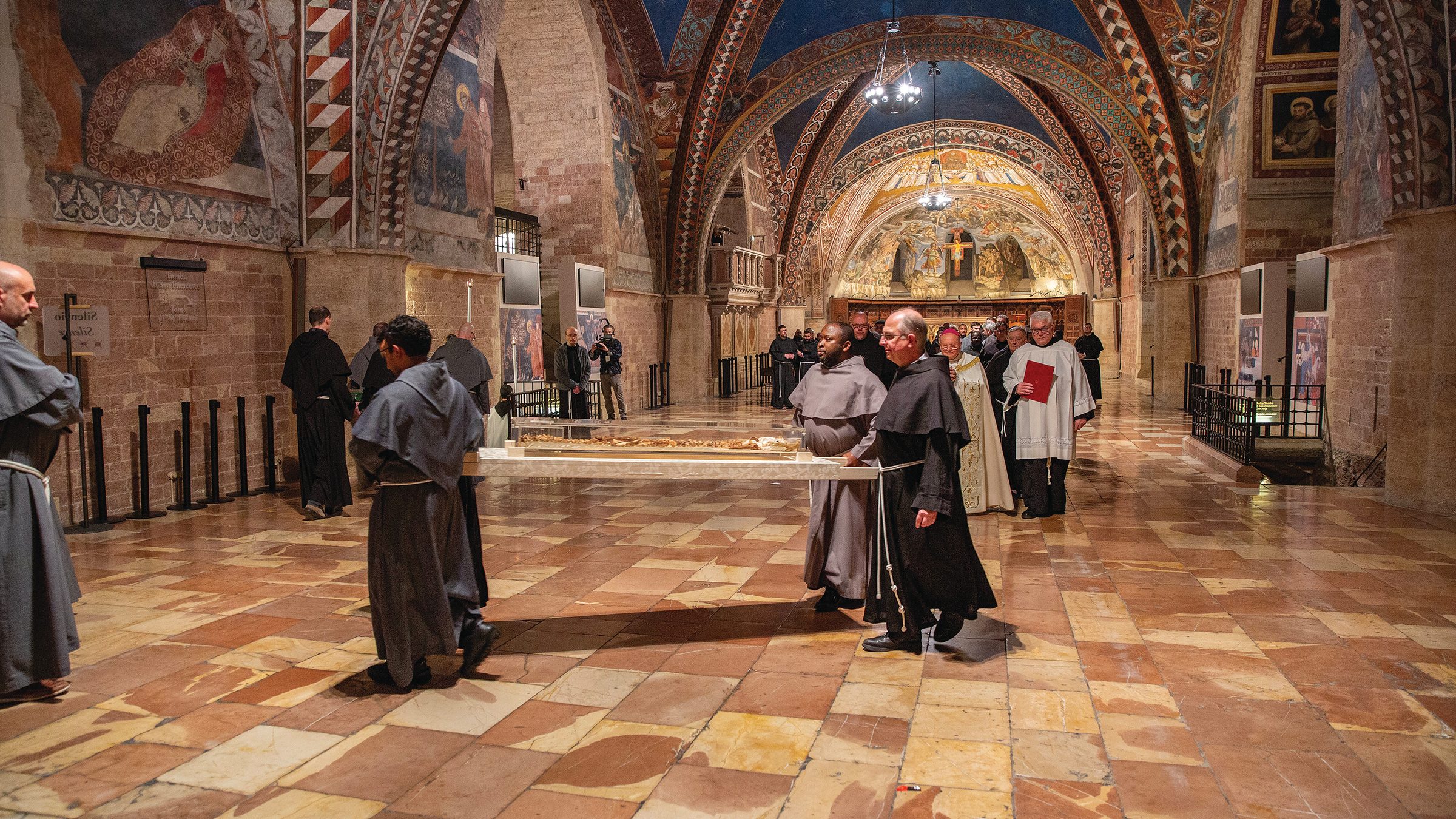
Following the Mass, Franciscan friars gathered for a final period of prayer with the relics before they were carried in procession from the basilica's Lower Church to the crypt. Before midnight, the saint's remains were sealed inside a gilded bronze urn along with the documentation required by canon law and placed inside the stone sarcophagus in the crypt of the basilica, where pilgrims can always pray in close proximity to the relics of the saint.
According to statistics released by the basilica, more than 5,000 of the American pilgrims and nearly 4,000 from Poland were able to venerate the relics, along with pilgrims from more than 40 other countries, including 99 pilgrims from China and 9 from Iran.
American mother Heather Martin was one of the first pilgrims to venerate the relics. "St. Francis is by far the most important saint in my life," she said, calling the experience "utterly life-changing."
Franciscan friars from Brazil, Tanzania, India, South Korea and the Middle East also made the pilgrimage to pray before the founder of their order.
Among those present in Assisi for the closing Mass was Ukrainian Ambassador Andrii Yurash, who attended alongside 70 members of the Ukrainian community in Italy to pray for peace.
"These encounters teach us that a just and genuine peace is not an unrealistic goal," Ambassador Yurash said.
"With the blessing of Saint Francis, an eternal symbol of love between peoples, our intentions can become reality."
During the period, more than 170 Masses were celebrated in the upper basilica, attended by more than 100,000 people, including 50 bishops and cardinals.
Franciscan Friar Giulio Cesareo, the spokesman for the Basilica of St. Francis in Assisi, said the turnout exceeded his expectations, not only in numbers, but in atmosphere.
"I really didn't expect … the collected and joyful atmosphere that characterized the pilgrimage and veneration in the basilica: silence, patience, cell phones in pockets," he said.
Pope Leo XIV has proclaimed a special Jubilee Year of St. Francis running until Jan. 10, 2027, offering a plenary indulgence to pilgrims who visit Franciscan churches or places of worship connected to the saint.
Father Jimmy Zammit of Toronto, now based in Rome as general definitor for the Franciscan order, shared his advice for Catholics who were unable to make the trip to Assisi who want to live out the special Jubilee Year of St. Francis in a particular way.
"If our heart becomes more Franciscan, we become makers of peace," Father Zammit told OSV News. "We seek out to help those who are less fortunate than we are to help the poor, but also to help those who are suffering because they're feeling isolated and maybe even shunned in some way."