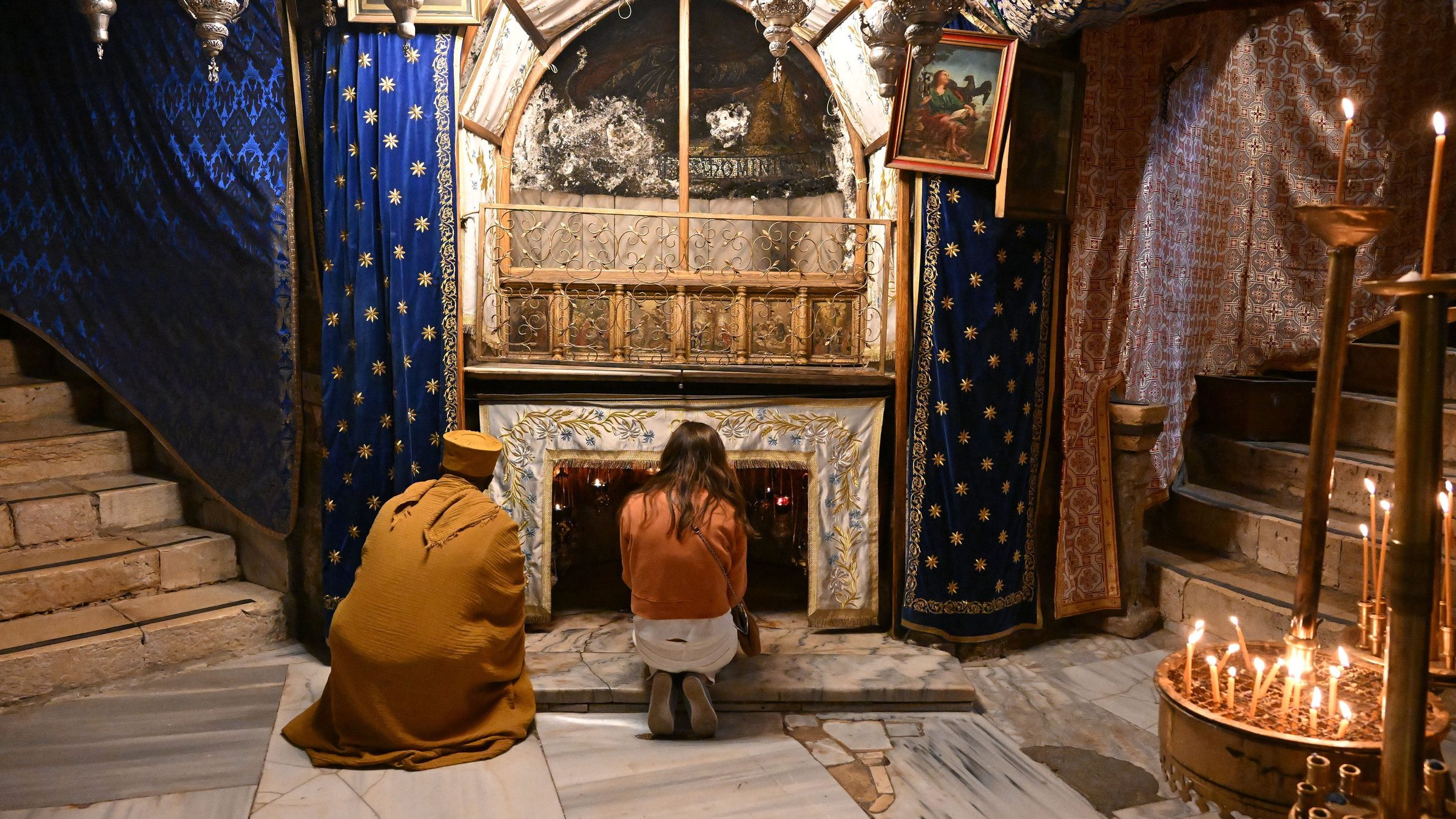

(OSV News) – As the celebration of Christ's birth draws near, the traditional Christmas tree lighting in various places, including Bethlehem and the Vatican, is meant as a sign of joyful expectation for the coming of salvation.
Meeting with representatives who donated the Vatican’s Christmas tree and Nativity scene Dec. 16, Pope Leo XIV noted that the Christmas tree “is a sign of life and evokes the hope that never fails, even in the cold of winter.”
That sign is what Caritas Jerusalem was hoping to convey to Christians in the Holy Land, especially in Gaza and the West Bank, after two years of war, destruction and hopelessness.
Throughout the month of December, Caritas Jerusalem launched the “Christmas of Hope,” a campaign meant to address the “deep need to restore joy, dignity, and spiritual renewal to communities that have endured” the devastation of war.
Among the initiatives, with assistance from Caritas branches in Italy and Sweden, are Christmas celebrations, tree lightings, and providing material support and comfort to Christians in Gaza and the West Bank.
“We're doing it in Bethlehem. We’re doing it in Jerusalem, we're doing it in Zababdeh, and even in Gaza,” said Anton Asfar, secretary general of Caritas Jerusalem, in an interview with OSV News Dec. 10. “We want to replant hope within the Christian community over here in the Holy Land.”
While a ceasefire brokered in October remains in place, Asfar told OSV News that the agreement remains “fragile.”
Despite the ceasefire’s first phase agreement to end hostilities, Israel has continued targeted attacks in Gaza, including the recent killing of a Hamas senior commander. According to Al-Jazeera, Israel has carried out at least 800 attacks and killed 400 people since the ceasefire began Oct. 10.
In a recent update, Ramiz Alakbarov, the United Nations' Deputy Special Coordinator for the Middle East Peace Process, warned that despite U.N. efforts to distribute tents, blankets and provisions for the cold winter months ahead, continued restrictions on humanitarian corridors are hampering those efforts.
“Tragically, the first hypothermia-related death of a two-week-old newborn boy from Khan Younis was confirmed earlier today,” the U.N. official said. “While hunger has improved due to increased aid and commercial foodstuffs, key protein sources remain out of reach for most of the population, alongside severe shortages of clean water, medical care, and shelter.”
Asfar told OSV News that Israeli tanks can be seen near the Holy Family Parish compound in the Gaza Strip and that “every day, between 3:00 and 6:00 in the morning,” locals can hear “the bombardments and shelling.”
“Even shrapnel is coming into the compound in Gaza,” he said. “Nobody talks about this now. Yes, the situation (has) improved, but it's a ‘war after war’ situation.”
The secretary general of Caritas Jerusalem also noted the difficulty for families as well as Caritas staff to navigate around the so-called “Yellow Line,” a boundary marked by Israeli forces in Gaza, which, according to some observers, continues to expand further into Palestinian territories.
“The people in Gaza are pushed back. On the eastern side, you have the ‘Yellow Line,’ and anyone who approaches this ‘Yellow Line’ will be shot at because they are seen as a threat. So if you mistakenly commute over there or walk over there, maybe you will be shot. It’s not easy. That's why we are very careful about how our teams are moving within Gaza, from the north to the south, or the other way around, in these areas,” Asfar said.
While Christians in Gaza have “never stopped praying and celebrating Mass,” with the current ceasefire in place, many are dealing with the trauma they have experienced and continue to endure.
“People now, after the ceasefire, are starting to understand what has happened to them and are starting to process what happened, so it's not an easy situation,” he told OSV News.
He also noted that many, including Caritas staff, have fled Gaza to other countries. Nevertheless, those who remain in are doing their best to “replant hope within this community” during the Christmas season.
“We want to be with them. We want to make the wonderful children in Gaza smile, but we can't do so if we are not allowed to bring toys into Gaza. We are not allowed to bring books or paintings or even pencils and drawing, supplies, or stationery into Gaza.”
Asfar expressed his appreciation to Pope Leo, who “sees the struggle of the people in Gaza and understands very well the situation in the churches of Gaza where people have lost their houses,” including 560 individuals currently sheltering “in both the Latin compound and the Orthodox compound.”
“The Holy Father understands well the situation as it is conveyed by our cardinal over here to him, and also he communicates, not so often, but with the Holy Family parish priest (Father Gabriel Romanelli) to get firsthand information on what’s happening on the ground,” he said.
Despite the difficulties, Asfar expressed his gratitude to Catholics worldwide for their solidarity and prayers, noting that “we feel very weak” without them.
He also expressed hope that the support of Catholics would continue in the coming year as Caritas Jerusalem prepares to launch a new appeal in the hopes of establishing “mobile clinics” in Gaza, as well as rehabilitation efforts and providing prosthetics for those who have lost limbs during the war.
“We couldn’t convey the love of the Gospel to others without their support, whether with their prayers or with their financial support,” he said.
(Junno Arocho Esteves writes for OSV News from Malmö, Sweden.)