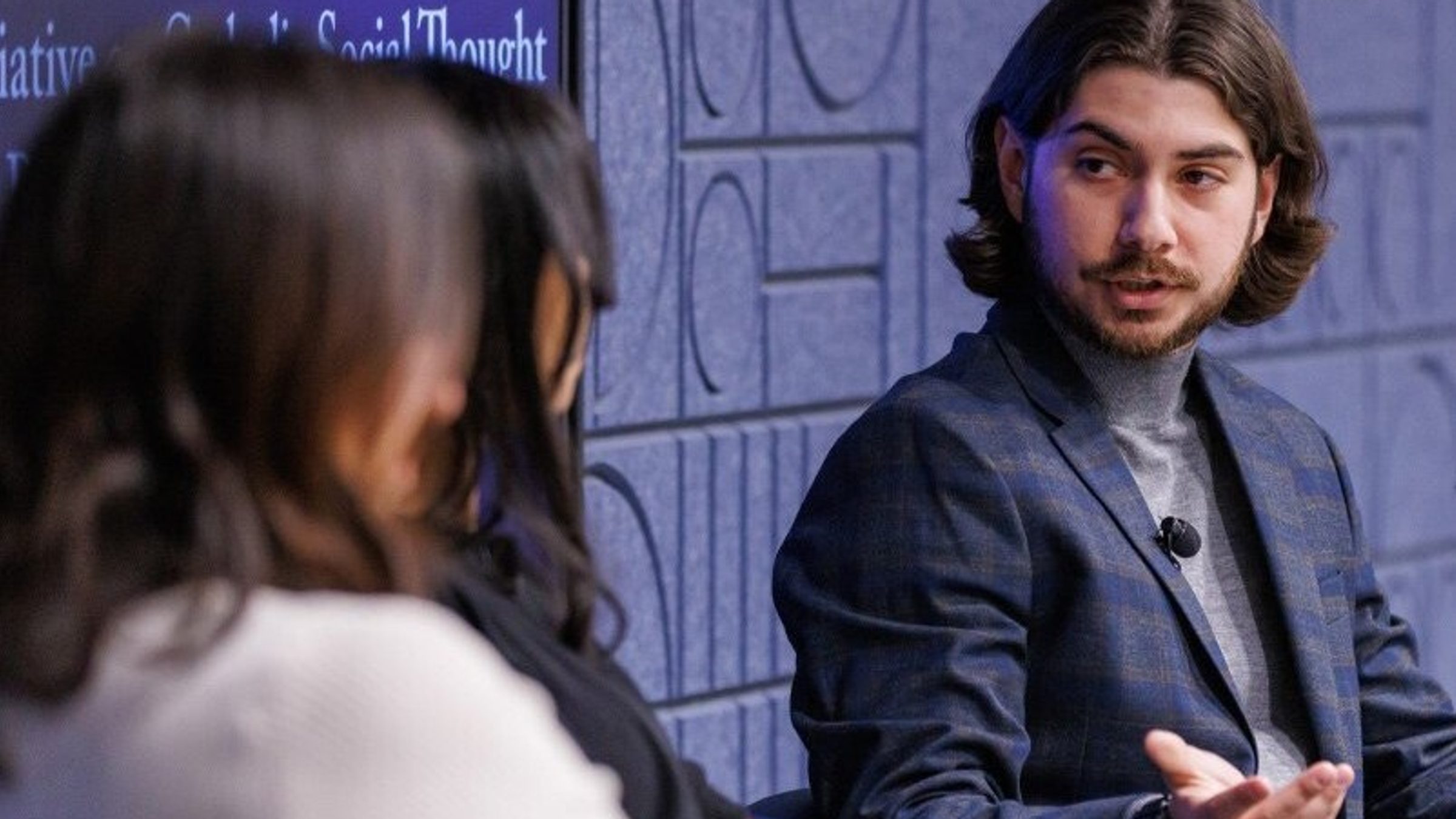

Since the U.S. government intensified mass deportations, daily life has changed drastically for Hispanics – especially for those who are undocumented, have temporary status, deportation orders, criminal records, or immigration paperwork still in process, speakers said at a Dec. 4 forum sponsored by Georgetown University.
“Our communities, our families, live in a constant state of fear and anxiety. And it is fear that shakes you – not because you are ‘doing something wrong.’ It is the fear of being in the wrong place at the wrong time,” said Roxana Rueda Moreno, a community leader with the organization Iskali, during a Latino Leader Gathering sponsored by Georgetown’s Initiative on Catholic Social Thought and Public Life.
“We see parents hesitating to take their children to school, families deciding to stay home and not go to work, everyday activities being disrupted because they are no longer safe. Things that are normal, like going to the supermarket, doing laundry, even attending Mass, simply the idea of being in public, are now a risk for our people. We are living in an environment controlled by fear,” Rueda Moreno noted during the dialogue, which was titled “Making Life Unbearable: The Impacts of Immigration Enforcement on Families and Communities.”
Iskali collaborates with young Hispanic Catholics to teach them to become transformative leaders, and their community in Chicago has been severely affected by immigration control measures there.
“On social media,” she added, “you can see hundreds of videos of encounters with ICE agents. We have seen raids with helicopters, apartment complexes searched while families were sleeping, and babies restrained (with plastic handcuffs). Hundreds of arrests have occurred without court orders.”
Rueda Moreno said that one day she saw her parish surrounded by federal agents during Mass, and that on Oct. 9 her uncle was detained.
Another place that has felt the impact of mobilizations by U.S. Immigration and Customs Enforcement is the city of Los Angeles.
“It has not just been a change in immigration policies; it has been a systematic violence that has wounded our community from within. When the daily life of a family or a community is disrupted, something breaks. This administration unleashed not only this violence but also a racism that destroys the basic trust that sustains any community,” said Yolanda Chávez, a theologian and pastoral leader who participated virtually from Jalisco, Mexico, after being deported from Southern California.
She states that, in her case, she was stripped of work, history, home, community, and belonging. This situation, she said, “forces us to rethink what truly underpins the dignity of human beings.”
Rosa Reyes, director of Dream Partnership and a student success advisor at Trinity Washington University, confessed that her “life has changed in many ways… and we have all been affected.”
She says she does not like what she is witnessing nor the conversations around it. She shared that even concerts by Hispanic artists are canceled because of ICE raids and to protect the community, which affects the public in the metropolitan area.
“Regardless of immigration status, everyone has been affected in one way or another – even citizens, who have to carry a passport or a copy of their birth certificate,” Reyes said.
The Latino leaders participating in the forum said that many detention centers for undocumented immigrants are closed to advocates, lawyers, and pastoral workers; they lack adequate water and food service; detainees are overcrowded and arbitrarily transferred to other centers far from their support network.
Paula Fitzgerald, executive director of Ayuda – an organization that works to increase the availability of direct legal, social and language service for low-income immigrants –perceives people’s fear as they go about their daily activities. She said churches and schools in the area call her asking what they can do to protect their spaces so members of the community can keep coming and feel safe.
“Our clients’ anxiety is through the roof, and it’s very hard to advise people,” she said, referring to crime victims who find it difficult to decide to report to the police because of the risks. “We have worked with law enforcement for years to create protections for our community, and these have vanished very quickly,” Fitzgerald added.
ICE arrests in the District of Columbia went from two per month in 2023/2024 to 459 per month since August 2025. As a result, people fear taking their children to school or seeking medical care.
Those who are victims of human trafficking or labor exploitation do not report it, Fitzgerald said, adding that she is convinced that is making communities less safe.
Church raises its voice
“The videos showing force and the spectacle of terror have caused many people in our communities to live in fear of participating in many essential aspects of life and have prompted an unusual unanimous reprimand from the Catholic Church, both in the United States and worldwide,” said Kim Daniels, director of Georgetown’s Initiative on Catholic Social Thought and Public Life.
She noted that U.S. Catholic bishops issued an almost unanimous statement a few weeks ago in support of the dignity of undocumented persons and criticizing the tactics used by the administration to enforce immigration laws. Likewise, Pope Leo XIV encouraged the bishops in this effort and offered his support in their decision to defend those targeted for deportation.
“Lay leaders and other members of the U.S. Church have organized public testimonies, pressing for pastoral attention to detained immigrants, and have found innovative ways to support one another in these times of fear,” Daniels said.
Moderator Christian Soenen, the initiative’s projects manager, echoed the words of Washington Cardinal Robert W. McElroy regarding ICE raids: They are “designed by the government to generate fear and terror among millions of men and women who, through their presence in our nation, have been fostering precisely the religious, cultural, community, and family ties that are most weakened and most valuable at this moment in our nation’s history.”
He repeated the words of Cardinal McElroy delivered in September during a Mass that followed a procession through the city for the World Day of Migrants and Refugees, where he described the government’s tactics as “an attack aimed at making life unbearable for undocumented immigrants.”
(Andrea Acosta is a reporter for El Pregonero, the Spanish-language newspaper and website of the Roman Catholic Archdiocese of Washington. This article was originally posted on El Pregonero’s website and was translated into English for the Catholic Standard.)