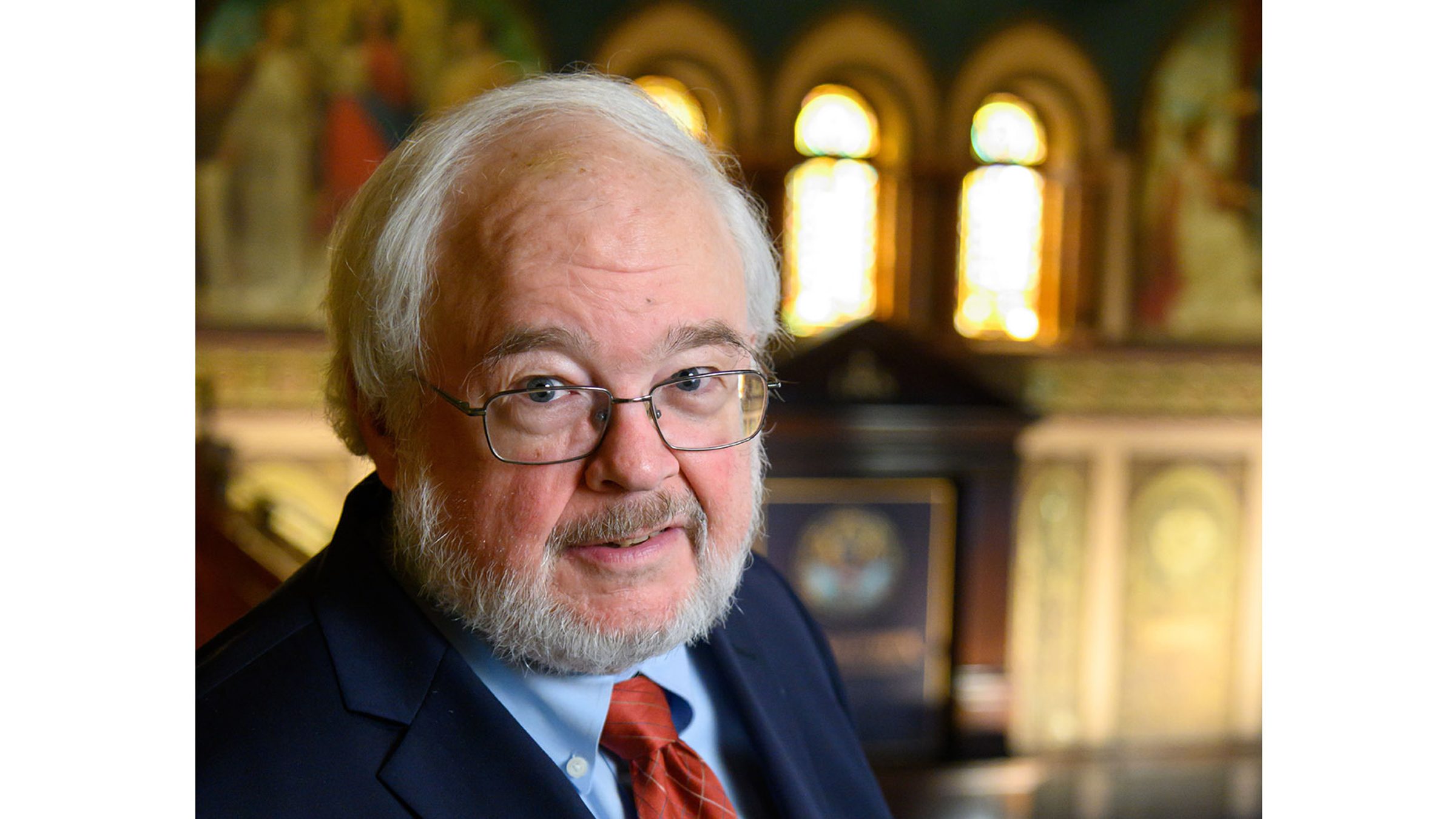

When John Carr was growing up in Minnesota, he dreamt of one day becoming either a priest or a U.S. senator.
Meeting and falling in love with his future wife, Linda, halted the priesthood dream for the onetime seminarian.
“She changed my life,” he said in a recent interview. In 2025, John and Linda Carr marked their 50th wedding anniversary, and they have four children and 10 grandchildren.
And losing a close race for the Minnesota House of Representatives at the age of 24 scuttled his dreams of public office.
Yet his life and work would ultimately revolve around the intersection of faith and politics, and on Jan. 21, 2026, John Carr – the founder of the Initiative on Catholic Social Thought and Public Life at Georgetown University who retired at the end of 2025 – was honored for a half-century of connecting Catholic social thought and public life.
That Georgetown gathering included an opening prayer by Cardinal Christophe Pierre, the apostolic nuncio to the United States; a conversation between Carr and Kim Daniels, the initiative’s current director; a dialogue with panelists David Brooks and E.J. Dionne, who are columnists for the New York Times; Kerry Robinson, the president and CEO of Catholic Charities USA; and Cardinal Joseph Tobin of Newark, New Jersey; and a closing prayer by Washington Cardinal Robert W. McElroy.
That evening, both John and Linda Carr received standing ovations.
Since the initiative’s founding in 2013, it has hosted more than 200 dialogues and other events, with more than 420,000 attendees in person or online. The more than 600 participants and panelists over the years included President Barack Obama, who joined a 2015 discussion on "Poverty in America.”
A Georgetown University publication on the work of the initiative noted that since its founding, it “has become a respected national center of principled and civil dialogue on faith and public life, a leader in sharing Catholic social teaching and the messages of Pope Francis and Pope Leo XIV, and a distinctive place of encouragement and formation for young and Latino leaders.”
In an interview with the Catholic Standard newspaper of the Archdiocese of Washington one week earlier, John Carr – who is now 75 –reflected on his faith and family, and on his work over a half-century that wound from the Twin Cities to the nation’s capital.
The Minneapolis native was born in 1950, the oldest of seven children of John Carr Sr. and Joanie Carr. He graduated from St. John Vianney Seminary and the University of Saint Thomas in St. Paul, Minnesota.
His father worked in the clothing business, attended daily Mass and “was an example of recovery,” John Carr said, noting that some men in his family have struggled with alcoholism or other addictions. He added that his mother, in addition to raising her seven children, once worked as a special education teacher and also helped found a pro-life center for women facing crisis pregnancies.
John Carr first experienced the intersection of faith and politics in his family home growing up. He joked that his parents , who were both Catholic, nevertheless had a “mixed marriage,” since his father came from a Democratic family in Minneapolis, and his mother came from a Republican family from St. Paul.
But they offered an enduring example to their children, he said. “We learned faith and family matter… and faith and family come first.”
From the Twin Cities to the nation’s capital
In Minnesota, Carr worked as a staff member of the Urban Affairs Commission of the Archdiocese of St. Paul and Minnesota. Around 1975, he and his wife moved to the Washington, D.C., area, first living in Virginia and eventually settling in Cheverly, Maryland, where they raised their children Mike, Tim, Kelly and Molly and have been longtime members of St. Ambrose Parish.
In Washington, John Carr first worked as a coordinator of urban issues for the United States Conference of Catholic Bishops, and Linda Carr worked as a director of religious education at St. Peter’s Parish on Capitol Hill.
Then John Carr worked with the National Committee for Full Employment led by Coretta Scott King, the widow of the slain civil rights leader Rev. Dr. Martin Luther King Jr. “What a valiant woman. She was carrying on her husband’s work,” Carr said.
Later after briefly working again for the Catholic bishops’ conference, John Carr served as the director of the White House Conference on Families under President Jimmy Carter.
Remembering President Carter, he said, “He preferred ideas to politics. He wanted to do the right thing. He was at (his) core a disciple of Jesus.” Noting how the former president continued to teach Sunday school and volunteer building houses with Habitat for Humanity, Carr added, “He was first and foremost a believer.”
‘The best boss I ever had’
During the 1980s, John Carr served as the Secretary of Social Concerns for the Archdiocese of Washington, working for then-Archbishop James Hickey, who led the archdiocese from 1980 to 2000 and became a cardinal in 1988. Carr said that Cardinal Hickey “was the best boss I ever had.”
“I’ve done a lot of things in my life, but working with Cardinal Hickey to renew the social ministry of the archdiocese was the most satisfying work I did,” Carr said. “He was very clear about the mission… He put the poor at the center of our faith and his ministry.”
Under Cardinal Hickey’s leadership, the archdiocese’s Catholic Charities established a network of shelters for homeless men and women, designed not only to offer them food and a place to sleep, but to help them find jobs and permanent housing. During those years, the archdiocese’s Spanish Catholic Center expanded its outreach to the Washington area’s growing population of Hispanic immigrants who were fleeing war and poverty in El Salvador and other Latin American countries.
“He would listen,” Carr said of Cardinal Hickey’s leadership style, adding, “He was a man of persistence and patience.”
Cardinal Hickey also welcomed Mother Teresa’s Missionaries of Charity sisters as they opened the Gift of Peace home in Washington, where they cared for men dying of AIDS at a time when there was much fear and misunderstanding about the disease.
In 1986, Cardinal Hickey addressed the clergy abuse problem by establishing child protection policies and procedures for the Archdiocese of Washington. becoming one of the first bishops in the United States to do that. “Cardinal Hickey early on responded to victims more as a pastor,” Carr said.
‘The Church at its best’
In the late 1980s, Carr began working again for the United States Conference of Catholic Bishops. A story that he likes to tell is that one time a woman in an elevator asked him what his job was, and he explained that he worked for the nation’s Catholic bishops, assisting with their work for justice and peace around the world. She responded by asking, “How’s that going?” and then added, “You need to do a better job.”
As the director of the justice and peace efforts at the conference, Carr assisted the U.S. Catholic bishops with their statements on “Faithful Citizenship,” on war and peace, Catholic social teaching, care for creation, and on human life and dignity. He also represented the U.S. Catholic Church in travels to Israel, the West Bank and Gaza, Rwanda and South Africa, Russia and Ukraine, Central America, Vietnam and the Philippines, Europe and the Vatican.
“I saw the work the Church is doing, and the difference it made,” Carr said. He added, “It was a blessing to work with people in our country and our world who were (living) the Gospel in action, and it was the Church at its best.”
After being elected as the president of Poland in 1990, Lech Walesa visited Washington. The shipyard electrician and Solidarity labor movement leader had helped lead that country to freedom from the Soviet Union. Walesa, a devout Catholic, visited the bishops’ conference building and knelt in prayer while attending a Mass in the chapel there. Carr remembered that Walesa said, “I came here to thank you for your courage in supporting us… In the beginning, the only people we could count on were in the labor movement and the Catholic Church, and that made all the difference.”
Carr said that the advocacy from the U.S. Conference of Catholic Bishops played a key role in Congress passing measures including the Family and Medical Leave Act, the Child Tax Credit, and legislation opposing the use of landmines.
He added, “I’m discouraged that a lot of the things I worked on are threatened” now.
‘A test of faith’
His most difficult moments in working at the conference, he said, came as the nations’ bishops grappled with the clergy abuse crisis, and the actions and inactions of some of them were widely publicized.
“For me it was a test of faith, that they would face up to this,” Carr said, noting that he was a parent who had worked for the Church for most of his adult life. Carr later revealed publicly for the first time that in his high school seminary, he had suffered sexual abuse and harassment.
Carr said the Catholic Church’s abuse crisis led him to a greater dependency on alcohol, and ultimately led him to seek treatment. “There were tough times, when the failures of bishops on sex abuse haunted me,” he said.
In 2002, the U.S. Catholic bishops adopted the “Charter for the Protection of Children and Young People,” which included a “zero tolerance policy” on priests who abuse children. When the charter was adopted, the president of the bishops’ conference was then-Bishop Wilton Gregory of Belleville, Illinois, who later served as the archbishop of Washington from 2019 until his retirement in 2025 and was named a cardinal by Pope Francis in 2020, becoming the first African American cardinal.
In an earlier interview, Carr praised the leadership of Cardinal Gregory on that issue, saying, “As a survivor of clergy sexual abuse, I will always be grateful for his principled and courageous leadership to listen and learn from victims, to take essential steps to respond with compassion and concrete action, and to protect young people and our Church from these horrific betrayals of trust.”

Founding the Initiative
After serving as a residential fellow on religion and politics at Harvard University’s Institute of Politics, Carr became the founder of the Initiative on Catholic Social Thought and Public Life at Georgetown University in 2013. Fortuitously, the initiative began the same year as when Pope Francis assumed the papacy, and a key dialogue topic in the program’s early years revolved around the “Francis Factor” and that new pope’s teaching on issues including caring for the poor and the environment. The diverse speakers participating in the dialogues included Church and political leaders, journalists, outreach providers, experts on social issues, and students.
The Georgetown University publication about the initiative notes that “John’s leadership and vision have helped the initiative to become a preeminent place of principled dialogue, a unique center of thought and leadership on Catholic social teaching, and a place where leaders come together to address the major questions facing the Catholic Church, nation and world.”
Reflecting on his retirement, Carr said, “I leave just full of gratitude they (Georgetown) took a chance on me and the initiative… What we found is there is a hunger for the moral vocabulary of Catholic social teaching.”
The seven themes of Catholic social teaching center on the life and dignity of the human person; a call to family, community, and participation; rights and responsibilities; the option for the poor and vulnerable; the dignity of work and the rights of workers; solidarity; and care for God’s creation.
“I’m now convinced that the principles of Catholic social teaching offer the best path forward for our Church and our country,” Carr said. “That’s the way to overcome our polarization. What if we could unite on defending the dignity of all God’s children – the unborn, the undocumented, poor kids, people on death row, the hungry of the world? We should be the human dignity people in our nation and our world.”
During his career, Carr helped found several Catholic, ecumenical and interfaith leadership groups, including the Catholic Climate Covenant and the National Religious Partnership on the Environment and care for creation; and the Catholic Mobilizing Network which works to end the death penalty.
Carr said he is proud of the Initiative on Catholic Social Thought and Public Life and hopeful about its future. “Kim Daniels is not only the right leader for the initiative, but she’s a tremendous leader for our Church,” he said.
He believes there are two keys to the initiative’s success: one is that participants had conversations instead of giving speeches, and the other is the diversity of its participants, about one-half of whom have been women, and almost one-half of whom have been Latino or African-Americans.
“Many have been young leaders making a difference,” he said, adding that the initiative’s work to encourage young adults and Latinos to draw on their faith and Catholic social teaching in confronting today’s challenges “offers great hope not only for the future but right now.”
A pope who ‘gets us’
Just as the initiative drew inspiration from Pope Francis, the same is now true with Pope Leo XIV, Carr said. After being elected to the papacy in May 2025, the new pope explained that he chose his name in honor of Pope Leo XIII, whose landmark 1891 encyclical “Rerum Novarum” championed social justice for workers in the modern world.
Then in October of 2025, Pope Leo issued his first major papal document, “Dilexi Te,” an apostolic exhortation that emphasized how loving and serving the poor is central to the Catholic faith.
“I’m extremely encouraged by Pope Leo, who chose the name Leo to lift up the social teaching of our Church and has now placed the poor at the center of our faith, and has challenged us to live our lives, including in our nation, with love, justice and solidarity for the poor,” Carr said.
The first U.S.-born pope, a native of Chicago, also served as a missionary for many years in Peru, and then as a Vatican official.
Carr pointed out that some American Catholics criticized Pope Francis for allegedly not understanding the Church in the United States. Pope Leo “knows us. He gets us. Now the question is, not whether he gets us, it’s if we get the pope,” Carr said.
In the interview, he emphasized that “one of the things I believe is that in tough times, you go back to the basics, and for us, the basics are the Gospels. Jesus’s mission was to bring good news to the poor and liberty to captives.”
Carr noted Jesus’s words in Matthew 25, describing God’s judgment for those who will enter heaven: “For I was hungry and you gave me food, I was thirsty and you gave me drink, a stranger and you welcomed me, naked and you clothed me, ill and you cared for me, in prison and you visited me… Amen, I say to you, whatever you did for one of these least brothers of mine, you did for me.”
Carr said those teachings from Jesus “are not optional or peripheral. They’re at the heart of our faith, and they need to be at the heart of our lives, our Church and our country.”
A new vocation
Asked about his retirement, Carr said he will be spending more time with his family, and he might do some occasional writing and speaking engagements. In recent years, he served as a Washington columnist for America magazine and its website.
“Grandparenting is a vocation,” he said, noting the fun that he and Linda recently had as they joined their four children and 10 grandchildren for Christmas at their home in Cheverly, Maryland. He joked that “I love them all. One of the great advantages of being deaf, I can turn down my hearing aid.”
Reflecting on his life, Carr said, “I’ve been so blessed in my work. Not many people get to spend their working life, working on what they believe in.”
His half-century career working for the Catholic Church coincided with four popes and eight U.S. presidents, and one woman in an elevator who chided him for not doing a better job promoting justice and peace in the world.
“My vocation wasn’t as a priest, but as a Catholic lay person trying to help share and apply (the Church’s) principles of human dignity, solidarity and the common good. It’s been a great blessing,” he said.