
Pope Leo XIV’s Sept. 25-28 visit to France is expected to be watched closely for his message to a Europe divided by political tensions and a recent wave of laws that undermine the dignity of life.
But the most fundamental message of the visit may not come from the splendidly renovated walls of Notre Dame Cathedral in Paris or the streets of that City of Lights.
It may come from Lourdes – a famed Marian shrine that has always been a primary place of welcome for the sick and those in need, and which has become a refuge for victims of clerical sexual abuse.
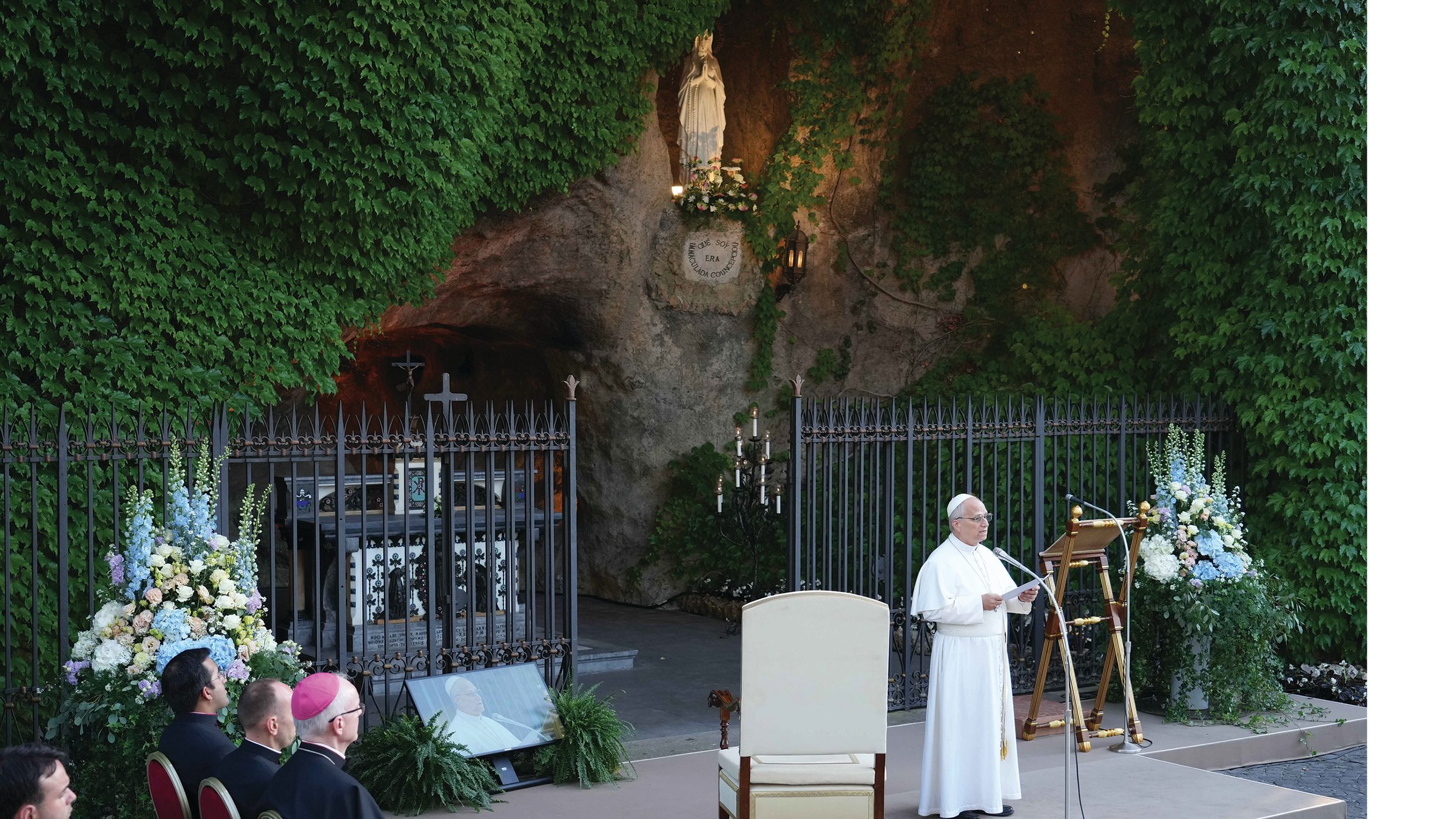
OSV News discussed the pope’s upcoming visit to the Marian sanctuary with Bishop Jean-Marc Micas of Tarbes and Lourdes. Pope Leo will arrive in Lourdes from Paris on Sept. 26 and will concelebrate Sunday Mass Sept. 27 on the meadow facing the grotto where the Virgin Mary appeared to St. Bernadette Soubirous in 1858.
Asked how preparations are going and about the emotions in Lourdes ahead of the papal visit, Bishop Micas said, “It’s a very big emotion to welcome the pope here in the sanctuary of Lourdes. He will be the third pope welcomed here ... and it’s really an honor, a pleasure, and a very, very, very, very big emotion.”
While there are “a lot of parameters to cross” ahead of the papal visit organized in just a few months, Bishop Micas said that “it’s a lot of work, but many, many, many people are very, very happy to be involved in it.”
The Sanctuary of Our Lady of Lourdes can accommodate 170,000 pilgrims for the papal celebrations, Bishop Micas said.
The Lourdes shrine includes the grotto where St. Bernadette witnessed 18 Marian apparitions beginning on Feb. 11, 1858. People then witnessed physical and spiritual healing miracles after visiting the site or drinking or washing in the spring Our Lady pointed Bernadette to in an apparition.
The pope’s day in Lourdes will begin with an early morning visit to the grotto, Bishop Micas told OSV News, followed by the central point of the day: Mass in front of the grotto. In the evening the pope will lead a candlelit rosary.
Asked whether Pope Leo will meet with pilgrims who are sick and seeking healing at Lourdes, Bishop Micas replied: “Of course – he will meet the realities of Lourdes, and sick people are among the most important of them.”
Bishop Micas is not only a bishop attending to papal preparations. He is the man who, urged by testimonies of victim-survivors of sexual abuse, in March 2025 covered part of the large-scale mosaic artwork created by disgraced priest Father Marko Rupnik, a former Jesuit.
The gesture made headlines around the globe.
Father Rupnik’s mosaics are displayed on the front wall of the Basilica of Our Lady of the Rosary, one of three basilicas on the sanctuary’s grounds. The mosaics were commissioned from Father Rupnik in 2008, 14 years before accusations against the then-renowned artist were made public. They were installed on the century-old basilica to mark the 150th anniversary of the apparitions of Our Lady. They portray the luminous mysteries of the rosary that St. John Paul II instituted in 2002.
Asked whether the pope will visit the inside of the basilica – and encounter the covered mosaics – Bishop Micas told OSV News that the core of the visit to Lourdes is “not really (about) the visit of places, but really meeting people” and that the celebrations are likely to be held outdoors to accommodate large crowds.
Bishop Micas was clear, however, in the sanctuary’s meaning for victims of clerical sexual abuse.
When in France, Pope Leo “will probably meet abuse victims,” the bishop said, “and this meeting is being prepared by the national committee,” a central body based in Paris organizing the visit on behalf of the French bishops’ conference. The meeting will likely take place in either Paris or Lourdes, he said.
The official program of the visit of Pope Leo in France will be published in early August and “we hope it will be possible to say that this meeting will take place,” he said.
Pope Leo is going to France after the National Assembly in a watershed vote for the nation on July 15 legalized assisted dying, including euthanasia and assisted suicide in certain cases.
Asked what the papal trip can give France at that moment, Bishop Micas said, “It’s always a question of life and the message of the Gospel – carried by saints, carried by Mary to some people, carried by the Church, by the pastors of the Church.”
“So of course the pope will do in France what he did in other places,” he said. “He will talk about the Gospel, he will teach the Gospel, and the Gospel speaks about life.”
Bishop Micas emphasized Pope Leo “will talk to the people who live here in France.” Those who “will reproach the political dimension of his speech” need to understand that it is not “political speech, but just a teaching of the Gospel.”
“The value of life doesn’t depend on human conventions between deputies or between politics,” he said. “When we are believers, we receive what God reveals to us about what is a human being, what is life. It’s his point of view we should adopt, and not our point of view we should impose. And this is – I hope, I’m sure – (what) he will explain to us.”
He also stressed that Lourdes may be a place where the strongest pro-life message will be conveyed.
“If he talks about this question in Paris, it will be interpreted as a political speech, because Paris is the capital of the country where the laws are voted on,” he said. “If he speaks and says exactly the same thing in Lourdes, it will be the word of a pastor and of a believer. It will be received in a different way.”
Bishop Micas said after what the world saw of Pope Leo’s visit to Spain in June, he expects in France “the joy and the enthusiasm will be the same. We feel it here,” he said, with excitement and anticipation for the first papal visit in Lourdes in 18 years.