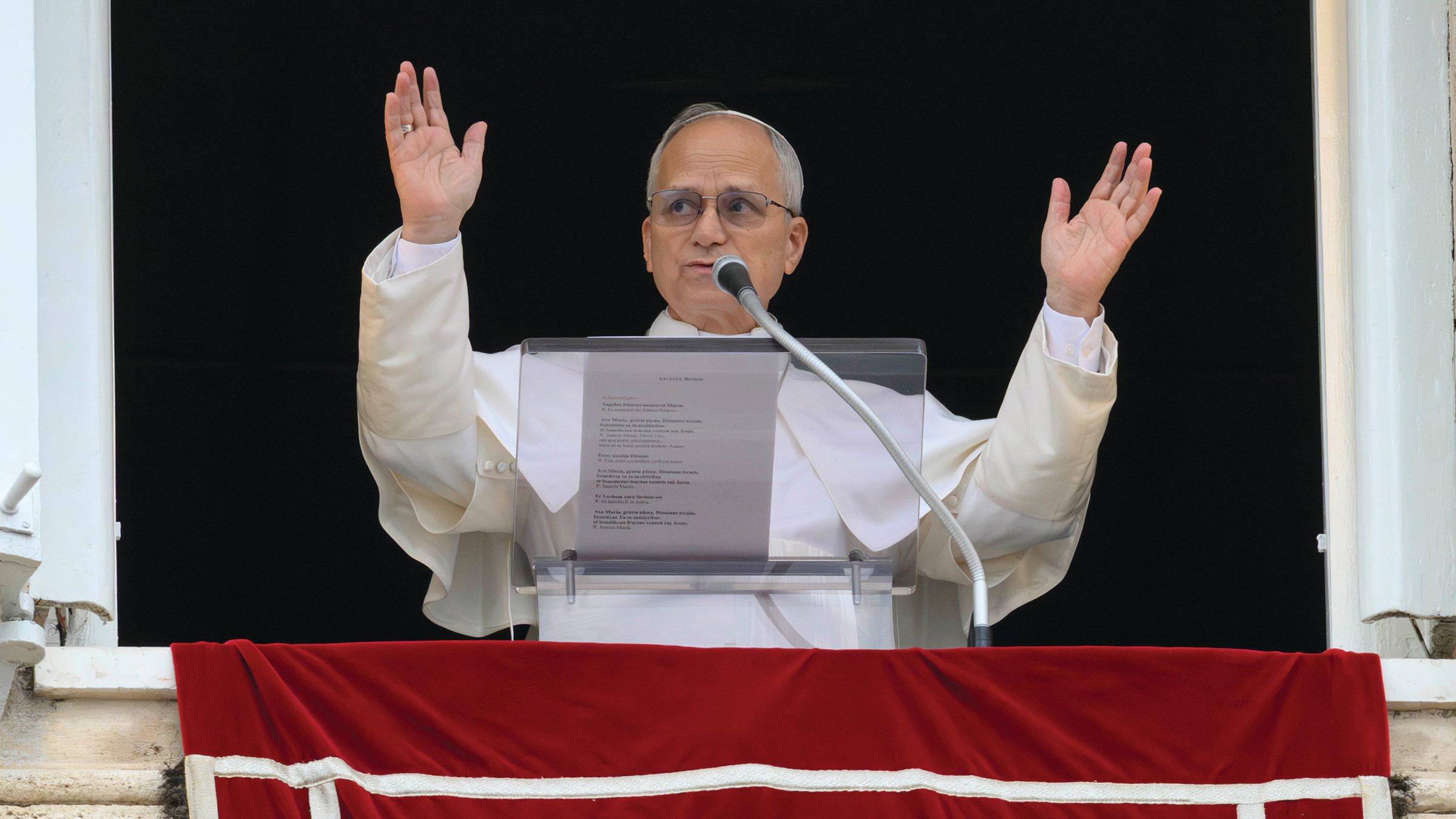

The following is the full text of Pope Leo XIV’s Angelus address given Feb. 8 to those gathered in St. Peter’s Square:
Dear brothers and sisters, have a good Sunday!
After proclaiming the Beatitudes, Jesus addresses those who live them, saying that, thanks to them, the earth is no longer the same and the world is no longer in darkness. “You are the salt of the earth. (…) You are the light of the world” (Matthew 5:13-14). Indeed, it is true joy that gives flavor to life and brings to light what did not exist before. This joy radiates from a lifestyle, a way of inhabiting the earth and living together that must be desired and chosen. It is the life that shines in Jesus, the new flavor of his gestures and words. After encountering Him, everything that deviates from his poverty of spirit, his meekness and simplicity of heart, his hunger and thirst for justice, which awaken mercy and peace as dynamics of transformation and reconciliation, seems tasteless and opaque.
The prophet Isaiah presents a list of concrete actions that put an end to injustice: sharing bread with the hungry, welcoming the destitute and homeless into your home, clothing the naked, and not forgetting your neighbors and those in your own household (cf. Isaiah 58:7). “Then,” the prophet continues, “your light will break forth like the dawn, and your wounds will quickly heal” (v. 8). On the one hand, the light, the one that cannot be hidden because it is as great as the sun that dispels the darkness every morning; on the other hand, a wound that once burned and is now healing.
It is indeed painful to lose flavor and renounce joy; however, it is possible to have this wound in the heart. Jesus seems to warn those who listen to him not to renounce joy. Salt that has lost its flavor, he says, “is good for nothing but to be thrown out and trampled underfoot” (Matthew 5:13). How many people – and perhaps it has happened to us as well – feel disposable, imperfect. It is as if their light has been hidden. Jesus, however, announces to us a God who will never discard us, a Father who keeps our name, our uniqueness. Any wound, even the deepest, will be healed by welcoming the word of the Beatitudes and by returning to walk the path of the Gospel.
Indeed, it is gestures of openness and attentiveness to others that rekindle joy. Certainly, in their simplicity, they set us against the current. Jesus himself, in the desert, was tempted by other paths: to assert his identity, to display it, to have the world at his feet. However, he rejected the paths where he would lose his true essence, which we find every Sunday in the broken Bread: a life given, love that makes no noise.
Brothers and sisters, let us allow ourselves to be nourished and enlightened by communion with Jesus. Without any ostentation, we will be like a city on a hill, not only visible, but also inviting and hospitable: the city of God, where, deep down, everyone desires to dwell and find peace. To Mary, Gate of Heaven, let us now direct our gaze and prayer, that she may help us to become and remain disciples of her Son.
Pope Leo XIV speaks after the Angelus
Dear brothers and sisters!
Yesterday, in Huércal-Overa, Spain, Father Salvatore Valera Parra was beatified. He was a parish priest entirely dedicated to his people, humble and attentive in his pastoral charity. His example as a priest focused on what is essential is an inspiration for priests today to be faithful in their daily lives, lived with simplicity and austerity.
With sorrow and concern, I learned of the recent attacks against various communities in Nigeria, which have caused grave loss of life. I express my prayerful closeness to all victims of violence and terrorism. I hope that the competent authorities will continue to work with determination to ensure the safety and protection of the lives of all citizens.
Today, the feast day of Saint Josephine Bakhita, we celebrate the World Day of Prayer and Reflection against Human Trafficking. I thank the religious sisters and all those who strive to combat and eradicate current forms of slavery. In agreement with them, I affirm: peace begins with dignity!
I assure you of my prayers for the people of Portugal, Morocco, and Spain – particularly Grazalema in Andalusia – and southern Italy – especially Niscemi in Sicily – affected by floods and landslides. I encourage the communities to remain united and in solidarity, under the maternal protection of the Virgin Mary.
And now I welcome all of you, Romans and pilgrims from Italy and other countries. I greet the faithful from Melilla, Murcia and Malaga, in Spain; those who have come from Belarus, Lithuania and Latvia; the students from Olivenza, Spain, and those preparing for Confirmation from Malta. I also greet the young people who are accompanying us from three oratories in the diocese of Brescia.
Let us continue to pray for peace. As history teaches us, strategies of economic and military power offer no future for humanity. The future lies in respect and fraternity among peoples.
Wishing everyone a good Sunday.