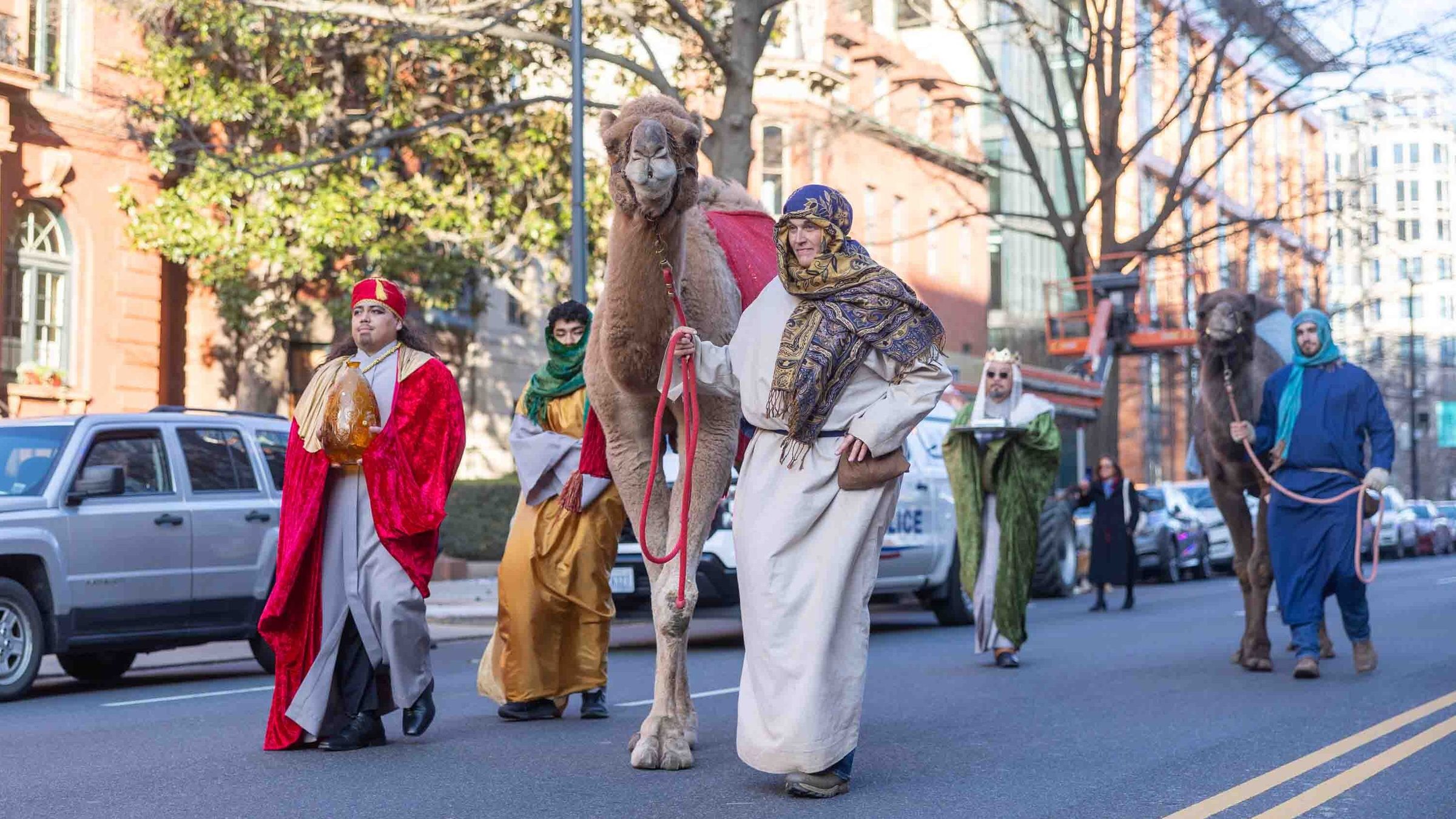

Christmas is too big to be confined to a single day or even an octave of days. It needs an entire season of joy and hope, including El Día de los Reyes Magos, which is also known as Epiphany.
When Jesus was born in Bethlehem, a group of foreigners crossed the border into Judea in search of a newborn king, having followed a great star. Upon seeing the infant Jesus with Mary, these men – called “Magi” – prostrated themselves and offered Him gifts of gold, frankincense, and myrrh.
Whatever practical use the gifts may have had, the Church sees them as representing three aspects of Jesus’s identity and mission. The myrrh signifies His Passion, the frankincense symbolizes His divinity, and the gold indicates His royalty – but we can also view the Magi and their gifts in light of our own relationship to the Lord.
The Magi – Our Common Humanity before God
Mary and Joseph may have wondered precisely who the Magi were, but the appearance and welcoming of strangers – even those from foreign lands – was not all that unusual. The parents of newborn Jesus were themselves travelers to Bethlehem, and the scriptures are filled with the migration of peoples. In fact, whether we are common people or hold positions of high authority, born in this country or that, we are all sojourners on earth. Human life is itself a journey, figuratively and literally. All of us leave our original homes for a new life elsewhere.
In the story of the Nativity, while the shepherds represent the people of Israel, the Magi are representative of the rest of the world. Church tradition would then come to further envision the Magi as kings of the three different continents of Asia, Africa and Europe, with their diverse ethnicities and cultures. Thus, we see the universality of humanity being presented before the Christ Child. At the same time, they are also called “wise men” – wise particularly because they saw and understood the signs pointing to God that others did not, and because they recognized Jesus as a king greater than themselves. Can we say the same of ourselves?
The Gift of Myrrh – Jesus Takes Our Sufferings upon Himself
Mary and Joseph may not have initially comprehended the meaning of the Magi’s gift of myrrh, which was typically used to prepare the dead for burial, but as Pope Leo XIV reminds us, “from the moment He entered the world, Jesus knew the bitter experience of rejection” (Dilexi Te, 19), specifically King Herod’s plot to kill Him together with other young boys of Bethlehem. What this means is that the Lord Jesus is one with people in their struggles and suffering – and not just in the ancient past. Rather, He is one with us; He “reveals Himself as the One who, in the here and now of history, comes to bring about God’s loving closeness” to liberate us from evil (Id., 21).
The new parents had already experienced great hardship in being compelled to deliver their baby in a stable far from home. Now, they would have another foretaste of Jesus’s Passion when they were forced to leave their homeland with their infant son to seek refuge in a foreign country because of the threat of murderous violence by a ruling authority (Herod) in addition to the ruthless oppression they and their neighbors were already subjected to by another regime (Rome).
If this story sounds familiar, it is. In many respects, it is the living story of countless families today who have been compelled to leave their homelands. And because it is also the story of Joseph, Mary, and their baby son, Jesus, as Pope Pius XII makes clear, “The migrant Holy Family of Nazareth, fleeing into Egypt, is the archetype of every refugee family. Jesus, Mary and Joseph, living in exile in Egypt to escape the fury of an evil king, are, for all times and all places, the models and protectors of every migrant, alien and refugee of whatever kind who, whether compelled by fear of persecution or by want, is forced to leave his native land, his beloved parents and relatives, his close friends, and to seek a foreign soil” (Exsul Familia Nazarethana (1952)).
The Gift of Frankincense – the Divinity of Jesus, God is with Us
In the liturgical tradition of the Church, the smoke of burning frankincense signifies our prayers rising up to heaven and making tangible God’s presence with us. In turn, God’s desire to be close to humanity is a recurrent theme of salvation history. He does this in an intimate way in the Incarnation and Nativity of Jesus, when the Lord became one of us to dwell among us forever.
If we understand this closeness of God in our lives, then we should not fear the troubles that may come our way. However, the Lord’s abiding presence is not necessarily automatic, something that happens without our involvement. The closeness of God that we need and inherently long for requires our own participation. For the Lord to be with us in our journey in life, we first must have faith in God, just as the righteous Joseph had faith that the Lord would guide and protect the Holy Family when he took them to Egypt. The Magi too had faith, when they went to find Jesus, that He was a newborn King.
Second, while Jesus teaches us in His adult ministry to follow Him, if we want to ensure that the Lord is with us always, the infancy of Jesus teaches us that, just as Joseph carried Him in his arms and just as the Blessed Virgin carried Him in her womb, so must we carry Jesus and take Him with us wherever we go. In this way, not only is the Lord always at our side, the people we encounter will also experience the Lord’s closeness, just as when John the Baptist leapt in the womb of Elizabeth during the Visitation of the pregnant Mary.

The Gift of Gold – Christ the King
The luster of gold has long been associated with the power and authority of kings. Yet the Magi discovered something even more precious – the newborn King Himself. The action of these kings laying down before Jesus, making themselves subservient to Him, was a recognition that He is greater than they. Let us pray that all public leaders recognize this as well.
Indeed, Jesus the Lord is sovereign of the entire universe, and thus is a greater King than all other princes, presidents, prime ministers and prideful others who hold worldly power. Christ triumphs and has dominion over all not by violence or usurpation, but by the power of His persevering love.
So, instead of falling prey to a sense of powerlessness or helplessness in the midst of persecution, suffering, struggles and oppression, this is why people throughout Latin America and elsewhere proclaim, “Viva Cristo Rey!”
We will not be robbed of hope because He is our sovereign Lord. He is the one in whom we entrust our lives. Viva Cristo Rey! Amen.
(Bishop Evelio Menjivar serves as an auxiliary bishop of the Roman Catholic Archdiocese of Washington.)