
On Labor Day, we remember the people whose hands, minds and daily sacrifices built this nation: the construction worker rising before dawn, the nurse working through the night, the teacher preparing lessons after school, the farmworker harvesting food under a relentless sun, and the parent holding two jobs while still struggling to pay the rent.
This year, another figure belongs in that picture: the worker wondering whether an algorithm will eliminate a job, reduce hours, deny an application or measure every minute of the workday. The machinery has changed. The moral question has not.
More than a century ago, the Industrial Revolution produced enormous wealth while leaving workers exposed to dangerous factories, poverty wages, exhausting hours and little protection against unemployment, sickness or old age. In 1891, Pope Leo XIII responded with Rerum Novarum, insisting that workers were not commodities and that the economy must be judged by its treatment of the human person.
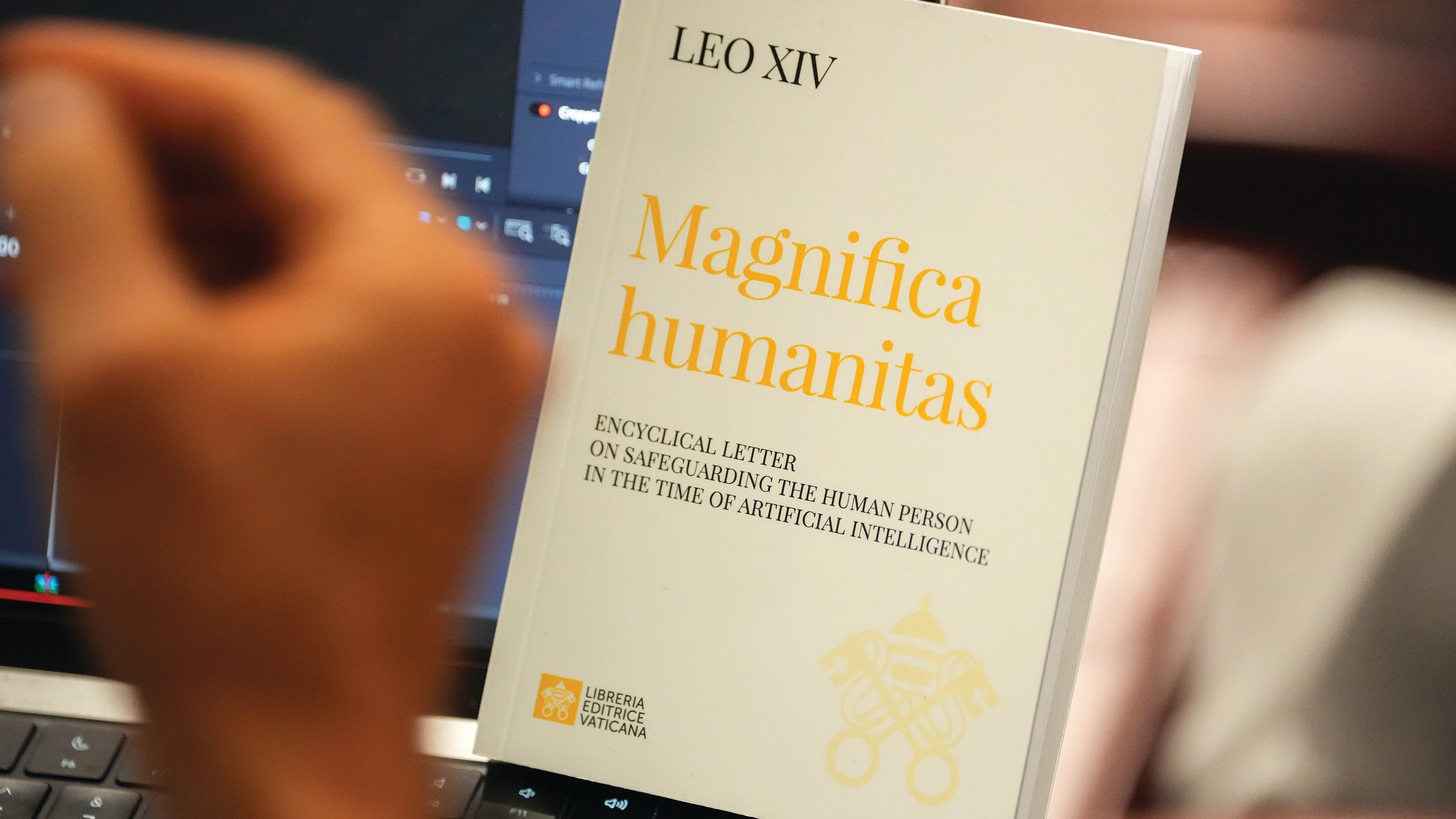
In 2026, Pope Leo XIV has addressed the “new things” of our age. In Magnifica Humanitas, his encyclical on safeguarding the human person in the age of artificial intelligence, he asks whether technology will serve humanity – or whether human beings will be forced to serve systems governed by profit, surveillance, speed and concentrated power. It is an especially appropriate question for Labor Day.
A priest who brought Catholic worker justice teaching into public life
The Catholic response to economic upheaval has never been limited to documents on library shelves. It has been carried into factories, fields, union halls, legislatures and government offices. Few Americans did more to translate Rerum Novarum into public policy than Msgr. John A. Ryan.
Born in 1869 and later known as the “Right Reverend New Dealer,” Ryan was a priest, moral theologian, economist, and tireless advocate for working families. Long before Franklin Roosevelt entered the White House, he argued that workers possessed a moral claim to a decent livelihood – not merely enough to avoid starvation, but enough for family life, education, health, religious participation, and human flourishing.
As early as 1909, he advocated for a legal minimum wage, limits on working hours, recognition of labor unions, public housing, progressive taxation and insurance against unemployment, sickness, disability and old age. He understood that joblessness was not always a personal failure: recession, industrial change or decisions made in distant corporate offices could deprive a willing worker of employment. Families should not therefore be reduced to destitution or humiliating poor relief.
In 1919, Ryan drafted the American bishops’ Program of Social Reconstruction, calling for unemployment protection, minimum-wage laws, labor’s right to organize, public housing, social insurance and greater governmental responsibility for the common good. Many proposals anticipated the New Deal by more than a decade.
Ryan later served on President Roosevelt’s Advisory Council on Economic Security, helping deliberate over the unemployment-compensation provisions that became part of the Social Security Act of 1935. He worked with Secretary of Labor Frances Perkins and others who believed government had an affirmative responsibility to protect families from economic catastrophe.
Ryan did not accomplish these reforms alone, and the bishops did not write the Social Security Act. But Catholic social teaching helped create a moral climate in which unemployment insurance, old-age protection, and labor rights could be understood not merely as political programs, but as requirements of justice. The Church’s social teaching is meant to shape laws, institutions, workplaces, and public choices.
Never “mere tools for profit”
The Second Vatican Council summarized this tradition clearly in Gaudium et Spes. Paragraph 27 commands every person to regard every neighbor “without exception as another self,” taking into account both that person’s life and “the means necessary to living it with dignity.”
The Council names the abandoned elderly person, the foreign laborer unjustly looked down upon, the refugee, and the hungry person whose need disturbs our conscience. It condemns murder, genocide, abortion and euthanasia, but in the same paragraph also condemns subhuman living conditions, arbitrary imprisonment, deportation, slavery, trafficking and “disgraceful working conditions” in which people are treated as “mere tools for profit, rather than as free and responsible persons.”
That phrase deserves renewed attention. A home-health aide is not merely a scheduling unit. A warehouse employee is not merely a number on a performance chart. A delivery driver is not simply a moving dot on a screen. A teacher is not merely a set of test results. A writer, artist or musician is not raw material from which a machine may extract value.
Each is a person with a family, history, conscience, abilities, vulnerabilities, and God-given dignity that no employer, government or technology company creates – and none has the right to take away. Vatican II does not separate the right to life from the conditions required for life with dignity. Food, shelter, health care, education, safe employment, family stability, and protection during unemployment or illness are among dignity’s practical requirements.
A new industrial revolution
Pope Leo XIV carries that teaching into the digital age. Magnifica Humanitas presents artificial intelligence as a transformation comparable to the Industrial Revolution confronted by Leo XIII. AI can assist doctors, expand education, perform dangerous tasks and help solve difficult problems. Pope Leo does not reject technology or encourage fear. But he warns that technological progress is not automatically human progress.
An economy can become more efficient while workers become less secure. A company can become more profitable while employees lose control over their work. A workplace can become more sophisticated while reducing people to data, rankings, and performance measurements.
Pope Leo therefore places “the human person at the center of our choices” (Magnifica Humanitas, no. 16) and teaches that work “is not simply an instrument; it expresses and enhances the dignity of our lives” (no. 149). Work is more than a paycheck. Through it, people support families, develop abilities, exercise responsibility, create useful goods, serve neighbors, and participate in society.
Technology should enhance those purposes: assisting workers rather than merely replacing them; relieving drudgery rather than intensifying surveillance; expanding creativity rather than deskilling employees; and distributing benefits broadly rather than concentrating wealth and decision-making in a few corporations.
The digital economy is not immaterial. Behind seemingly effortless technologies are mines, energy systems, warehouses, data centers, and people performing poorly paid or hidden labor. Some label data, review disturbing online material or train computer systems without receiving a fair share of the wealth generated. Elsewhere, children and impoverished laborers extract minerals needed to power the digital world. The machine may appear clean and weightless on our screens. Its human supply chain often is not.
Here Magnifica Humanitas speaks directly to Gaudium et Spes. Vatican II condemned arrangements that treated people as instruments of profit. Pope Leo warns that digital systems can sort, monitor, exclude, and monetize people on a scale the Council Fathers could not have imagined. The technology is new. The temptation to sacrifice the weak for the powerful is ancient.
Who decides – and who benefits?
The debate over artificial intelligence is not only about technology. It is about power. Who decides how AI will enter a workplace? Are workers consulted, or are life-altering decisions announced after the fact? Who receives the benefits of greater productivity, and who bears the costs when jobs disappear? Can a person challenge an algorithmic decision affecting employment, credit, insurance or public benefits? Are older workers, persons with disabilities, and poorer communities being unfairly screened out by systems no one can adequately explain?
Catholic teaching does not provide a technical answer to every question, but it provides moral standards. Workers must have a voice in decisions that profoundly affect their lives. Human judgment must remain responsible for decisions affecting dignity. Productivity gains should benefit the whole community, not only executives and investors. Workers displaced by technology deserve income protection, education, and meaningful opportunities in the emerging economy.
The right to organize and bargain collectively may become more – not less – important when individual workers confront multinational corporations armed with immense stores of data and computing power. Pope Leo’s call for transparency, accountability, and meaningful participation in the governance of AI applies the principles of solidarity, subsidiarity and the common good.
An economy measured by human flourishing
Anthony Annett, PhD, in Cathonomics: How Catholic Tradition Can Create a More Just Economy, argues that economics cannot be separated from ethics. An economy should not be judged only by output, efficiency, stock prices or gross domestic product, but by whether people and communities can flourish.
A “virtue economy” asks: Can workers support their families? Is employment safe and meaningful? Are the vulnerable protected? Is wealth serving the common good? Are the benefits and burdens of change shared fairly? Are workers free to organize? Does development leave people more human – or more disposable?
Those questions guided Catholics confronting factories, sweatshops, child labor, and mass unemployment. They must guide us as we confront automation, platform employment, algorithmic management, and AI. Msgr. Ryan believed faith required more than sympathy for struggling workers; it required organized social protection and effective public policy. Today he would likely ask not only how many jobs AI might create or eliminate, but what society owes workers whose lives are disrupted by decisions they did not make and systems they do not control. His answer would begin with the human person.
The work before us
Labor Day is not only an occasion for remembering past victories. It is an invitation to continue the unfinished work of justice.
Catholics can honor workers by supporting just wages, safe workplaces, reasonable hours, family and medical leave, unemployment protection, affordable health care, the right to organize, and meaningful assistance for people displaced by technological change.
Employers can include workers in decisions about AI and ensure that technology complements rather than degrades human labor. Legislators can require transparency, protect workers from discriminatory algorithms, strengthen social insurance, and ensure that technology’s gains are shared fairly.
Parishes can teach the Church’s social doctrine, listen to working people and remember that ministries addressing food, housing, immigration, unemployment, and family hardship are not separate from the defense of human life. They are part of the same reverence for the human person proclaimed in Gaudium et Spes.
The question before us resembles the one faced by Leo XIII and Msgr. Ryan: Will new economic power be governed by justice, or will vulnerable people pay the price of progress?
Pope Leo XIV gives us a clear standard. Technology must serve humanity. Work must serve the person. The economy must serve the common good.
On this Labor Day, perhaps our most important act of remembrance is to look beyond the machinery – whether factory machinery or artificial intelligence – and see the person standing beside it. That worker is not a cost, a statistic, a data point or a tool for profit.
That worker is our neighbor – another self.
Robert Stewart is an Ignatian Volunteer who does writing and research for the Ignatian Solidarity Network-Education for Justice and for Social Action Linking Together (SALT), a Virginia-based advocacy organization. He retired in 2007 as the director of retirement programs for a Fortune 100 company. Earlier in his career, he served as a field service representative and later as a pension and employee benefit appeals hearing officer for the United Mine Workers of America Health and Retirement Funds. He also chaired the Justice and Peace Commission for the Catholic Diocese of Belleville, Illinois, during the late 1970s and the 1980s. He and his spouse are parishioners at Holy Trinity in Washington, D.C.