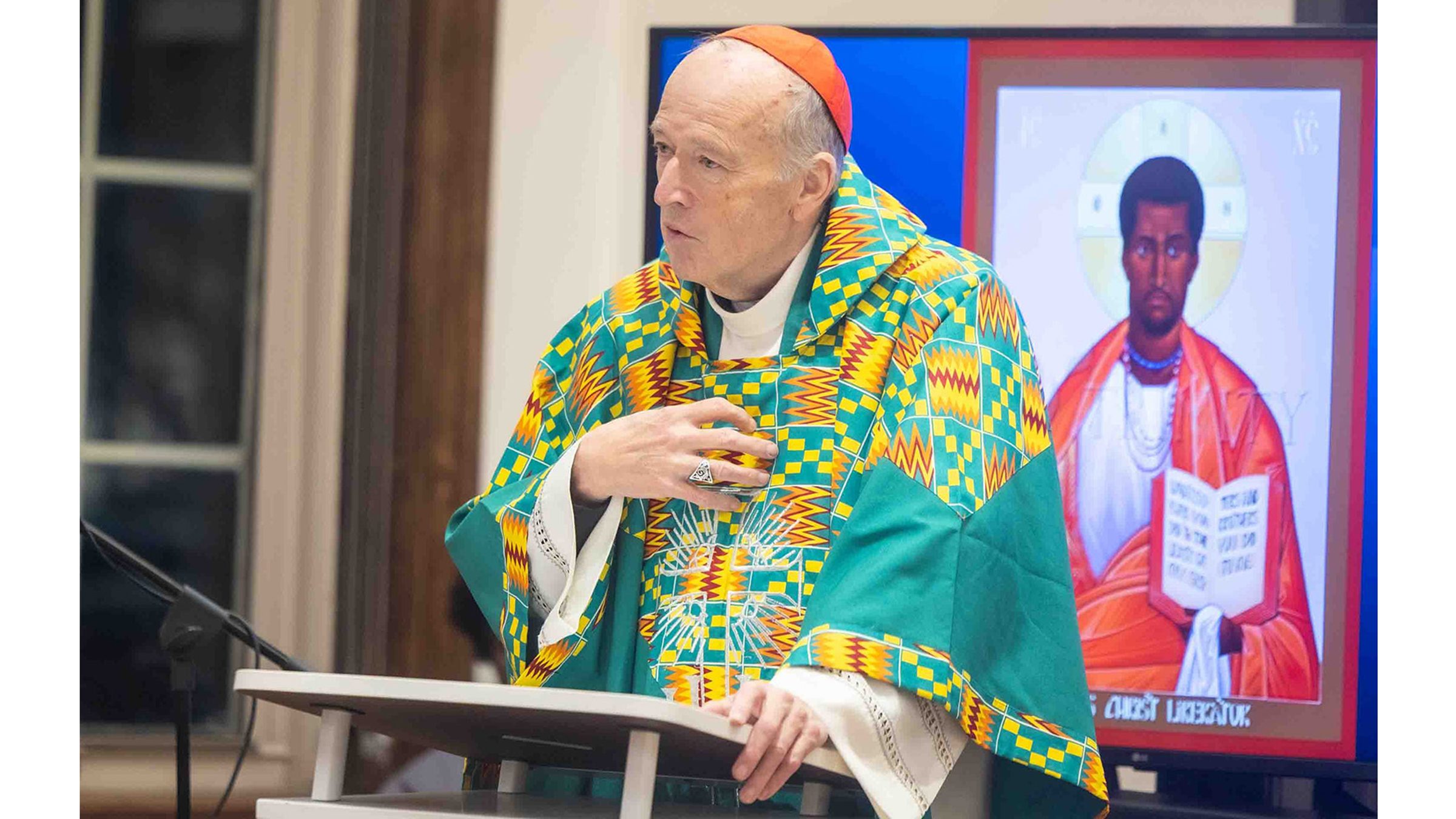

(The following is the text of the homily given by Cardinal Robert W. McElroy, the archbishop of Washington, at the Jan. 31 opening Mass for the 2026 national meeting of the Association of Catholic Colleges and Universities.)
In the movie “The Tree of Life,” Terrence Malick’s breathtaking religious allegory of life and death, an anguished mother, grieving over the suicide of her son who had been bullied, laments: When we were young, the sisters taught us there were two things that move the hearts of men – the order of nature and the order of grace.
The order of nature thrusts itself upon us. It compels us to obey. It is self-seeking and overrides the well-being of others. It rests upon power and the ability to dominate.
The order of grace, on the other hand, teaches us to find God’s beauty in the hearts and lives of others. It rejoices in forgiveness. It does not seek dominance as a source of contentment but community and peace. It values embrace and dialogue over the accumulation of power.
I fear we as a nation are experiencing a moment in which the order of nature is eclipsing the order of grace.
For us as Christians this is a crisis which we cannot ignore.
Today’s Gospel makes this clear. For the Beatitudes present the fundamental inversion of the order of nature that is at the heart of the Christian mission. Blessed are not those who seek to dominate and seek massive wealth and power. No, no blest are they who have no power. Blest are the poor who have no wealth. Blest are they who show mercy. Blest are the peace makers. Blest are the persecuted.
As a society we have allowed a Hobbesian conception of the world to dominate vital elements of our policymaking and public conversation. Principles of human dignity and compassion are discarded in favor of a calculus that values the acquisition of wealth, military power and the stoking of racial, ethnic and economic divisions.
The Beatitudes are the counterpoint to this Hobbesian worldview. They call our hearts to those virtues and actions which can help to redeem us in our current torments.
Part of the problem with most of us as Christians is that we do not take the Beatitudes seriously. We think of them as an uplifting vision to comfort us and dream how life should be.
The Beatitudes are not a call to dream or find comfort. They are a moral framework for our personal lives and our public lives as citizens. They are rooted in the conviction of Jesus Christ that these virtues are for the real world, and that they point the way toward truly building up the Kingdom of God on this earth. It is by living the Beatitudes that we strengthen the order of grace all around us and in our nation.
Bringing the Beatitudes to the cultural and political issues that divide us as a nation does not mean that the complex questions we are facing can be reduced to simple solutions. Solving our immigration problems will have to include controlling our borders and deporting undocumented individuals who have been convicted of violent crimes. But solutions rooted in the order of grace cannot countenance the vilification of the undocumented or the indiscriminate deportation of millions of undocumented men and women and families who have lived productively and peacefully in our land for decades and who contribute to our society so many of the values that we are desperately in need of.
The United States by reason of its military and economic power can achieve much good in the world. But the order of grace cannot be built upon military and economic threats used to advance narrow national goals at the expense of the vital well-being of others and the solidarity among nations that its essential for the well-being of all.
America cannot end poverty in our world. But the order of grace cannot tolerate the richest nation in the world, decimating the less than one percent of our federal budget that our nation gives to international humanitarian aid. For compassion lies at the very heart of the Beatitudes. No country can call itself compassionate if it retains even the scraps from its table rather than providing economic assistance to those who are starving, hungry or sick in our world. And as Pope Leo pointed out in Dilexi te, “No Christian can regard the poor as simply a societal problem. They are part of our family.”
Even on the issue of abortion, this new rejection of the order of grace has brought us to a point where neither political party is willing to support critically important actions necessary to protect the unborn children of our country. And Jesus weeps.
The order of grace demands the healing of the polarization that creates false and amplified divisions in our culture. Our community and institutional life have been crippled by the toxic drive to judge and ostracize others on all sides of the political spectrum. We should never forget that judgmentalism is the sin which Jesus mentioned most frequently in the Gospels. It is a mystery of the human soul why we feel better about ourselves when we can look down upon others and judge them. But we do, and this mystery of the human soul is destroying the bonds of community that will be our only salvation as a country.
The Colleges and Universities of our nation, and particularly Catholic Colleges and Universities, have a critical and substantive role to play in arresting the eclipse of the order of grace in our society. For part of your core mission is precisely to advocate for the inversion of values that the Beatitudes represents.
That means, as Pope Francis stated so often, going to the peripheries, seeking the marginalized and the vulnerable in our midst, and trying to understand how proposed policies impact and benefit or hurt them. Every Catholic university should seek to form in its students a constant search to improve and protect the position of the most vulnerable in our society, the undocumented, the unborn, the poor, the elderly, those with mental illness.
This mission of Catholic colleges and universities requires placing the order of grace at the heart of college life. It means being unapologetic about Catholic social teaching, no matter whom it alienates.
It must never be forgotten that this effort is intrinsically one of conversion, not compulsion or exclusion. To forget this first principle is to betray the order of grace and the Beatitudes that are its content. Discussion and debate lie at the heart of college and university life, and to true moral and spiritual conversion.
Pope Francis stressed that key to authentic dialogue is accompaniment, the willingness to truly embrace the other and walk with them in profound respect for their dignity and opinions. Catholic universities must truly accompany their students with respect, caring for their deepest needs and beliefs and carrying the torch of the order of grace to help light the way in our troubled world.
Link to related article: