
Many things are named in honor of popes, including shrines, schools and other structures.
In Singapore, there’s even an orchid variety with a papal moniker: Dendrobium His Holiness Pope Francis, presented to its namesake during the late pope’s 2024 apostolic visit to that nation.
And the convention has taken to the heavens – literally.
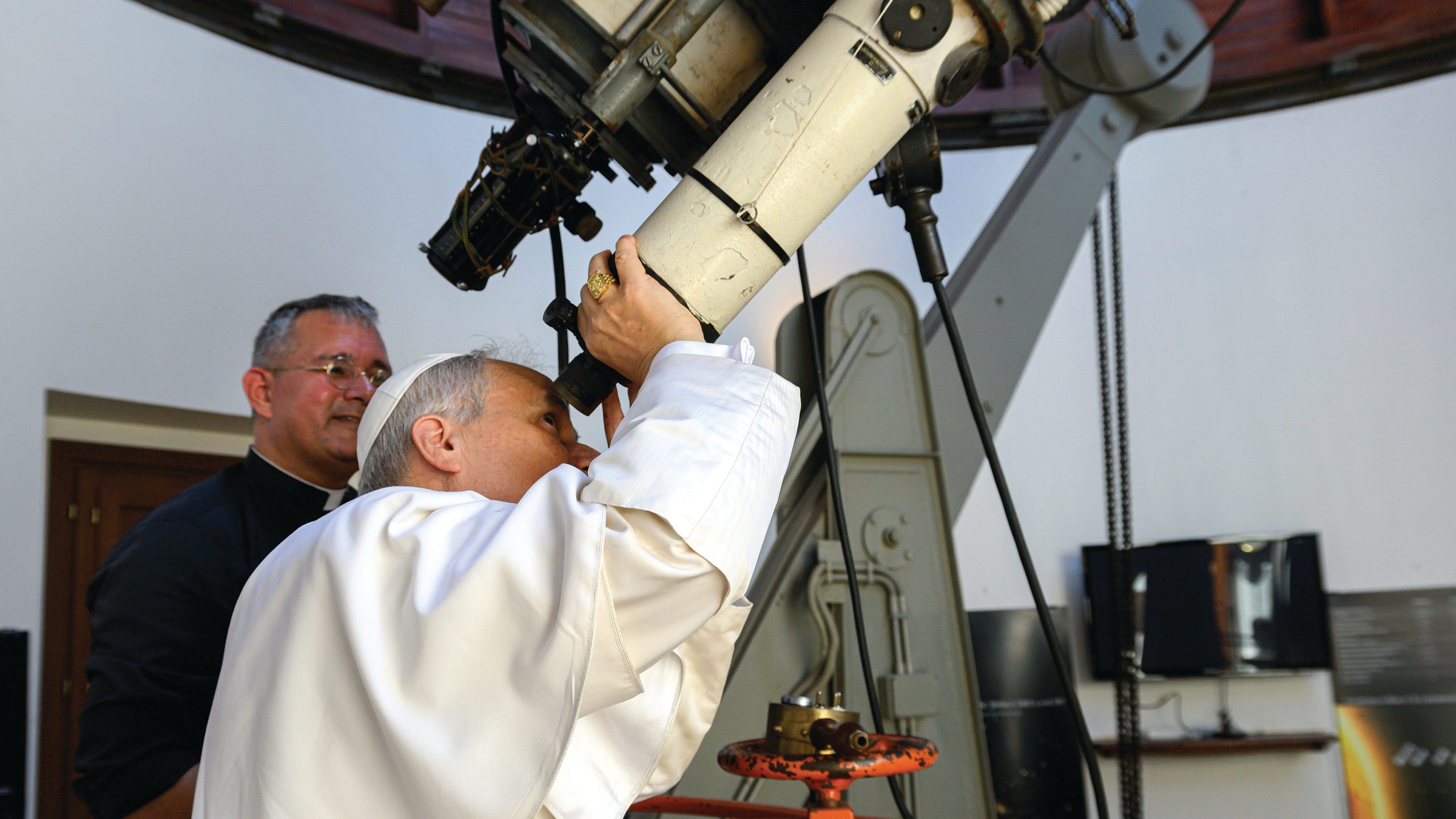
The Vatican Observatory announced in an April 29 press release that an asteroid has been named in honor of Pope Leo XIII, who formally reestablished the observatory in 1891.
Sometimes known as “minor planets,” asteroids are rocky leftovers from the formation of the solar system some 4.6 billion years ago, NASA notes on its website.
Ranging anywhere from 33 feet to almost 330 miles in diameter, most asteroids orbit the sun between Mars and Jupiter, in a formation known as the asteroid belt. According to NASA’s Jet Propulsion Laboratory, the number of asteroids currently exceeds 1.5 million.
The Pope Leo XIII asteroid is one of four discovered by Lithuanian astronomer Kazimieras Cernis and Jesuit Father Richard P. Boyle, a Vatican Observatory astronomer. The pair detected the bodies using the Vatican Advanced Technology Telescope, or VATT, on Mount Graham, Arizona, constructed in partnership with the University of Arizona’s Steward Observatory.
The remaining three asteroids have been named for other key figures in the history of the Vatican Observatory, which traces its roots to the solar calendar reform of Pope Gregory XIII in 1582 – an effort that corrected a widening gap between the calendar and the seasons incurred by the Julian calendar.
The Vatican Observatory noted that in honor of his calendar reform, Pope Gregory XIII already has his own VATT-detected space rock, technically known as “(560974) Ugoboncompagni.” In 2000, the late German astronomer Lutz Schmadel named one of his many asteroid discoveries after Pope Benedict XVI: “(8661) Ratzinger.”
Along with Pope Leo XIII, the newly named asteroids are a nod to Oratorian Father Giuseppe Lais, an astronomer who served as the observatory’s deputy director for 30 years; Cardinal Pietro Maffi, archbishop of Pisa, Italy, who was observatory president from 1904 until his death in 1931; and Jesuit Father Florent Constant Bertiau, a Belgian astronomer who founded the observatory’s computer center in 1965.
The names for the four asteroids discovered by Cernis and Father Boyle were recently unveiled in the April 13 edition of the International Astronomical Union’s WGSBN (Working Group on Small Bodies Nomenclature) Bulletin.
In the bulletin, the asteroid names appear in their scientific format, conforming with the IAU guidelines that govern the process.
The Vatican Observatory explained in its press release that an asteroid is first assigned a provisional designation upon discovery, based upon the date it was first observed.
An asteroid only receives a permanent number after its orbit and likely future trajectory can be sufficiently ascertained. Afterwards, discoverers can propose a name to replace the provisional designation, with the IAW working group reviewing the name for compliance with its standards.
An official designation, once approved, begins with the permanent number in parentheses, followed by the asteroid name.
The four asteroids spotted by Cernis and Father Boyle are officially listed as follows:
• “(858334) Gioacchinopecci,” which evokes Pope Leo XIII’s baptized name, Gioacchino Vincenzo Raffaele Luigi Pecci.
• “(836955) Lais” for Father Lais, who participated in the early 20th-century “Carte du Ciel” (“Map of the Heavens”) photographic star atlas project.
• “(836275) Pietromaffi” in honor of Cardinal Maffi, who recommended the Vatican Observatory be entrusted to the Society of Jesus, under whose care it remains to this day, with its current director Jesuit Father Richard D’Souza appointed by Pope Leo XIV in July 2025.
• “(688696) Bertiau,” which recognizes Father Bertiau’s efforts in pioneering computerized data analysis and conducting research on star distribution in the Milky Way galaxy and on light pollution.
“The discovery of these four asteroids and their naming by members of the Vatican Observatory continues Pope Leo XIII’s intention to support science and to show the world and the Church that faith and science go together,” said the observatory in its press release.
The observatory also quoted Pope Leo XIII’s 1891 motu proprio, “Ut Mysticam,” by which the observatory – the predecessor of which had operated from 1789-1821 – was reborn.
The Vatican Observatory aimed “to promote a very noble science which, more than any other human discipline, raises the spirit of mortals to the contemplation of heavenly events,” Pope Leo XIII wrote.
And that mission continues, even despite challenges such as light pollution, which has forced the Vatican to relocate and expand its observatory resources over the years.
VATT emerged from the Vatican Observatory Research Group in Tucson, Arizona, built for better viewing amid light-soaked skies. Years earlier, an ever-brightening and expanding Rome had compelled Pope Pius XI to move the Vatican Observatory to Castel Gandolfo, the papal summer residence in Italy.
In fact, the residence has its own asteroid: (90718) Castel Gandolfo, formerly 1991 RW3, which at press time is somewhere – along with its numerous counterparts – making the rounds between Jupiter and the sun.