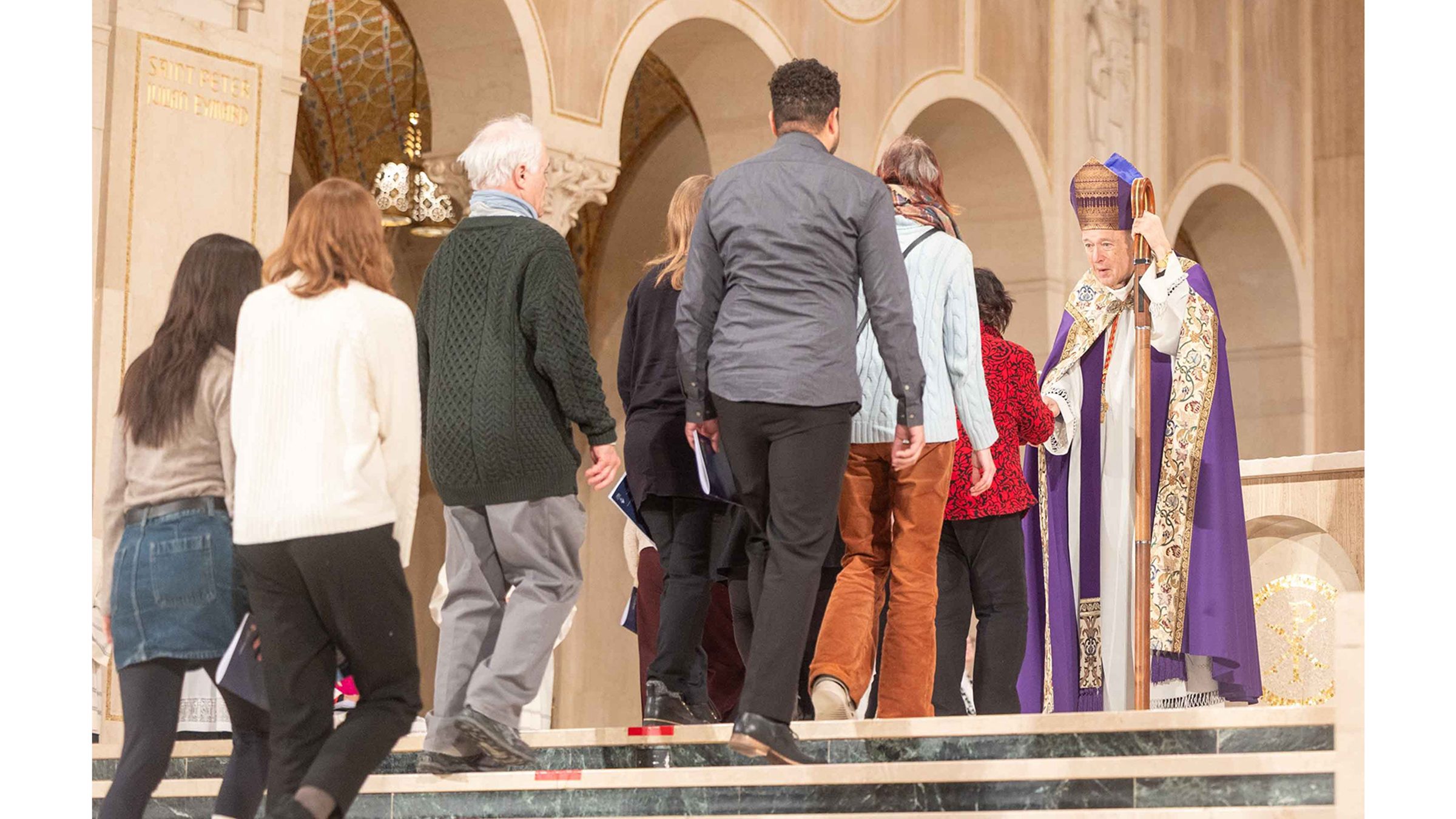

As a winter storm approached the Washington area on Feb. 22, the Basilica of the National Shrine of the Immaculate Conception – the largest Catholic Church in North America – was filled to capacity with men and women preparing to enter more deeply into the life of the Church, joined by their godparents, sponsors and family members.
On Feb. 22, Washington Cardinal Robert W. McElroy celebrated the Rite of Election and Call to Continuing Conversion, the Lenten liturgy marking the final stage of preparation for those who will receive the Sacraments of Initiation – Baptism, Confirmation and Eucharist – at the Easter Vigil on April 4 in the Roman Catholic Archdiocese of Washington.
Wearing purple vestments for the Lenten season, Cardinal McElroy presided as catechumens and candidates processed up the basilica’s long center aisle, their footsteps echoing against the marble.
According to statistics provided by Sara Blauvelt, the secretary for catechesis for the Archdiocese of Washington, 1,755 people from more than 100 parishes in the District of Columbia and the five surrounding Maryland counties and from six campus ministry programs at area universities are participating in this year’s Rite of Election and Call to Continuing Conversion held on the first and second Sundays of Lent, on Feb. 22 and March 1. Blauvelt said last year’s total of 1,566 people entering the Catholic Church at Easter had been the previous high for the Archdiocese of Washington over the past 15 years.


The people at the liturgy stood shoulder to shoulder in pews and along the walls. First, catechumens — those preparing for Baptism, Confirmation and the Eucharist — filled the sanctuary as their names were called from the Book of the Elect. Cardinal McElroy stood at the top of the steps leading into the sanctuary, crozier in hand, greeting them one by one as the Church formally declared them chosen for the Easter sacraments. Later, candidates who were already baptized came forward with their sponsors during the separate Call to Continuing Conversion, publicly affirming their desire to complete their Sacraments of Initiation or enter into full communion with the Catholic Church.


Of the total entering the Catholic Church in the Archdiocese of Washington at this year’s Easter vigil, 678 are catechumens who will receive Baptism, Confirmation and the Eucharist at Easter. Another 292 are baptized Christians seeking full communion with the Catholic Church. An additional 785 are baptized Catholics preparing to complete their initiation through Confirmation and the Eucharist. Baptized Catholics seeking only Confirmation do not participate in the rite.
The group reflects the archdiocese’s diversity. Blauvelt noted that 668 participants are young adults ages 20 to 35, and 595 are age 36 and older. About 540 listed Spanish as their primary language, with 55 indicating another primary language. Significant participation came from St. Andrew Kim Parish in Olney, Maryland, and Epiphany Parish in Washington, representing the Korean community.


In his homily, Cardinal McElroy situated the rite within the broader story of salvation history.
“In the readings from Scripture today, we see unfolding the history of humanity in the world and of God’s redemption of each and every one of us,” he said.
Reflecting on the Book of Genesis, the cardinal emphasized that creation itself reveals the depth of God’s love.
“Every blessing that we know in this world and in our lives is a gift from God, filled with beauty, filled with grace, given without any merit on our part,” he said. “We are created in God’s image, and that always remains true no matter what we do in our lives.”
He acknowledged the reality of sin and suffering, noting that those things entered the world “not by God’s design but by human weakness.” Lent, he said, calls the faithful to confront both God’s goodness and their own need for mercy.
Turning to the Gospel account of Jesus’ temptation in the desert, Cardinal McElroy said Christ’s victory over temptation offers a model for believers. Yet he stressed that Catholic faith does not rest on human perfection.
“It’s key — and I say to you, all of you who are entering into the fuller life of the Church on this day and at the Easter Vigil — never lose sight of the fact that it is in our moments of failure that we encounter God’s greatest gift, which is mercy,” he said. “God forgives us no matter what we do or fail to do on this earth.”

The cardinal underscored that God did not have to enter human history in order to redeem it.
“God is all-powerful and could have redeemed us without ever enduring the suffering of the cross,” he said. “But God chose to do that as the ultimate sign that God’s love for us is total and without reservation.”
He described the Church as a community that both receives and extends that mercy, recalling Pope Francis’ image of the Church as a field hospital.
“Each one of us in our lives has areas where we are hurting and need healing,” Cardinal McElroy said. “And each one of us in our lives has the capacity to help others … who are hurting and need healing. Thus the whole of the Church is a field hospital, both being healed and healing in the name of Jesus Christ.”


For Whit Johnston, a 20-year-old student at George Washington University majoring in international affairs, the rite marks a decisive step.
“I’m a true catechumen,” Johnston said. He will receive Baptism, Confirmation and the Eucharist at the Easter Vigil.
Originally from Montgomery County, Maryland, Johnston said his path to the Church began during his first years of college.
“When you get to college, it’s a brand new experience in a lot of ways,” he said. “There’s a lot of fulfillment you get in school and in your education, especially in D.C. … but there are some things that can’t give total fulfillment.” What drew him to become Catholic, he said, was his desire for “ spiritual fulfillment, and it was a calling.”
He said Catholic friends and mentors played a significant role in his journey, including members of the university’s Newman Center and Knights of Columbus council. He credited Father James Glasgow, the chaplain at the Newman Center, for being “incredibly influential and helpful” throughout the process.
Raised with some Baptist background, Johnston said one aspect of Catholicism that struck him was its historical continuity, and “how steeped the Catholic Church is in tradition over 2,000 years, and the fact that Christ himself founded the Church is a major factor.”
His sponsor, Alex DeCamp, who is 21 and a fellow student at George Washington University, described himself as a “Catholic revert.” Baptized Catholic as an infant, DeCamp said his family stopped attending Mass when he was around 8 years old. As he entered adulthood, he identified as atheist before returning to the Church.
DeCamp said many conversations about faith eventually led him to invite Johnston to the Newman Center.
As the Lenten season unfolds, catechumens and candidates will continue their preparation through prayer, formation and participation in the Church’s liturgical life, culminating in the celebration of the Easter Vigil, when the Sacraments of Initiation will be conferred.
At the close of his homily, Cardinal McElroy reminded those gathered that the journey toward Easter rests not on human effort alone but on divine fidelity.
“We may turn our backs on God,” he said, adding that “God never turns his back on us, but always has the outstretched arm.”