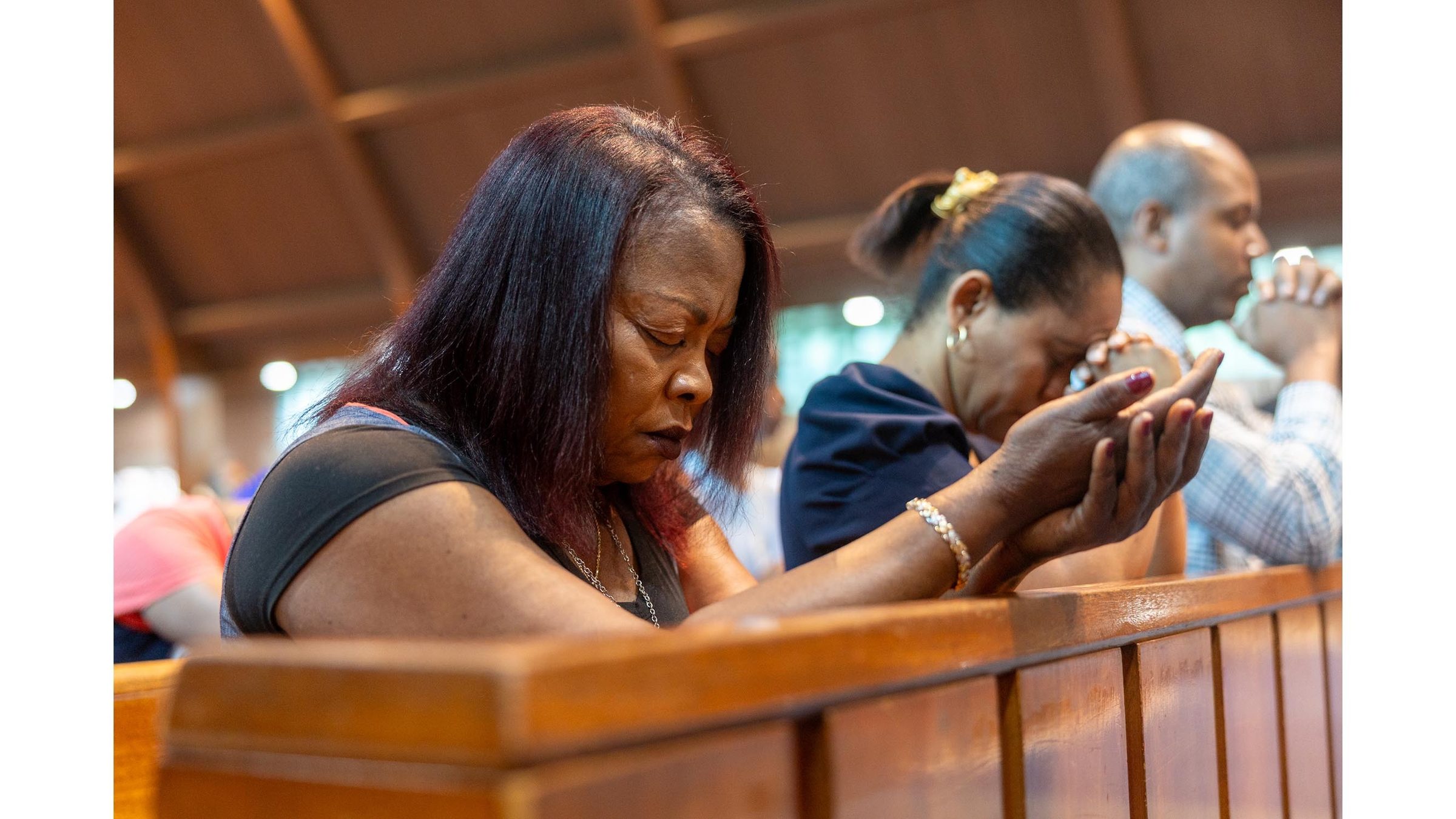

As Haitian Catholics often do in challenging times and in everyday life, they turned to Mary.
The Haitian Catholic Community of the Archdiocese of Washington’s Mass on June 28 celebrating the feast day of Our Lady of Perpetual Help, the patroness of Haiti, unfolded three days after a Supreme Court ruling that paved the way for the Trump administration to end Temporary Protected Status (TPS) for Haitian and Syrian immigrants. Hundreds of people attended the Mass celebrated in French and Creole at Our Lady of Sorrows Church in Takoma Park.
The ruling could cause an estimated 350,000 Haitian immigrants who have lived and worked in the United States to face deportation to Haiti, which has been wracked by gang violence and political instability in recent years.
The website of the U.S. Citizenship and Immigration Services notes that a country can be designated for TPS due to “ongoing armed conflict (such as civil war); an environmental disaster (such as earthquake or hurricane), or an epidemic; and other extraordinary and temporary conditions.”
TPS protections were first granted to Haitian immigrants in 2010 following a catastrophic earthquake that devastated Haiti, the poorest country in the Western Hemisphere, and then the protections were extended several times over the years. Trump administration officials have vowed to end those TPS protections for Haitian and Syrian immigrants, and analysts say the Supreme Court’s ruling could impact 1.3 million immigrants from more than a dozen countries.

In an interview after the Mass, Father Luc Philogene – who has served as the chaplain of the Haitian Catholic Community of Washington since 2018 – called the court’s ruling “a disaster for us.”
The next day in an email interview, the priest noted that in the Washington metropolitan area, several hundred Haitian families are enrolled in the TPS program, including many in the Catholic community.
“Since 2010, the situation in Haiti has continued to deteriorate. With the current socio-political situation, things are getting worse. People have lost their homes, their jobs, and their businesses,” he said, adding that some of the Haitian TPS participants have been in the United States for 15 years. “They’ve worked hard to fit into the system. They have their families, their homes, and their careers. They have a home, a car, and they’re raising their children. They do the jobs they wouldn’t have done in their own countries – jobs that perhaps the native-born people of this country don’t want to do. They’re in every sector, helping out, working, and earning a living.”
Some Republican and Democratic governors have urged that the Haitian immigrants be allowed to remain in the United States, and they have noted that they provide vital work, including caring for the elderly in nursing homes.
Father Philogene said that if the TPS protections are removed for those immigrants, they will no longer have work permits. “Many will lose the homes they bought and in which they invested all their savings… And unfortunately, they no longer have homes (in Haiti) because gang members have burned, stolen, or taken them… The situation in Haiti today is difficult. Eighty percent of the country is under the control of armed gangs.”
He noted that because of the current immigration situation, more than 20 members of the choir didn’t come to sing at the Mass, and “some parishioners haven’t been coming to Mass because they’re afraid.”

As the chaplain to the Haitian Catholic community in unsettling times for those immigrants, he has offered pastoral care by accompanying them to appointments with ICE (U.S. Immigration and Customs Enforcement), DHS (the U.S. Department of Homeland Security) and to court hearings. He has helped families find lawyers and has translated documents for them.
Haitian Catholics attend parishes across the Archdiocese of Washington, and Father Philogene celebrates weekend Masses for about 400 families in Maryland at St. Camillus Church in Silver Spring and Our Lady of Sorrows Church in Takoma Park, and in Washington at the Shrine of the Sacred Heart.
The priest emphasized that “one thing to know about the Haitian people is their faith. Haitians do not lose their faith and hope in difficult times. Haitians hope that the Lord will do something. Haitians rely heavily on providence… Haitians always believe that God will provide.”

He added that this year as they celebrated the feast of Our Lady of Perpetual Help, Notre-Dame du Perpètuel Secours, “we turn with confidence to Mary, the tender Mother who comes to our aid… In these difficult times, marked by uncertainty and the end of TPS, which affects more than 350,000 of our compatriots, we place in God’s hands the anxieties, hopes, and future of all Haitians here and elsewhere. We implore the Virgin’s intercession for migrants, families in distress, undocumented immigrants, the sick, and all those who seek peace and dignity.”


Our Lady of Perpetual Help became regarded as the patroness of Haiti after a plague of cholera and smallpox swept through the island in 1881, and it subsided after people there prayed for her intervention. Pope Pius XII later approved a request by Haiti’s bishops to recognize Our Lady of Perpetual Help as the nation’s patroness.
The main celebrant of the Mass for Our Lady of Perpetual Help, was Bishop Pierre-André Dumas from the Diocese of Anse-à-Veau-Miragoâne, Haiti, an outspoken critic of the violence and instability in his country, who survived a 2024 explosion near Port-au-Prince that left him with third-degree burns over more than 40 percent of his body.
In the interview, Father Philogene said the bishop has become “a living witness to God’s love and mercy; what he has lived through has made him a living martyr.”

The priest noted that in his homily, Bishop Dumas “emphasized trust as the key to living in the present moment. In his message, he reminded us that we must live with gratitude for the past, for all the miracles that Mother Mary has worked for Haiti; he also invites us to ask the Virgin Mary for strength and courage to live in the present moment here in the U.S. and in Haiti, and to have hope that the Lord, through the intercession of Mary our Mother, will do something for us.”
The Mass opened with the hundreds of people at Our Lady of Sorrows Church joyfully singing “Ave, Ave Maria.” The opening procession was led by a man carrying the flag of Haiti followed by four men reverently carrying a platform bearing an icon of Our Lady of Perpetual Help.
Moments later, Bishop Dumas blessed the icon with incense.
The 10 concelebrating priests included Father Philogene; Father Angel Fermin, the pastor of Our Lady of Sorrows; and Capuchin Franciscan Father Anthony Baetzold, the new pastor of the Shrine of the Sacred Heart.
During the singing of the Gloria in French, girls and young women performed an expressive liturgical dance.


After Bishop Dumas gave his homily, the young women led the offertory procession, carrying the flag of Haiti and baskets with fruits and vegetables grown in the island, including pineapples, mangoes and avocados.


Later at the reception following the Mass, members of the Haitian Catholic community of the Archdiocese of Washington spoke about what that community means to them, and they reflected on the challenging time being faced by Haitian immigrants who might lose their TPS authorization to live and work in the United States.
“We all know someone who is impacted by it, whether a relative, a friend or someone in the community,” said Monique Meleance, a parishioner at Our Lady of Sorrows who works as a controller for a trade association in Washington.
Meleance was helping to coordinate and prepare the meal at the reception, which included traditional Haitian food like griot, a fried pork dish, and rice with beans.
She noted that the Haitian immigrants in the TPS program “come here and contribute to the country,” working as health aides, in the hospitality industry, in construction and other fields. Returning to Haiti is going to be difficult, she said. “Unfortunately, Haiti is quite unstable at this time.”
She added that many of those immigrants have established themselves in the United States and have homes and mortgages, and they worry about what will happen to their children born in this country.
The Haitian Catholic community in Washington offers an opportunity to pray together and “have fellowship with your brothers and sisters with the same heritage,” said Meleance, who is a naturalized citizen of the United States. “When one of our neighbors is in need, we come together to see how we can assist.”

During the reception, Jean Varneld Paul and his wife Sabine Paul, who are members of Resurrection Parish in Burtonsville, Maryland, also reflected on the challenges being faced by Haitian immigrants in the TPS program.
“We’re looking for a miracle at this point. We’re looking for her (Mary’s) help,” said Jean Varneld Paul, a software engineer originally from Haiti who became a U.S. citizen in 1990. He added that “I’ve been here for 40 years. I still feel for my brothers and sisters… I’ve been here. I’m still Haitian. My heart goes to Haiti.”
Sabine Paul noted, “We’re interacting with them (TPS recipients) every day.” She said the situation being faced by those immigrants “is very discouraging… (we have to) keep believing there’s a way out and better days are ahead.”
The couple noted how Bishop Dumas in his homily encouraged Haitians to have hope and trust in God like Mary did, and he noted what is regarded as her miraculous intervention in Haiti when smallpox was raging through the country.
“At this point, all we can do is pray,” Jean Varneld Paul said, adding, “Since Our Lady of Perpetual Help helped us before, we hope she can help us again.”
He said the bishop emphasized that “if you have trust in her (Mary), miracles will happen.”
Bishop Dumas’ message, Sabine Paul said, was “she intervened and came to our rescue back then. She can do it again if we trust.”
Sabine Paul, a retired auditor for the federal government who was born in the United States and is of Haitian descent, said the immigrants in the TPS program face an uncertain future.
“It’s heart-wrenching,” her husband said.
She asked, “What is the motivation to send people back when you know they are in danger?”
The U.S. State Department’s travel advisory for Haiti recommends “do not travel to Haiti due to crime, terrorism, kidnapping, unrest and limited health care.”
In a statement on June 26, Bishop Brendan J. Cahill of the Diocese of Victoria, Texas, who serves as the chairman of the U.S. Conference of Catholic Bishops’ Committee on Migration, said, “Revoking the legal status of hundreds of thousands of people residing in our country creates a moral crisis when returning to their country of origin is not a safe or reasonable option. If we are truly to affirm the God-given dignity of every human person, we as a nation cannot turn a blind eye to such an injustice and the impossible choices it will create for families and communities.”
In March, the U.S. House of Representatives passed a bipartisan bill that would require the Secretary of Homeland Security to extend Haiti’s TPS designation, and on June 29, the USCCB Office of Government Relations sent out an advisory encouraging people to contact and urge the U.S. Senate to pass that legislation.
In the interview, Jean Varneld Paul underscored how attending Mass and other activities with the Haitian Catholic community “means a lot. It feels like being back home.”


That point was echoed by Krystele Antoine, a young adult who just completed law school at Barry University in Orlando, Florida. She said the Haitian Catholic community in Washington is like an “extended family” to her.
Antoine, who is 28, was born at Holy Cross Hospital in Silver Spring, Maryland, and her parents are Haitian immigrants to the United States. She was baptized at Our Lady of Sorrows Parish and continues to be a parishioner there. After graduating from St. Francis International School in Silver Spring and Our Lady of Good Counsel High School in Olney, she earned a degree in accounting at Loyola University Maryland in Baltimore before attending law school.
She said the situation being faced by Haitian immigrants who might lose their TPS authorization “is sad. It pains me. Everyone should have a chance at a new life.”
Antoine added, “People shouldn’t be scared, looking behind their back. They’re not criminals. They’re contributing to society… I hope they can find a way to stay in the country.”

As she deals with anxiety while preparing to take the examination to be certified to practice law in Maryland, Antoine said she found inspiration from Bishop Dumas, “to hear his story, how his faith kept him safe and sound.”

In an interview at the reception, Bishop Dumas said in his homily at the Mass he told the people that Haitians should bring all their “sufferings, hopes and expectations” to Mary. He noted how when Jesus was on the cross, he told St. John, “Behold your mother.”
“It’s not only for John, it’s for us,” the bishop said.
He said he encouraged them to have trust like Mary did. “Mary can intercede for us. God has trust in her, because Mary said ‘yes.’”
“I explained Mary is the mother of trust,” Bishop Dumas said, adding that he pointed out that in America, people’s money has the phrase “In God We Trust,” and people should have that phrase “not only in your money, but in your heart.”
He also noted the phrase that is central to the Divine Mercy devotion: “Jesus I trust in you.”


Bishop Dumas said he closed his homily with a prayer to Our Lady of Perpetual Help, to Mary “who teaches us how to live with trust. She is the one who lives and gives trust to God.”
In the interview, the bishop also said, “Haitian people, they have a lot of faith… God is someone very close to them.”
Link to related column: