
The shelf in the trailer broke late one night.
The pilgrims climbed back into the van and drove to Target.
Someone grabbed duct tape. Someone else found zip ties.
For the next hour they stood beneath the white glow of the parking lot lights, repairing the broken shelf.
By morning they would gather for prayer, load the trailer and accompany the Body of Christ into another city, as though nothing had happened.
Then the road would begin again.
For nearly two months, scenes like this became part of the rhythm of the 2026 National Eucharistic Pilgrimage, as nine Catholic young adults serving as perpetual pilgrims traveled more than 2,200 miles carrying the Blessed Sacrament through downtown streets, neighborhoods, fishing towns and state capitals. The National Eucharistic Pilgrimage, with the theme “One Nation Under God,” marked the nation’s 250th anniversary by processing through most of the 13 original states, traveling from Florida to Maine and concluding in Philadelphia on the July 4th weekend.
Most mornings began before sunrise. Breakfast came first, followed by three to five miles on foot behind the Eucharist. Lunch was usually a deli sandwich eaten whenever the schedule allowed. Dinner depended on the hospitality of the local Catholic community.
Among the perpetual pilgrims was John Paul Flynn, a 20-year-old junior at The Catholic University of America who, only weeks earlier, had not even known the pilgrimage existed.
“I actually had no clue the pilgrimage was happening this summer,” he said.
His girlfriend sent him an Instagram story announcing pilgrimage organizers were seeking a media missionary. Flynn applied, completed several interviews and waited.
The call came while he was at home working on social media projects.
“I sadly missed the call,” Flynn said.
A text message followed, and Flynn called back immediately.
“I was overjoyed,” he said. “I really felt like the Lord had blessed this decision to apply because it really was out of the blue for me.”
His family and friends celebrated the news before turning to more practical questions. Where would the pilgrims sleep? How would they travel between dioceses? Who would provide their meals?
“I was kind of asking myself the same questions,” Flynn said.
By the time the trailer shelf broke, those questions no longer mattered.

Every evening ended much the same way. Another parish hall or retreat center. Another unfamiliar room. Another carry-on suitcase to unpack. Gas stations and grocery stores became stops for forgotten necessities that revealed themselves only once the pilgrimage was underway. By nightfall, Flynn’s handful of pilgrimage shirts smelled of sunscreen, sweat and incense. They spun through hotel or retreat center washing machines from one state to the next, only to be folded back into his suitcase and worn again the next morning.
Months later, Flynn still remembers the Target parking lot.
The repair held. The shelf made it through the rest of the pilgrimage without another problem and, to Flynn's surprise, was sturdier than it had been before.
“It helped bring our team (become) even closer,” he said.
Summers have rarely followed the same path. One year he managed a Chick-fil-A restaurant. Another summer he worked as a lifeguard. He served as a missionary at a Catholic summer camp in Ohio and even spent part of one summer working in a Nebraska cornfield.
Flynn traces his relationship with the Eucharist back to a Catholic summer camp where, during Eucharistic Adoration, he experienced what he describes as his first personal encounter with Christ. He grew up in Bowie, Maryland, where he and his family are members of Sacred Heart Parish.
During the school year, Flynn studies entrepreneurship and sales while producing social media content for Catholic organizations. Through campus ministry at Catholic University, he occasionally filmed university events.

“We had a Eucharistic procession through campus, which I got to film,” he said. “That allowed me to get a little hands-on practice before getting to record videos every single day of the processions.”
On May 24, 2026, the eve of the opening Mass on Pentecost Sunday, reporters from around the country gathered in St. Augustine, Florida, for a press conference. Serving as one of the pilgrimage's media missionaries, Flynn greeted journalists, answered questions and watched interviews unfold just hours before the pilgrims would begin a six-week journey across the country.
“We knew our impact was not just on the people who came to our events, but really on the country as a whole,” he said.
“My expectations were definitely different from the actual experience,” he said. “It blew those expectations away.”
By Memorial Day, the pilgrims had reached Savannah, Georgia, and the pace of the journey had caught up with Flynn.
It had been one of those days when, as he put it, “nothing was going according to plan.” Physically and emotionally exhausted, he found himself wondering how he would make it through the weeks still ahead.
“I was a little bit down in the dumps throughout the day, which just makes everything harder,” he said.
That evening, the pilgrims arrived at the Cathedral Basilica of St. John the Baptist.
Flynn walked through its doors and looked up.
The soaring columns, stained-glass windows and vaulted ceiling stopped him. After a day spent replaying everything that had gone wrong, the cathedral offered something the road had denied him: stillness. For the first time that day, his attention shifted away from his own exhaustion.
“It really uplifted my heart toward God,” Flynn said. “It allowed me to realize I can’t do it on my own, that I need to rely on the Lord, and the Lord will provide the graces for me to get through the pilgrimage.”
The next morning, the road was waiting.
So were the early alarms, the miles behind the Eucharist, the hours in the van and another unfamiliar room at day's end. None of that had changed. Flynn still missed his family. There were evenings when sleeping in his own bed was all he wanted. But he now had a different perspective.
“There was something bigger at play here,” Flynn said. “We were doing something for the Lord, and we knew He would provide the graces we would need. So whenever I was struggling, it would be a constant reminder that I can do nothing on my own, but can do everything through the graces of God.”

In Boston, Flynn saw the pilgrimage from a perspective he rarely had while walking inside it.
The procession began in a park and climbed a long slope. Flynn moved ahead of the crowd and walked up a set of stairs at the top of the hill. When he turned around, thousands of people stretched out below him.
It was the largest turnout Flynn had seen during the pilgrimage. Most days, walking among the crowds meant he could see only the people immediately around him. From the top of the hill in Boston, he could see almost everyone at once.
“It was really awe-striking to see this many people show up for Christ,” he said.
While traveling through Maine, the perpetual pilgrims boarded a ferry back from Peaks Island where the pilgrimage had journeyed for Eucharistic Adoration at St. Christopher Church.
As they stepped aboard, bells rang softly over the deck. The processional cross came first, followed by the ombrellino, the red-and-gold canopy held above the Blessed Sacrament. Conversations slowed. Passengers looked up from books and phones. A few simply stared.
Before long, people began walking over.
“What is this?” they asked.
A young man traveling with his wife and young child wanted to know why the pilgrims had carried the Eucharist onto a ferry.
Flynn explained the Church’s belief that Christ is truly present in the Eucharist.
“He was just kind of blown away,” Flynn recalled. “He said, ‘Wow, this is so cool that you guys are doing this.’”
The ferry docked before the conversation was finished.
Flynn still wonders what became of the man.
“I like to hope and to think that something did happen,” he said, “that it sparked a desire in him, that he started asking questions, and that he will come to the fullness of truth in the Catholic Church.”
Encounters like that became part of the pilgrimage.

Wherever the pilgrims processed, curiosity often became conversation.
“They would usually ask what was happening, why it was happening and who was putting it on,” Flynn said.
The missionaries explained the pilgrimage, handed out prayer cards and sometimes invited people to join the procession.
“Those were often the most beautiful moments,” Flynn said. “Getting to see someone totally random, someone usually not Catholic, who had no clue what was going on, and they would join us all because they just asked why.”
Before those conversations ended, the missionaries almost always asked one more question:
“Is there anything we can pray for?”
“I remember one gentleman shared very deep prayer intentions,” Flynn said. “I thought it was really beautiful how he was able to open up so quickly and share what was really going on in his heart and in his life. It shows how much people have a desire to be prayed for, and that these intentions really meant a lot to them.”
“That was the goal of the whole pilgrimage,” he said. “To allow the grace of God to come to the most hidden-away places, the places you would never expect Jesus in the Eucharist to go.”
After weeks on the road, the pilgrimage crossed into Maryland.
In Annapolis, the familiar smell of the Chesapeake greeted Flynn as the pilgrims joined the first Eucharistic procession across the bay, carrying the Blessed Sacrament by boat from the Archdiocese of Baltimore to the Diocese of Wilmington.
As the boats approached the Annapolis waterfront, Flynn pointed out familiar landmarks to the other perpetual pilgrims.
There was the harbor.

There was the dome of the Maryland State House rising above the city.
“Getting to walk with Jesus in places I’ve been so many times really made the experience all that more special,” he said.
His family was waiting for him in Annapolis.
In the Archdiocese of Washington, he followed the Blessed Sacrament past the White House, the Washington Monument and the Lincoln Memorial.
“After being in so many new places all the time, it was such a relief to be somewhere I was familiar with,” Flynn said. “Getting to see Jesus bless the places where all the decisions were made in the U.S. was such a profound thing to me.”
There was another reason Washington felt like home. Five days earlier, while Flynn was still on the road, his mother had given birth to his youngest sister. Mary Sophia was the 15th child in the Flynn family, and Flynn met her for the first time when the pilgrimage reached Washington.

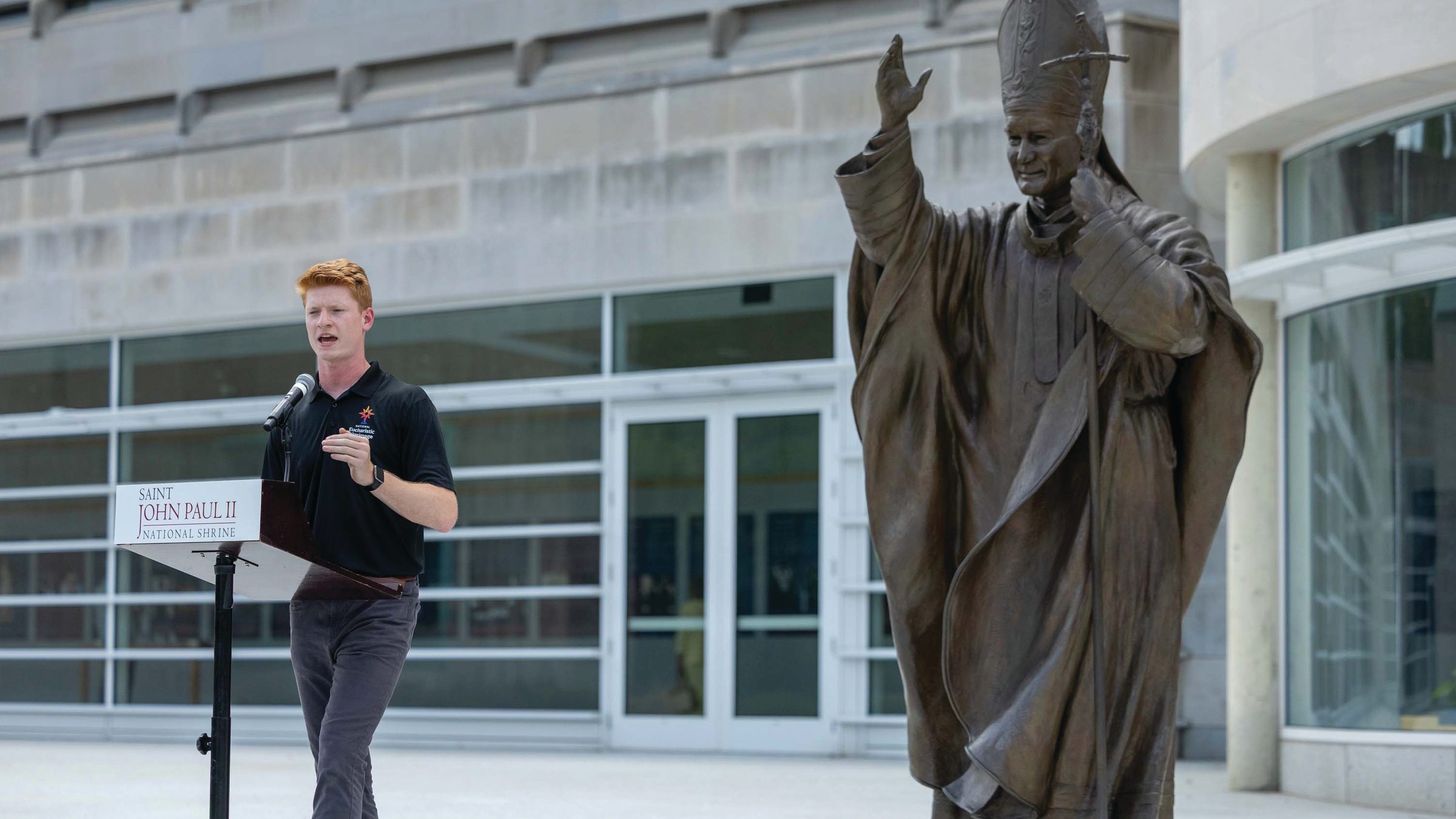
The pilgrimage also brought Flynn back to the Saint John Paul II National Shrine, a place he visited many times as a student at The Catholic University of America. He was there to speak about his experience as a perpetual pilgrim. He gave his talk near a towering bronze statue of the pope whose name he bears.
“I really feel like St. John Paul II’s presence was right there next to me,” Flynn said. “Walking me through my speech and interceding for my success.”
In Philadelphia in early July, Flynn lingered over every step. Six weeks earlier, the city had seemed impossibly far away. Now it had arrived almost too quickly. For weeks, Philadelphia had been the answer Flynn gave whenever anyone asked where the pilgrimage was headed. The perpetual pilgrims were finally there as the nation prepared to mark the 250th anniversary of the Declaration of Independence.
Looking back, Flynn said the pilgrimage taught him something about Christ’s love.
“Jesus was trying to show me His unconditional love,” he said. “His unconditional love for me, for you, for the homeless man on the side of the street.”
Eventually, the miles ran out.
The trailer was unloaded. The carry-on suitcase that had traveled through parish halls, retreat centers and borrowed bedrooms across 13 states was unpacked for the last time.
Back at The Catholic University of America, the road no longer began before sunrise. If Flynn wanted to spend time before the Blessed Sacrament, he had to make the deliberate walk to the chapel for Eucharistic Adoration.
Asked how the pilgrimage changed him, Flynn didn’t hesitate.
“My relationship with Christ became more personal,” he said.
He paused.
“Like a friendship.”