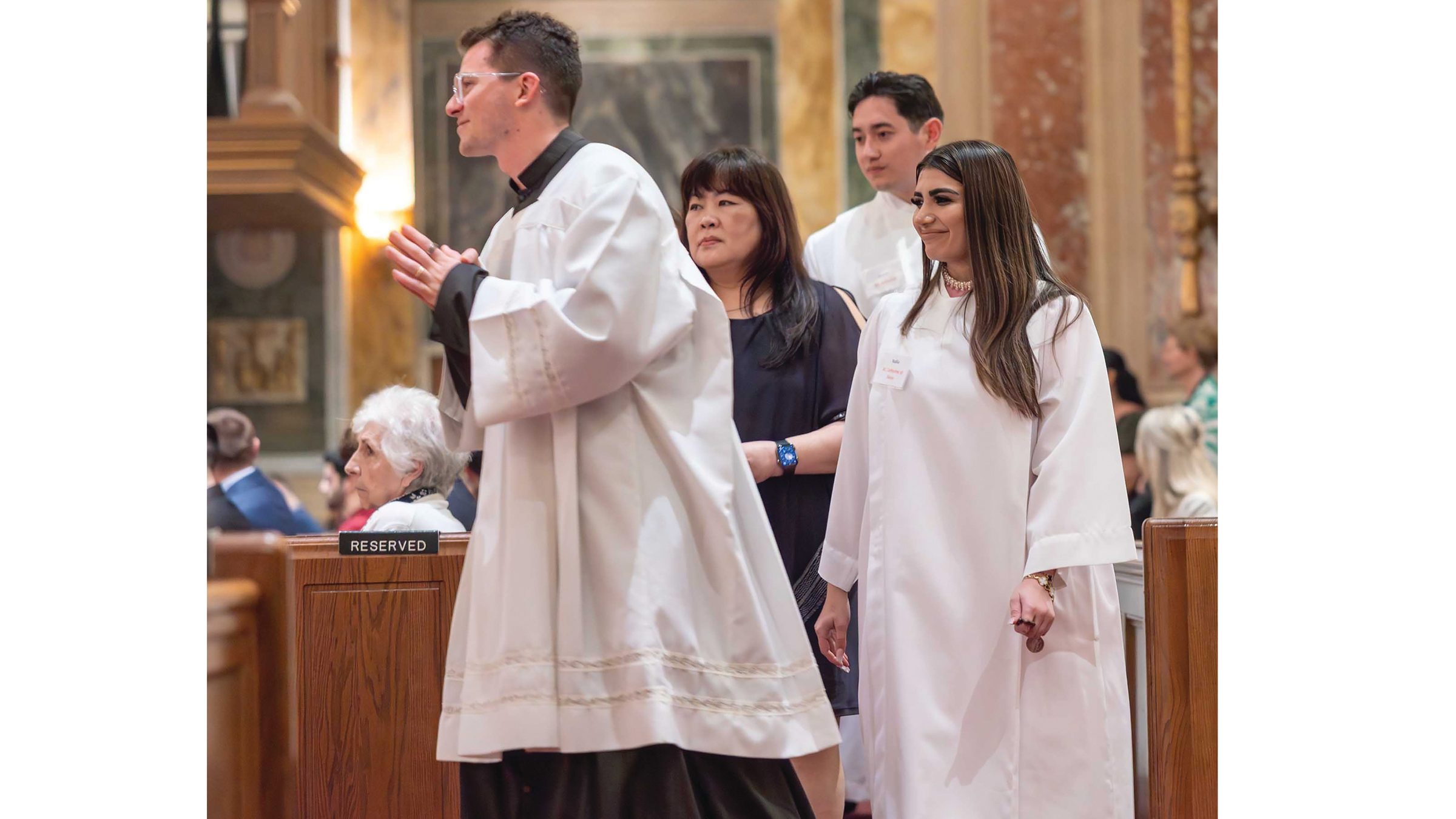

Before becoming Catholic at the Easter Vigil on April 4 at the Cathedral of St. Matthew the Apostle in Washington, Nadia Zafari grew up in Iran, where “religion is enforced by law and deeply embedded into every part of life,” she said.
Zafari – who was baptized and also received the sacraments of Confirmation and Eucharist at the Easter Vigil – shared the story of her faith journey in an email interview with the Catholic Standard newspaper.
“I have come to believe that every path in my life was meant to lead me here,” she said, reflecting on her newfound Catholic faith.
She and her family had moved to the United States when she was 13, after winning a Green Card Lottery in their native Iran. Now after earning a master’s degree in industrial organizational psychology, the application of psychology and science to the workplace, she works in recruitment and hiring for the government.
As a child growing up in Iran, she never identified as being Muslim, and she had no exposure to Christianity or the Bible.
“Despite that, I formed a very deep connection with God at a very young age,” Zafari said. “As early as five years old, I remember having vivid dreams where I felt God’s presence clearly, and I immediately opened my heart to Him. In one of those dreams, I was shown that I would one day live in America with my family and be freed.”
But as she grew older, she was warned that believing that she had a direct connection with God and was being guided by Him was unhealthy and “could get me into serious trouble,” she said, adding, “What affected me most was being completely alone in what I believed. No one around me thought it was possible for a person to have a direct relationship with God… Because of this, my relationship with God became something I had to keep entirely private, a deep secret.”
Prayer became a safe harbor for her during that time in her childhood.
“Every day, I intentionally set aside hours of time alone in my room so I could pray and connect with God safely in that hidden space. That time became the highlight of my day. It was the only place where I could experience peace, love, and hope for a future that felt completely out of reach when the world around me was filled with chaos,” Zafari said.
During that time, people around her worried that she spent too much time alone. “They didn’t understand that those moments were what allowed me to keep going. Even then, I was not afraid to stand firm in what I believed. My relationship with God mattered more to me than fitting in, being understood, or avoiding prosecution,” she said.
Recalling some experiences where her belief was tested, Zafari said that in elementary school, children had to participate in Islamic religious practices.
“At nine years old, I was forced into a ceremony that marked adulthood in Islam and was told that from that moment on, I was expected to fully practice the religion or face serious punishment in both this life and the afterlife,” she said. “Even as a child, I knew something about that did not feel right. I already had a relationship with God, and I knew that pretending to follow something I did not truly believe in just to avoid consequences would be dishonest.”
When she was a sixth grader, her class was told that in order to go on a field trip, they all had to attend afternoon prayer at the school mosque. While her classmates rushed in, she stood outside.
“I knew that stepping into that mosque and pretending to pray would go against everything I believed. It wasn’t an act of rebellion, but a decision rooted in honesty. I could accept punishment, but I could not accept knowingly doing something sacred without truly believing in it. I was the only one who refused,” she said.
Then as the other students went on the field trip, she was left behind at the school, and her Islamic studies teacher stayed with her. But instead of reproaching her, the teacher shouted in frustration at what the school had done.
“She told me that prayer should never be forced, and that it should come from a genuine desire to be close to God. She praised me for being the only person who honored and respected God in that moment and reassured me that I would not be punished,” Zafari said. “Looking back, I believe that was a moment when God worked through someone I expected to punish me, to protect me, because I chose to honor Him.”
Later when she was a young teenager, her family was able to immigrate to the United States. “I had always believed that what God showed me in my dream was bound to come true,” she said.
Zafari said people told her that “I was lucky to be moving to a place where religion was no longer forced and advised me to stay away from it entirely so I could live a happy life. For a long time, I did stay away, not because I didn’t believe in God, but because I didn’t think I would ever find a faith that reflected the relationship I had already built with Him.”
But she said everything changed two years ago, when she was working part-time at a country club and saw a large family gathered together to celebrate a girl’s First Communion, and then they were joined by a priest who sat with them.
“That moment affected me deeply,” Zafari said. “I found myself tearing up as I watched the celebration unfold. I realized that what I had been deprived of my entire life was not just community, but the ability to live my faith openly without fear alongside others, especially religious leaders. In that moment, I realized it was not too late for me to build that life for myself. That is when I knew I wanted to become Catholic.”
When Zafari participated in the Rite of Acceptance this past October at St. Matthew’s Cathedral, that marked the first time she had ever stepped in a church. “I have always held God close to my heart, and I wanted my union with Him to happen in a meaningful way, on His timing,” she said.
Preparing to become Catholic, she took part in the Order of Christian Initiation of Adults classes there, not knowing anything about Catholicism or what to expect.
“I never imagined that Catholicism would align so closely with the faith I had built in my heart thousands of miles away from the Church,” Zafari said, adding, “This has been an incredibly spiritual journey for me. Not only have I learned that the God I was defending in Iran is real, I have finally found a place and a community that accepts me.”

Reflecting on her faith journey, she said, “I don’t think anyone truly understands how hard I searched my entire life to find this. There are no words to fully describe how fulfilling my life has become since starting OCIA. The relief of no longer having to keep my relationship with God a secret, no longer needing isolation just to pray, and finally having a community I can pray with – it all feels incredibly freeing.”
Zafari said her decision had implications for her ability to return for a visit to Iran.
“I came to realize that the moment I chose to join the Church, I had already accepted exile. In choosing my faith, I let go of my attachment to being able to return home freely,” she said.
Referencing the current war that the United States and Israel are waging against Iran following the widespread protests and slaughter of tens of thousands of Iranian demonstrators earlier this year, Zafari said, “…For the first time in 47 years, there is real hope that my homeland may become free. That would not only allow me to visit my family, but also make it possible for them to visit me.”
She added that, “This past year has been very challenging for me. There was a two-week period in January when my family faced Internet blackouts in Iran, and I was unable to reach them or check on their well-being. Even now, as I write this, they are experiencing an extended blackout in the middle of the war. During these moments, the Lord has worked through OCIA and the community to give me strength, stability, and peace in the middle of deep uncertainty. I never thought I could endure this much pain and uncertainty and remain whole.”

Asked about her goals after the Easter Vigil, Zafari said, “Joining a community that shares my faith has been a lifelong goal of mine. I never really thought about what I would do after finally finding it. I know that I will be prioritizing my faith and serving the community through acts of service. This journey has made me realize that the most meaningful moments in my life have come when I least expected them. The fulfillment I’ve experienced through the paths God has guided me on is something I could never have created for myself.”
Zafari said that through her faith journey, “I have learned to let go of control. I am excited to see where the Lord takes me from here. I believe there is still more for me to discover about my purpose, and I remain hopeful that one day I will fully grow into the person I am meant to be.”
During this time, she has come to realize that “this journey is not just for me. Before everything happening in Iran, some of my friends had started to feel drawn to the Catholic faith as well,” she said, adding, “If one day they are free to explore that path, I hope I can walk alongside them and be part of their journey the way others have been part of mine.”