
An historical coincidence added meaning and poignance to the Juneteenth Family Day, titled “Lifting Legacy, Revealing Truth,” held on June 19, 2026 on the grounds of Sacred Heart Catholic Church in Bowie, Maryland.
The Juneteenth national holiday on June 19 commemorates the day in 1865, more than two months after the Civil War ended, when U.S. Major General Gordon Granger issued an order informing the people of Texas that all enslaved people there were now free.
And on that same day 27 years earlier, on June 19, 1838, the Maryland Society of Jesus, the Jesuits, signed an article of agreement to sell 272 enslaved men, women and children to two sugar plantation owners in Louisiana, a sale that helped ensure the financial survival of Georgetown College, now Georgetown University.
That infamous 1838 sale provided a backdrop to the Juneteenth Family Day, because many of the enslaved in the transaction came from the White Marsh Plantation, one of seven Jesuit missions in Maryland during that time, and the present-day Sacred Heart Church and its historic chapel and cemetery are located at that site. In recent years, archaeological surveys on the cemetery’s hillside have uncovered what are believed to be the unmarked graves of hundreds of enslaved people who lived, worked and died at the White Marsh Plantation in the 1700s and 1800s before Emancipation.
“It’s remarkable that the day of this tragic event (the 1838 sale) also marks the day we celebrate freedom for all Americans in the United States,” said Kevin Porter, a descendant of ancestors enslaved by the Jesuits at their Maryland plantations who is the president of the White Marsh Historical Society.

In an interview before the Juneteenth Family Day’s morning session, Bishop Roy E. Campbell Jr., a retired auxiliary bishop of Washington, noted the coincidence of the June 19 dates, saying it was “providential” that the day when those 272 enslaved people in Maryland were sold would years later be the same day when enslaved people in Texas learned they were finally free.
That point was echoed by Dr. Lynn Locklear Nehemiah, another descendant of ancestors enslaved by the Jesuits in Maryland who is a founding member of the White Marsh Historical Society.
“I believe God ordained this. He’s always about restoration and healing. He brought us to this day for this purpose,” she said, noting that the people participating in the gathering included descendants of enslaved ancestors and descendants of slaveholders.
The Juneteenth Family Day was sponsored by the White Marsh Historical Society and Sacred Heart Church, and it was supported by a MD Two Fifty grant submitted by the Sacred Heart/White Marsh Cemetery Vision and Design Subcommittee. The Maryland commission is supporting efforts to promote the state’s contributions to American history as the nation marks its 250th anniversary.
Nehemiah, a retired dentist who serves as the chair of the White Marsh Cemetery Vision Design and Memorialization Committee, noted the committee includes descendants of the enslaved and emancipated communities associated with the White Marsh plantation, and one of its objectives has been to create a permanent memorial at White Marsh to honor the uncompensated labor that the enslaved provided that undergirded the Jesuits and their outreach during colonial times and in the nation’s first century.
The Juneteenth event included the unveiling of four storyboards alongside the walkway leading to the Sacred Heart Chapel and near its cemetery that are part of a White Marsh African American Heritage Trail telling the story of the White Marsh Plantation, slavery and resistance there, how the cemetery was sacred ground for generations of African Americans, and how descendant communities reflect the enduring strength of their ancestors.
‘Their lives always mattered’
In an interview before the morning session, Father Michael Russo, the pastor of Sacred Heart Parish, said it is an honor to welcome the descendants of those who were enslaved at the White Marsh Plantation, to hear the stories of their families “and to work together with them to tell the history of Catholicism in Maryland.”
He praised their enslaved ancestors, noting how they kept the faith in Christ and in the Catholic Church through oppression, even at the hands of “those who should have been leading them to Jesus.”
“They’re our brothers and sisters, and they are part of the communion of saints, and we want to know as much as we can about them, honor them, pray for them, and get them to pray for us,” he said.

Kevin Porter in an interview praised those enslaved ancestors as survivors who at the Maryland plantations and then in Louisiana “from the first light of dawn to sunset had to work under horrific conditions.” He added that “when they were living, they were denied their dignity as human beings. Their lives always mattered.”
The White Marsh Historical Society, he said, works to “restore their dignity and reconstruct their families… to honor their resilience and keep their legacy going forward for future generations.”
Porter, whose enslaved ancestors include members of the Queen family, said to this day, many of their descendants are Catholic. “They kept the faith. This brought a sense of community, even in slavery,” he said.
Commenting on that legacy of faith, Bishop Campbell said that Black Catholics and other Black Americans have historically relied on their faith. “They believe that God will make things right… and that is the faith that keeps them going.”
Bishop Campbell has helped lead the Archdiocese of Washington’s initiative, “Honoring Those Who Were Enslaved: Do Justice, Love Goodness and Walk Humbly,” which has an action plan that includes providing access to sacramental and other records to assist descendants of the enslaved in discovering their family history, and funding a public monument to commemorate contributions of enslaved peoples to the Catholic Church in Maryland.
The bishop stressed the importance of “trying to show honor to those who were treated so unjustly in their lifetime.”
‘We were united through this history’
In another interview before the morning session, Henrietta Pike – a nursing supervisor at MedStar Southern Maryland Hospital Center in Clinton who is also a descendant of ancestors enslaved by the Jesuits – said, “We are here building our future… We’re looking out for our ancestors’ legacy.”
Pike, a member of Our Lady Help of Christians Parish in Waldorf, noted how members of the descendants’ community have come together to support each other. “We’re coming together as cousins,” she said, later adding, “It’s not only about our ancestors, it’s about helping each other heal… We were united through this history.”

As she welcomed people to the morning session of the Juneteenth gathering that was held in the parish hall at Sacred Heart Church, Lynn Nehemiah said, “We’re here to celebrate and honor our enslaved ancestors who lived and labored on this plantation for generations.”
After leading the group in praying the Our Father together, she said, “This is a day of healing, a day of reconciliation, and a day of redemption.”
Standing near a banner listing the names of hundreds of enslaved people who lived at the White Marsh Plantation, Kevin Porter said, “They weren’t just names on a ledger, they were parts of family networks, not only at this site, but at the other plantations throughout Maryland and the Chesapeake.”

He then introduced a video produced by the White Marsh Historical Society, in remembrance of the enslaved at that plantation. In the video, the names of those men, women and children were scrolled as mournful music played, and occasionally actors wearing period dress portrayed some of the ancestors. As it concluded, the video noted that between 1719 and 1864, more than 400 people were enslaved at White Marsh, including some whose names are lost to history.
“We honor their names, speak their names and honor their legacy,” Porter said.

Then Robin Proudie, a descendant of enslaved ancestors who is the founder and executive director of Descendants of the St. Louis University Enslaved, noted that research has uncovered how in 1823, three enslaved couples from the White Marsh Plantation were transferred to St. Louis to support the Jesuits’ building projects there, and 16 more enslaved people from White Marsh were also forced to relocate there in 1829.
Three pillars guide her group’s work – remembrance, restoration and reparative justice.
Proudie noted how she has come to know cousins who are fellow descendants related to those enslaved ancestors separated from their family members in Maryland when they were brought to St. Louis. “This is why this is so important, because it’s the restoration, it brings families together who were separated during this horrible diaspora,” she said.
After she spoke, descendants of enslaved ancestors were invited to stand up, and the audience applauded them.


The next speaker, Adam Rothman – a professor in the Department of History at Georgetown University and the director of Georgetown’s Center for the Study of Slavery and its Legacies – said serving on a working group there 10 years ago studying the university’s and the Jesuits’ historic connections to slavery “was a life-changing opportunity.”
He said those links to slavery were never a secret – scholars have written about that for the past century, and the university taught courses on it – but when the working group started publicizing its findings, “it came as a shock and revelation to most people in the Georgetown community and beyond.”
That convinced him “to make a commitment to researching and understanding this history, and trying to tell it to anybody who will listen,” he said.
Rothman said he was honored to be at the Juneteenth event and participate in “this descendant-led project of research, understanding and reconciliation.”
‘The irony of the day’
Noting the “irony of the day,” as they gathered to celebrate the June 19 holiday, on the same day “that is so bittersweet for us,” since it is also the date of the 1838 sale of the Maryland Jesuits’ enslaved community, Rothman said he wanted to reflect “both on the history of slavery connected to this day, but also the aspirations for freedom.”
The Georgetown professor pointed out that while the nation is about to celebrate the 250th anniversary of the Declaration of Independence, the White Marsh Plantation has a nearly 300-year history, dating to 1729 when James Carroll, a merchant and planter, bequeathed his land holdings and enslaved laborers to the Jesuits in Maryland. Part of that property, he said, became the White Marsh tobacco plantation, “a site of the life, labor and death of enslaved people, as well as one of the central sacred places of the Maryland Catholic community.”
“By the time the 1838 sale rolled around, the enslaved families at White Marsh had been there for generations, and for generations this had been their home,” he said.
Rothman noted that the down payment from that sale “was used to pay off the crushing debts of Georgetown College. I would not be standing here with you today as a historian of slavery at Georgetown… if it were not for the sale of your ancestors, and that is a humbling thought to me.”

The historian added that “what’s so striking about the 1838 sale is that this was a community of families, of co-congregants, of Catholics, and the Jesuits knew this.”
While researching the White Marsh sacramental records, Rothman said he was struck by the documentation of an 1832 marriage between John Queen and Nancy Harrison, who were both enslaved at White Marsh. Six years later, John and Nancy Queen and their 4-year-old son Patrick were among the names of the enslaved people in the 1838 bill of sale, and that fall they were transported on a ship called the Katherine Jackson from Alexandria, Virginia to New Orleans.
“I tell my students if you can understand how the Jesuits could baptize the people they owned one day and sell them the next, then you understand American slavery,” he said.
Rothman said the Georgetown Slavery Archive is also a freedom archive, because it documents the aspirations for freedom among the Maryland Jesuits’ enslaved community, including petitions and contracts made by the enslaved to try to purchase their freedom.
The origin of Juneteenth in June 1865, he said, offers a reminder how the promise of the Emancipation Proclamation that Abraham Lincoln issued two and one-half years earlier on Jan. 1, 1863 unfolded differently in different states, including for the enslaved communities in Maryland and those who had been transported to Louisiana.
“This history really shows you the gap between paper promises of freedom and the realization of those promises,” Rothman said, adding that, “I would say we are still living in that gap, and I hope some day we’ll close it.”


‘That struggle continues today’
In his remarks, Irving Gaither – the treasurer of the White Marsh Historical Society – noted that the points that Frederick Douglass made in his famous 1852 speech, “What to the Slave is the Fourth of July?” still ring true today. The abolitionist and orator said that for the enslaved, Independence Day was a day of mourning, a day of cruel mockery, and a day to expose hypocrisy.
“That struggle was our ancestors’ struggle, and it is time for us to pick up that struggle,” Gaither said.
After the 1838 sale, the Jesuits’ Maryland enslaved community members transported to Louisiana “were forced into the brutal, life-shortening labor of Southern sugar plantations… We remember that our ancestors’ struggle was real, and that struggle continues today,” he said.
Gaither noted that the storyboards about to be unveiled that day were researched and produced by descendants of enslaved ancestors from White Marsh and other Jesuit plantations in Maryland.
“Let us not forget. Let us pick up these stories and continue to tell them,” he said, as he also encouraged the descendants “to understand how much we have in common with our cousins and embrace them.”


Then the participants walked up the hill for the unveiling ceremony of the storyboards next to the Sacred Heart Chapel. They walked past a bronze monument on the side of the chapel that noted how at that chapel in White Marsh in 1789, Georgetown University was planned, and Father John Carroll was elected as the first Catholic bishop of the United States. Bishop Carroll led the Diocese of Baltimore which then included all 13 original states.
Later that afternoon, the Juneteenth Family Day would also feature a musical performance by Faith Mussa from Malawi, an elder’s circle, a genealogy workshop, a presentation on White Marsh history, children’s crafts and field activities, and food trucks and vendors.
Among those attending the unveiling ceremony was Rose Elliott, a retired D.C. school teacher from Upper Marlboro, Maryland who held a copy of the death certificate of her third great uncle, Washington Jackson, a farmer who died at the age of 95 in 1937 and was buried at the White Marsh cemetery.
“I’m anxious to find out more,” she said regarding her family’s heritage. Noting the names of the enslaved White Marsh community members on the banner displayed at the morning session, she said, “We have those names in our family.”


Unveiling ceremony
At the unveiling ceremony, prayers were offered by Bishop Campbell and by Pastor William Spence of the Harvest Life Fellowship in Washington. Then the storyboards were unveiled, telling the stories of the enslaved ancestors at White Marsh, their legacy and their descendants. (See related sidebar story at the end of this article.)
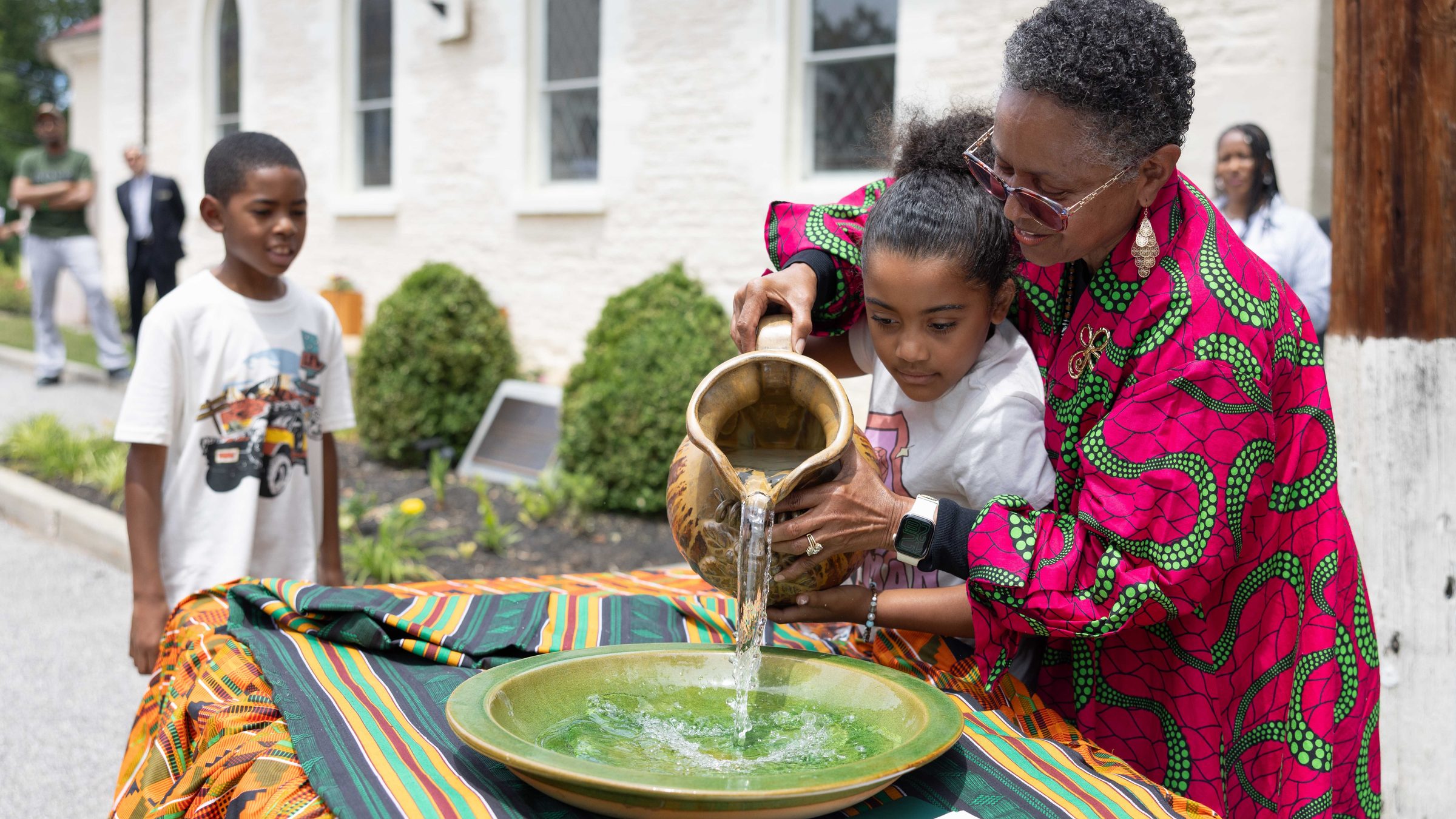
Fran Hawkins – a member of St. Peter Claver Parish in Saint Inigoes, Maryland, who is a descendant of enslaved ancestors from the Jesuits’ Maryland missions – then performed a traditional African libation ceremony, pouring water to honor the spirit of the ancestors known and unknown, who are buried in graves marked and unmarked at the Sacred Heart cemetery.
“We pay tribute to them for making a way for us, by the grace of God, who makes a way where there is no way,” she said.
Hawkins encouraged the people gathered there to call out the names of their ancestors as she poured the water.
“We pray for the souls of our ancestors who were inhumanely enslaved on this and other grounds… especially those enslaved by the Jesuits and the Catholic Church, that their souls may rest in peace,” she said.
Lifting up the legacy of the ancestors, Hawkins said, is a way to reveal “the truth about them and us.”

Also after the unveiling ceremony, two singers – brothers Matthew and Joshua Maxwell – led the participants in singing “Lift Every Voice and Sing” – the song written by James Weldon Johnson that is known as the Black national anthem.


Then people lined up to view the storyboards. Bruce I. Campbell – a retired federal worker who is a member of St. Catherine Laboure Parish in Wheaton – noted that his grandmother, Emma Fletcher Campbell, is buried at the Sacred Heart cemetery, but he has been unable to find her gravesite.
Campbell, who is a visual artist, said he appreciated the Juneteenth gathering honoring the legacy of the enslaved ancestors, and the opportunity to see family members.
“There’s still so much more that needs to be uncovered,” he said.
Storyboards on White Marsh African American Heritage Trail
Here are highlights from the four storyboards unveiled during the Juneteenth Family Day on June 19, 2026 along the walkway leading to the historic Sacred Heart Chapel in Bowie, Maryland. The storyboards are part of the White Marsh African American Heritage Trail, an effort of the White Marsh Historical Society and Sacred Heart Catholic Church in Bowie.

White Marsh Plantation
This storyboard notes that in 1729, “the wealthy merchant-planter James Carroll bequeathed his land holdings and enslaved laborers to the Society of Jesus, the Jesuits.” At their White Marsh plantation in what is now the Bowie area, more than 400 enslaved people spanning multiple generations “were forced into labor to help build the Roman Catholic Church in America.”
The storyboard also points out how Bishop John Carroll was elected the first bishop of Baltimore at the White Marsh chapel in 1789, “making him the leader of the Roman Catholic Church in the newly formed United States. Although he spoke out against slavery, Bishop Carroll himself enslaved people.”
Also pictured is a map showing the seven Maryland missions operated by the Jesuits between the 17th
and 19th centuries, including the White Marsh plantation.

Slavery and Resistance at White Marsh
This storyboard notes that “Jesuits enslaved African American families for many generations at White Marsh and other plantations across Maryland. Large, close-knit family units labored in bondage against their will.”
A copy of a newspaper ad from 1795 shows how the Jesuit priest managing the White Marsh plantation offered a reward for the capture of 12 runaway enslaved people. The storyboard also notes how “between 1791 and 1815, court records show that members of the Queen, Thomas and Mahoney families brought freedom suits against Jesuit priests.”
The storyboard also has a reproduction of the 1838 bill of sale listing the names of 272 enslaved men, women and children sold by the Maryland Jesuits to sugar plantation owners in Louisiana. The funds generated from the sale helped sustain the survival of Georgetown College, now Georgetown University, and “kept the struggling institution from financial collapse.”

Sacred Ground
This storyboard notes that “Sacred Heart Cemetery was once the site of the White Marsh Plantation, owned and operated by the Jesuits, in use from 1722 to 1933, where nearly 900 African Americans were buried between 1818 and 1965.”
The Catholic Beneficial Society of White Marsh was established by African American members of the White Marsh Catholic Church in 1885.
Next to a photo and map of Sacred Heart Cemetery, the storyboard notes that
“the Catholic Beneficial Society of White Marsh provided financial assistance to many of the Black families buried at the cemetery. The site reflects a history of slavery, faith, and enduring African American resilience.”

A Community of Descendants
This storyboard notes that many of the families buried at Sacred Heart Cemetery have ties to Maryland’s early Catholic gentry, and points out that ”Charles Carroll of Carrollton, the last surviving signer of the Declaration of Independence… relocated several enslaved families to what became the White Marsh mission,” and they later formed kinship ties with enslaved people on nearby plantations and remained Catholic.
Also noted in the storyboard is that “after Emancipation, men, women and children from these communities came together to forge new lives. The White Marsh Catholic Church became their central meeting place – a beacon of hope and continuity.”
The storyboard includes a group photo of descendants of families buried in the cemetery, and points out how over the years, some of those families lived near White Marsh, while others migrated to surrounding communities and to Washington, D.C. The storyboard says that “their lives reflect the enduring strength of a generation rooted in Maryland soil, whose descendants now flourish across the United States.”