This past Easter season for Father Stephen Wong was a time of recuperation and reflection following quadruple heart bypass surgery for the retired U.S. Army intelligence officer.
Ordained two years ago as a priest of the Roman Catholic Archdiocese of Washington, the 64-year-old Father Wong underwent five hours of surgery March 12 at Johns Hopkins in Baltimore after complaining of tightness in his neck while taking his daily rosary walks. His surgery was weeks after the loss of his older brother from a head injury sustained in a fall in Florida.
“You walk, but your heart is heavy. You believe, but you don’t understand. You trust, but you are shaken. That is the road to Emmaus,” Father Wong told the congregation of Nativity Catholic Church in Washington, D.C., in his first homily post-surgery. “Suffering is not failure. It is the path to glory.”
While recovering at the priests’ residence at Our Lady of Mercy in Potomac, Maryland, where he spent his first year as a priest, Father Wong shared that being confronted with his own mortality has given him more clarity in his mission as a priest.
“As I was going under the anesthesia, all I heard was: ‘Remember, you are not alone,’” Father Wong recalled a priest friend who accompanied him saying. “I went into surgery with such calmness, such confidence that no matter what happens, I was in the hands of God.”
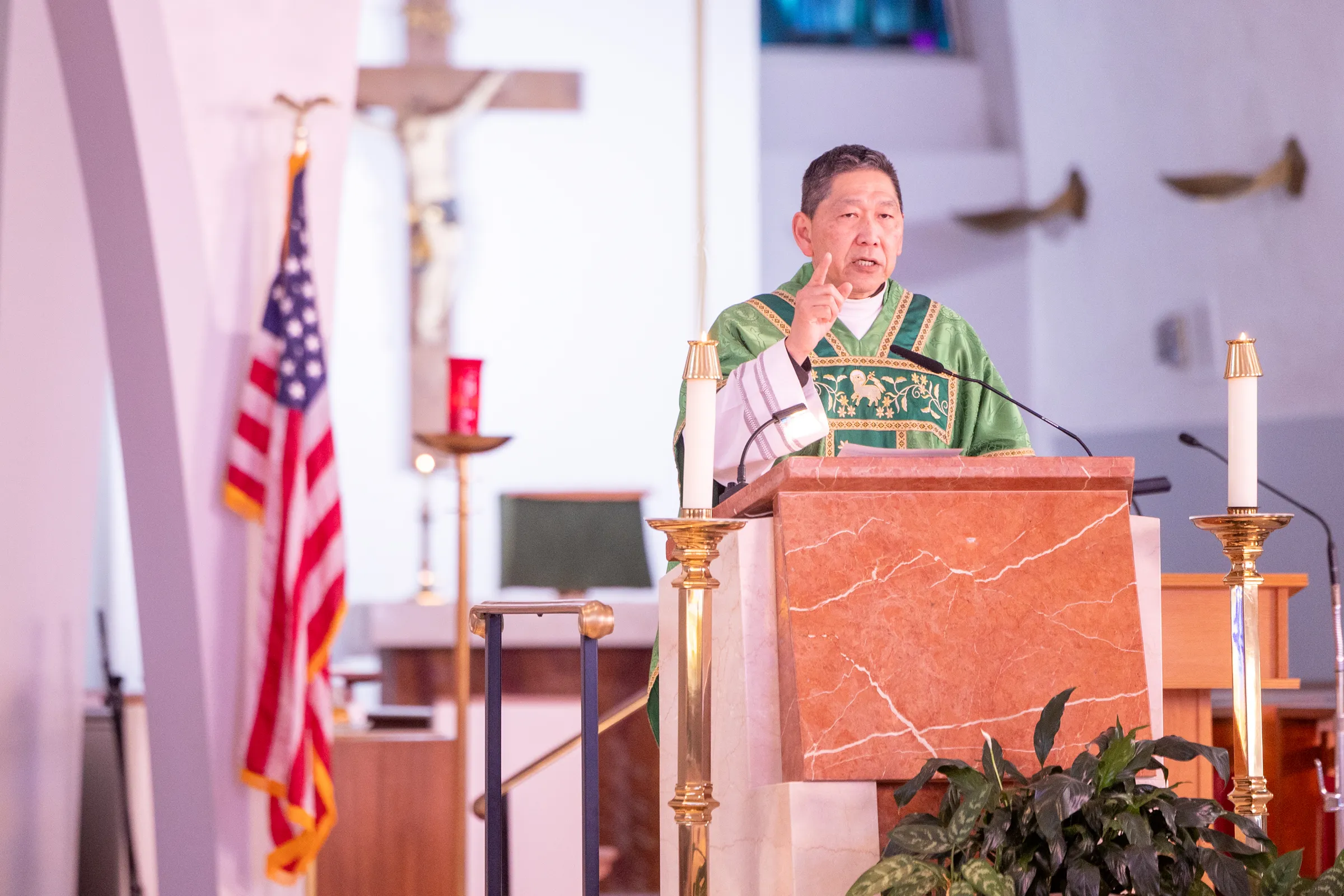
Raised in Jamaica by a single mother, his calling to the priesthood reads like a fictional bestseller: the fifth-generation Chinese-Jamaican grew up in a violent neighborhood in Kingston before fleeing Jamaica at the age of 17 and enlisting in the Army for what would be a distinguished 40-year career.
Chinese-Jamaican ancestry
The future priest’s ancestors sailed to Jamaica from China in the early-to-mid-1800s when slavery was abolished in the British colony and Jamaican sugarcane planters began recruiting indentured laborers abroad in places like China, India and Sierra Leone.
A century later, his 15-year-old mother married his father, who left her while she was pregnant with Steve, born in 1962 and the youngest of three boys.
His youth marked a tumultuous period for the island nation: criminal gangs and political polarization pitted socialism against democracy. When tensions heightened and martial law was declared in 1976, soldiers sealed off neighborhoods to combat the rise in violence.
“From 6 p.m. to 6 a.m., if you were caught on the street, you were automatically shot, no questions asked,” Father Wong said. “It would be 5:30 p.m. as I was leaving high school and the soldiers would be putting out barbed wire on the streets to block the roads for the evening curfew. Once I was inside my house, I would hear gunshots because the soldiers would start automatically shooting people on the road after 6 (p.m.).”
Father Wong recalls that his neighborhood was known as “Little Beirut,” and that he frequently saw violence and shootings, noting it made him tough as a child.
Fleeing Jamaica
The political tensions hit home during his high school years when his mother was arrested at her job after someone turned her in for having American currency, which was illegal at the time. A colleague called and alerted the family that police were on their way to raid their home.
“We had to find all the U.S. dollars that my mom had, which was about $2,000,” Father Wong said. “We took that and dug a hole under the pepper tree (in the yard), and planted it. Then we went and washed our hands and cleaned everything up.”
The police arrived soon after and interrogated the family and ransacked the house. They never found the money, but the family knew then that they would be under scrutiny always and would have to flee for their safety.
It was during this formative time for the future priest, then a 15-year-old sophomore at the Jesuit-run St. George’s College High School in Kingston, that he was befriended by a young teacher who became a de facto father figure.
“He was always very interested in taking an active role in my life and making sure I was keeping up with my scholastic work,” Father Wong said. “I had some good role models among the Jesuits, and something gave me the inclination that maybe the Lord wanted me to be a priest.”
The Jesuits offered refuge to the youngster during a time of volatility on the streets and at home with an uncle who used to beat the three young brothers. In the summer of 1977, his Jesuit teachers encouraged him to attend a three-week aspiring priest program in Boston, where his father figure teacher had been transferred.
“When he left, I felt like I was losing the only father I had,” Father Wong said.
He felt his initial call to the priesthood at this time, but he put things on pause as Jamaica unraveled. He graduated in 1979 from high school, and while he was pondering his future, his family received word that they had been granted permission to emigrate to the United States.
The extended family of eight left Jamaica for a one-bedroom apartment in Orlando, Florida. One afternoon, while people-watching at a shopping mall with several cousins, they played a game of guessing what people did for a career based on their attire. That’s when a man wearing a uniform captured his attention.
He walked up and asked the man who he was and what was that uniform he was wearing. The man was a U.S. Army recruiter, and he struck up a conversation with the 17-year-old, found out he had his green card, and 30 days later, Stephen Wong was in boot camp at Fort Knox in Kentucky.
“I had to get out of that situation (of living in the crowded apartment),” he said. “The Army was the answer. Everything became Army for me. My family became Army. My culture became Army. My identity became Army.”
Into the U.S. Army
Stephen Wong embraced his life as a soldier and the growing responsibilities and recognition that came with it. He reenlisted after his initial four years, realizing “there was no doubt that this is what I wanted to do for a career. What better way to integrate yourself into a new society than to join its military. I met people from all walks of life and experiences. I learned to understand the culture and to be flexible and adapt. It taught me how hard work really pays off.”
The Jamaican native thrived in his new life. In 1982 while stationed at the 2nd Infantry Division in South Korea, he applied for U.S. citizenship. Citizenship opened the way for him to obtain his first of many security clearances and increased his scope of responsibilities and opportunities.
A warrant officer friend encouraged him to pursue a career in counterintelligence. Two years later, Stephen Wong applied for Officer Candidate School and later completed Airborne School. The now 28-year-old was tapped to serve in a Signal Brigade – a role typically reserved for an Army captain, two ranks higher than Second Lieutenant Wong.
In August 1990, Saddam Hussein invaded Kuwait and Wong was selected to go on the advance party to bring a brigade of 4,500 people to Saudi Arabia for Desert Shield/Desert Storm. In 1991, he was assigned to the general staff for a year, after which he returned to Kuwait for another year.
By 1993, when returning to the United States, Wong was assigned to lead a military intelligence company – Delta Company 306, Military Intelligence Battalion in Fort Huachuca, Arizona.
Though he felt destined to be in the Army, the hard charger noted there were times when he was discouraged by those who discriminated against him as an immigrant, and he felt compelled to work harder to prove himself.
“It's things like that that I had to get over as I was growing up and developing in the military, but that just made me stronger,” Father Wong said. “I could not have received or recognized the graces that God has revealed to me as a priest if it wasn't for these experiences,” he said, adding that those experiences have made him more “compassionate, merciful and sympathetic” in his priesthood.
Serving in Army intelligence around the world
In 2000 after 21 years in the Army he retired with the rank of major. The next day he began working as an Army intelligence civilian, supporting U.S. and NATO commanders. He was recognized as a subject matter expert in counterintelligence, human intelligence and counter-terrorism, and served tours in the Persian Gulf, Afghanistan, Iraq, Bosnia, Kosovo, the Netherlands, Japan, Germany, South Korea, and Belgium, and he traveled to most European and Asian countries on the job.
“It was wonderful. I never slowed down. I never had a family. I was engaged twice, but it never came to fruition. I loved the Army so much. The Army was basically my life. I lived a secular life, the life of a soldier,” he said.
In 2016, while deployed in South Korea as a civilian, Stephen Wong began to realize something was missing. Despite career promotions and recognition, he was not fulfilled.
“Every time I got promoted, I would be happy for one day. And the next day, I was like, ‘I want to get a higher rank. It’s not enough. I want more,’” he said.
A wake-up call from a chaplain
During this time frame, the self-described “cafeteria Catholic,” attended Mass once every month or two. His faith had been secondary to him throughout his Army career. One Sunday while in South Korea, he attended Mass. The homily, given by the new Army chaplain, “really hit home. He hit it out of the ballpark,” Father Wong said in a podcast on Catholic Military Life in 2025.
After Mass, he introduced himself to the chaplain, Father Joe Campbell, and the two became friends. A year later, Stephen Wong had his first Confession in more than 15 years with Father Campbell, who shared with him that “if you continue living the way you are living, I don’t think you’ll make it to heaven.”
It was a wake-up call for the future priest, who drew the comparison with Saul when he was knocked off his horse and blinded on the road to Damascus.
“He (St. Paul) became the staunchest advocate for Jesus after his conversion,” Father Wong said. “This is somebody who knew what it was to be wrong and then to make things right.”
Stephen Wong’s conversion was not easy, and it was something he wrestled with for more than two years. When he began having difficulty sleeping, Father Campbell introduced him to the Liturgy of the Hours.
He became devoted to reading it daily and praying for change in his life. One day, while reading Psalm 86, he felt tears running down his cheeks. It was the first time since his Jesuit high school days “that it got my attention focused on (God) again,” he said. Yet as the director of Counter-Intelligence/Human Intelligence for the 8th Army in South Korea, he routinely worked 16-hour days and found little time for much else.
Father Campbell challenged him, saying, “If you can go to the gym every day, why can’t you spend one hour of your week to get to know Jesus more?” The two struck a deal: if Wong started attending a Bible study that Father Campbell hosted, then the chaplain would join him in the gym several times a week. The seed was planted, but duty beckoned and Wong headed to Belgium in 2018 to be the principal counterintelligence advisor to Allied Command Counterintelligence, NATO’s Supreme Headquarters for Allied Forces Europe.
The call to priesthood
His discernment toward the priesthood began in South Korea and continued in Belgium, where he prayed, read Scripture and sat before the Blessed Sacrament as often as time allowed. He wrestled with understanding if what he was feeling was truly a call from God or his own thinking that this was what God wanted.
One day while praying in a chapel in Belgium before Mass, he demanded the Lord show him the answer and clarify his confusion. During Mass, a visiting priest from the Sudan shared his own vocational calling during his homily, and looked around the church pointing his finger saying, “If any of you have been called by our Lord, do not ignore Him.”
The priest’s finger stopped when he reached Wong, who turned around to see if there was someone behind him to whom the priest was pointing. “Don’t turn around, I’m talking to you,” the Sudanese priest said.
That was the moment Wong knew he had his answer. “God has a plan, and it’s on His timing,” he said. “We just have to trust that His will – the way it unfolds – is the way He wanted it.”
Stephen Wong began researching seminaries in the United States. But as a 56-year-old, the hurdles were high. His inquiry was rejected by one West Coast archdiocese based on his age. His chaplain in Belgium then recommended he call the priest who was then serving as the director of priest vocations for the Archdiocese of Washington, Father Mark Ivany.
He called Father Ivany, and the two spoke more than hour initially while Wong was still stationed in Belgium. Father Ivany asked him to meet with him on a future trip to Washington, D.C.
On June 1, 2019, Stephen Wong stepped down from his four decades of Army service to begin a new life of service, attending seminary at Theological College in Washington. Before seminary began, he was asked to do a summer assignment at St. Peter’s on Capitol Hill under Father Gary Studniewski, a former Army chaplain who was then the pastor there and who was later ordained as an auxiliary bishop of Washington in July 2026.
In 2024, Father Stephen Wong was one of 16 new priests ordained for the Roman Catholic Archdiocese of Washington. He was one of three priests over the age of 40 in that ordination class.

The new priest was assigned to serve as a parochial vicar at Our Lady of Mercy Parish in Potomac, Maryland, and he became known for his homilies that reflected on his life in the Army. One year later, he was transferred to serve as a parochial vicar at St. Joseph’s Parish in Largo, Maryland. He returned to Our Lady of Mercy after his bypass surgery in March to aid in his recovery and make him less inclined to reengage in daily pastoral activities so soon after surgery.
The number of cards, letters, texts, emails and phone calls he received during his recovery this spring let him know how much he is loved and the “importance of pastoral care,” Father Wong said. “I’ve had so many people who are suffering and in need. I've seen such miracles of their lives changing because they're willing to accept Jesus and to accept what suffering is.”
Father Wong believes he has also experienced his own miracle. Physicians discovered he had four major blockages – one at 100 percent, two at 99 percent, and one at 80 percent – but his heart compensated by building its own natural bypass through the growth of collateral arteries.
In the days before his surgery, “my faith got even more dependent on God. I told Him that if He wants to take me, I will be with Him sooner. If there’s something else you want me to do, then let it be done according to Thy will.”
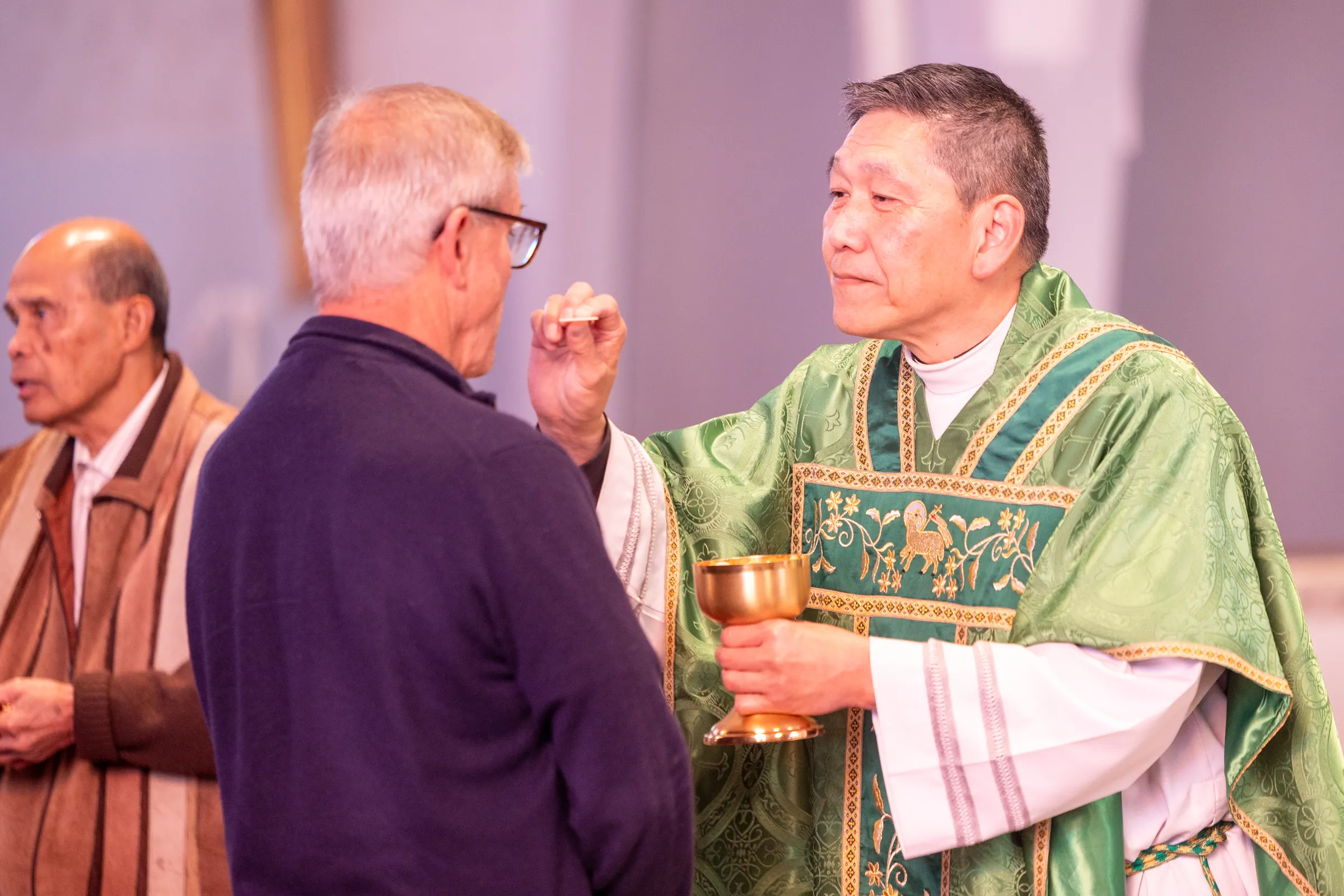
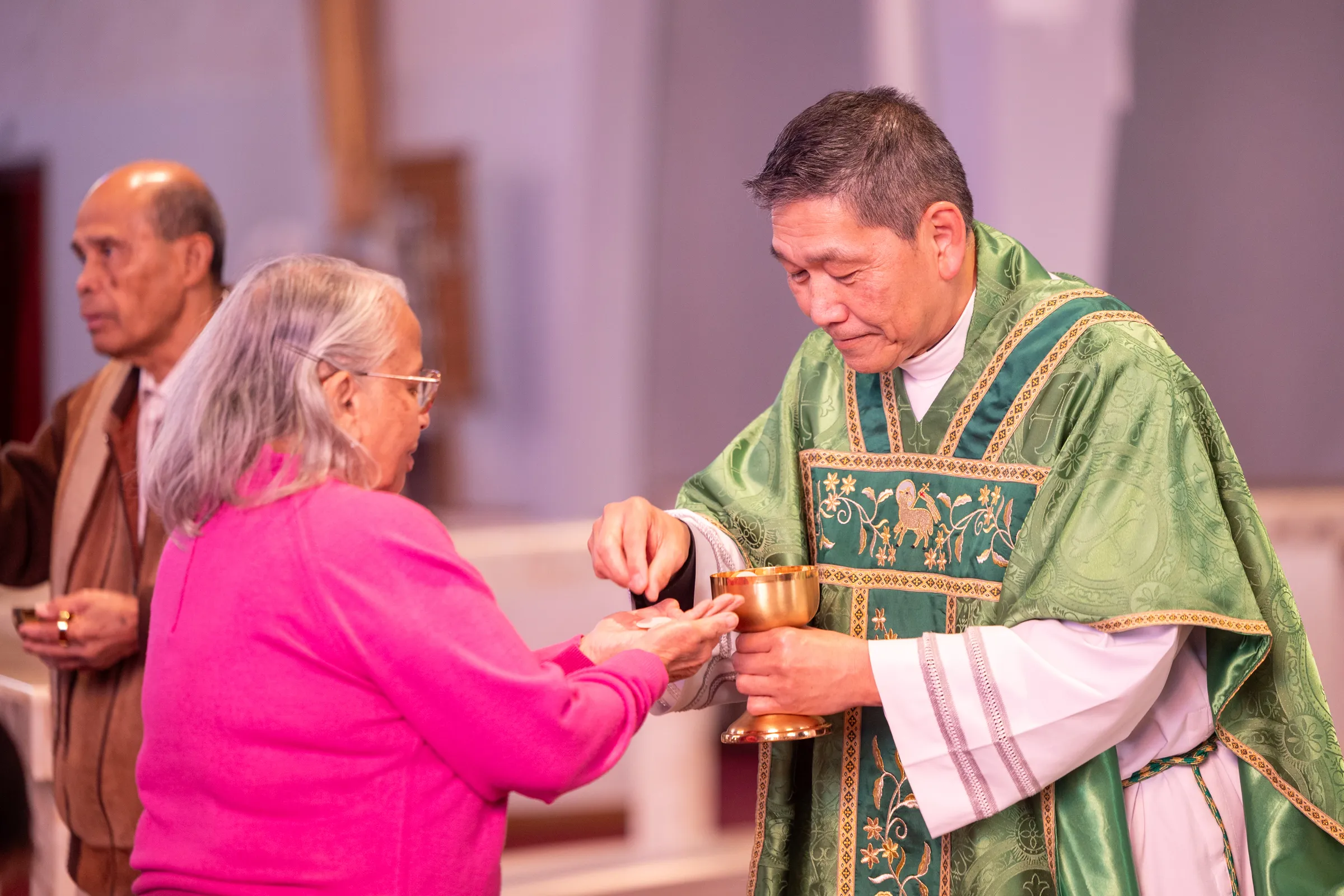
The calmness and clarity of mission for the former soldier has never been more clear.
“My surgery and recovery may have opened in me a deeper pastoral tenderness as I now understand suffering not just theologically, but personally,” said Father Wong, who has served as a parochial vicar at St. Mary’s Parish in Rockville since July. “Before, I spoke about Christ from conviction. Now, I speak about Him from having been carried by Him.”