Seven Black Americans who are being considered for canonization by the Catholic Church are embodiments of the trials and triumphs that form part of the Black American experience in the United States, according to an archdiocesan official speaking at event to promote their cause.
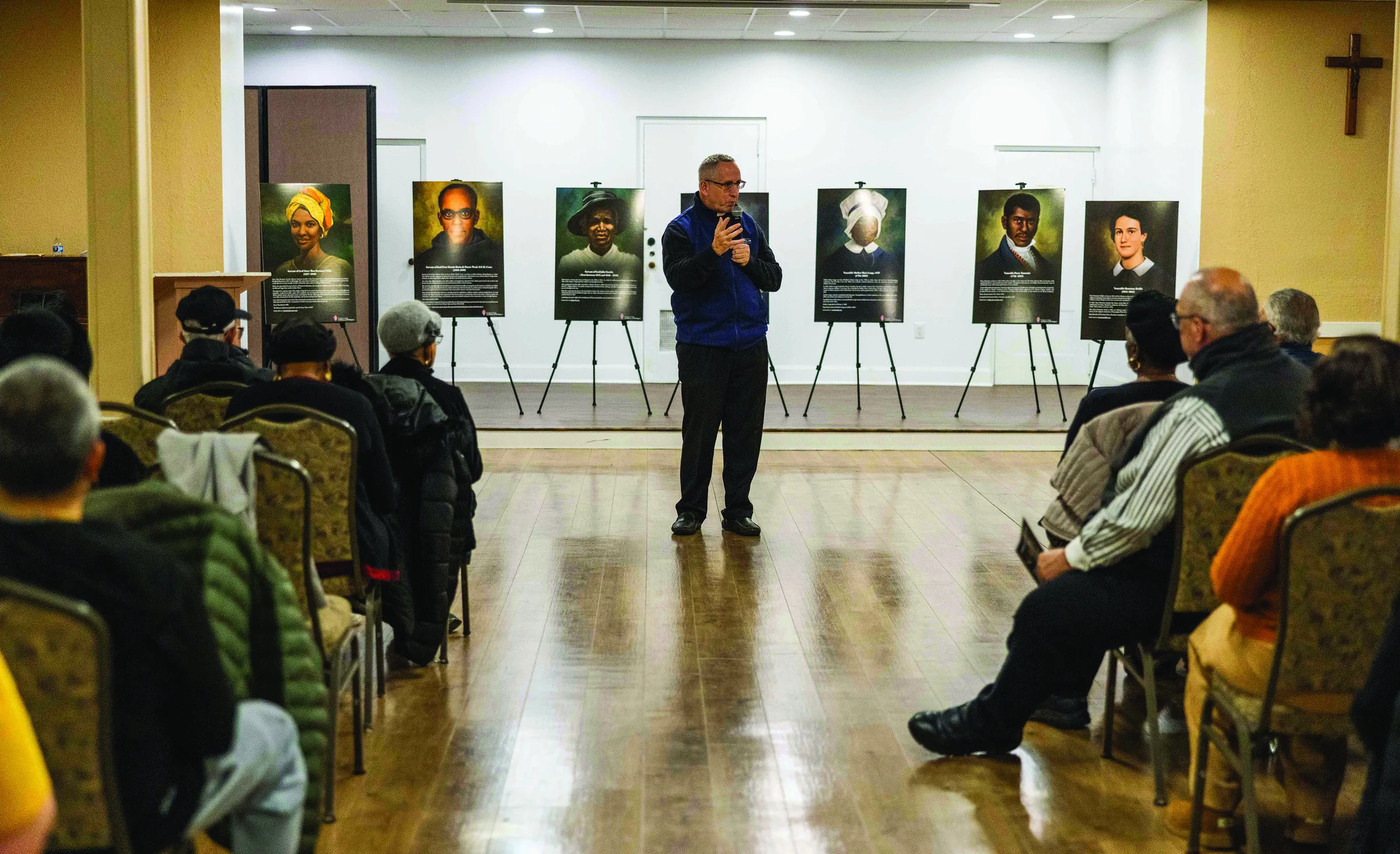
“Adversity does not have the final say. We have the final say over our identity, our purpose, and our relationship with God,” said Wendi Williams, executive director for the Office of Cultural Diversity and Outreach for the Roman Catholic Archdiocese of Washington. She spoke on Nov. 14 at an event to remember the witness of the “Saintly Seven” Black Catholics at St. John the Evangelist Parish in Clinton, Maryland.
Father Daniel Leary, pastor of St. John the Evangelist Parish, offered Mass to begin the event and also offered remarks for the forum following, which took place at the parish hall.
About 60 people from roughly a dozen parishes attended the Saintly Seven event. Father Leary told those assembled that he wants to investigate the parish cemetery using sonar technology to determine if there are unmarked graves, which could include the remains of African Americans buried on the parish property, so that he could place a cross above their graves.
After Father Leary concluded his introductory remarks, one question Williams wanted the attendees to consider was, “What does it mean to each of us to answer God’s call to thrive?”
“Thriving does not mean adversity disappears,” she added.
Williams also pointed out that Black Catholics in the United States are not “monolithic,” similar to the Saintly Seven. Venerable Pierre Toussaint and Venerable Mother Mary Lange were Haitian immigrants to the United States, for example, but the former was a lay person who achieved financial success, while the latter embraced poverty and launched a religious order. Venerable Henriette Delille spent her entire life in New Orleans with a biracial familial background but decided to buck the expectations laid on her by her family and society to become a religious sister. She founded the Holy Family Sisters, while Mother Lange’s order is the Oblate Sisters of Providence.
Servant of God Julia Greeley, meanwhile, was born into slavery and after emancipation lived in Colorado for most of her life, a daily communicant and convert to Catholicism. Venerable Father Augustus Tolton, meanwhile, was also born into slavery and was the first U.S. Catholic priest publicly known to be Black.
Echoing recent advice by Bishop Robert Boxie of Washington, Williams suggested that the participants at the Saintly Seven event select one of the seven canonization candidates, learn more about their lives, and pray for their intercession.
Being declared venerable by the Catholic Church is the first part of a three-stage process toward canonization, with the second step beatification and the third part canonization. Being declared venerable means the deceased person has been formally recognized by the pope as having lived a life of "heroic virtue." Ultimately, to be canonized, the Catholic Church has to document two miracles attributed to the intercession of the candidate.
One former Catholic school principal who attended the Saintly Seven event said that he was drawn to it because three of the Saintly Seven had Franciscan affiliations.
Tobias Harkleroad, former principal at St. Francis International School, is a member of the Secular Franciscan Order who said he has a particular affinity for Servant of God Friar Martin Maria de Porres Ward, as well as Servant of God Julia Greeley, another secular Franciscan, and Servant of God Sister Thea Bowman, who was a Mississippi native and convert to Catholicism who became a Franciscan Sister of Perpetual Adoration.
“Franciscans are continually in a state of penance,” Harkleroad told The Standard. He recently became director of government programs and grants at the Catholic Schools Office for the Archdiocese of Washington. The challenges and difficulties that Servant of God Sister Thea Bowman and Servant of God Julia Greeley encountered, not to mention Servant of God Friar Martin de Porres Ward, a Boston native who had to serve as a missionary in Brazil because he wasn’t welcome to serve in his native country, inspire Harkleroad.
Williams also tried to give a local connection to the event, inviting the participants to make a field trip to the Oblate Sisters of Providence motherhouse in Baltimore, as well as make a pilgrimage St. Peter Claver Parish in St. Inigoes, Maryland.
In his remarks, Fr. Leary made it clear he wants to continue to partner with Williams and her office, and she may visit St. John the Evangelist Parish in several months.