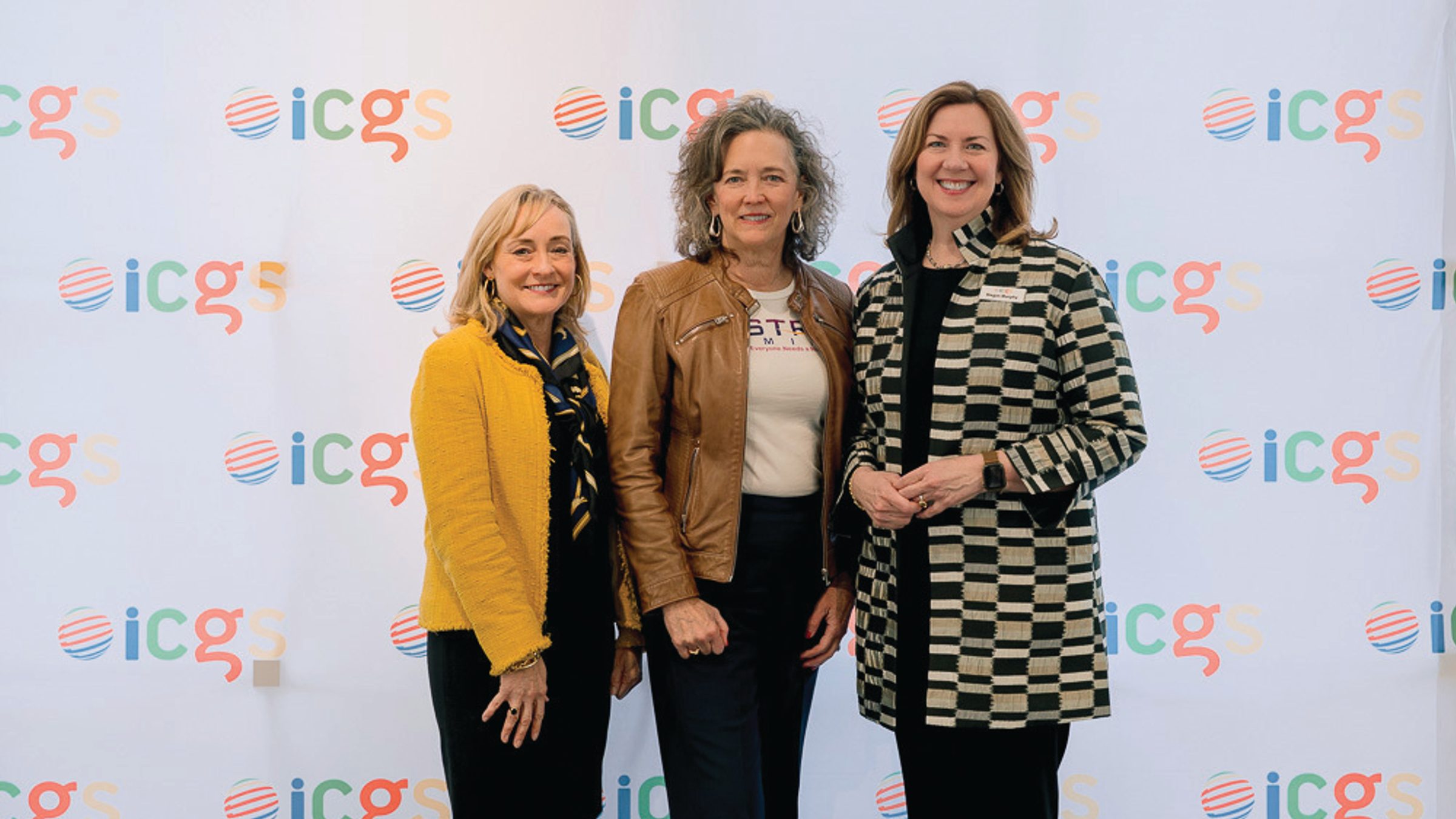

More than 375 educators and students from 43 girls’ schools across the United States, Canada and Guatemala gathered Feb. 6 at Stone Ridge School of the Sacred Heart in Bethesda, Maryland, for a symposium examining women’s leadership, resilience and the distinctive role of girls’ education in forming young women for lives of purpose.
Held in partnership with the International Coalition of Girls’ Schools (ICGS), the daylong event examined how girls’ schools cultivate confident, ethical and globally minded leaders while engaging questions many young women face about vocation, career and family life.
The symposium opened with a welcome from Olympic swimmer Katie Ledecky, a 2015 Stone Ridge graduate, who addressed attendees by video. Ledecky, one of the most decorated swimmers in Olympic history, has won 14 Olympic medals, including nine gold medals.
In her remarks, she credited her all-girls education with shaping her confidence and discipline. Describing herself as “lucky” to have attended Stone Ridge, Ledecky thanked teachers for their support and encouraged educators to continue helping students discover their passions.
ICGS describes itself as a global advocate for girls’ schools, uniting communities “in elevating women’s leadership worldwide.” On its website, the coalition calls gender equity “an urgent, enduring and global imperative” and emphasizes learning environments where girls’ development is intentionally prioritized.
One of the keynote speakers, Dr. Barbara Bell, a retired Navy captain and aviator, traced her journey from small-town Michigan to the U.S. Naval Academy and ultimately to Navy Test Pilot School.

Bell entered the Naval Academy as part of one of its early classes of women, when female midshipmen represented only a small percentage of the student body.
“The law said we could be there,” she said, recalling those early years, “but our experience told us differently.”
She described moments when women were openly questioned about whether they belonged. Rather than leaving, she and her classmates chose to persist.
“We put one foot in front of the other,” Bell said. “Grit and persistence are built one day at a time.”
Of the 90 women who began in her Naval Academy class, 53 graduated. Bell later logged more than 1,600 flight hours in 35 aircraft types, graduated from Navy Test Pilot School and served as a senior program manager overseeing major defense systems. She also joined fellow military aviators in advocating for the repeal of combat exclusion laws, helping open combat ships and aircraft to women.
Today, she teaches ethics and moral reasoning at the Naval Academy and serves on the board of Astra Femina, a nonprofit that connects girls with women leaders in STEM fields.
“I tell my story because girls need to hear it,” Bell said. “When we tell our stories, we change lives.”
The symposium included dozens of breakout sessions led by educators from across the country, including Stone Ridge faculty. Topics addressed student mental health, artificial intelligence, global competence, civic leadership, financial literacy and ethical decision-making.
Several sessions reflected the Sacred Heart tradition that shapes Stone Ridge. The Society of the Sacred Heart was founded in recognition of the vital role women play in both the home and society, and its schools are guided by five goals and criteria: faith, intellect, social awareness and action, community and personal growth.
Catherine Ronan Karrels, head of school at Stone Ridge, said the school’s formation centers on integration of those goals.

“At Stone Ridge, we’re always trying to help our students understand how to integrate those things fully,” Karrels said. “The fullness of their humanity and the gifts that God has given them come alive when they’re able to integrate all of those components.”
That formation, she said, informs how students discern their futures. Professional ambition and family life are not presented as competing callings.
“A vocation in work doesn’t necessarily have to exclude a vocation with one’s family,” Karrels said. “We’re trying to help students navigate a complex world, where both family life and meaningful work are possible.”
Drawing on her experience as one of the early women at the U.S. Naval Academy, Bell reminded educators that many young women will encounter moments when they question whether they belong.
“It is our job to say yes, you do,” Bell said. “You belong.”