
Almost two years after the death of Bishop Mario Dorsonville, a Washington, D.C.-based foundation bearing his name is ensuring that his mission of charity and advocacy continues to live on.
When Bishop Dorsonville died at the age of 63 in Louisiana on Jan. 19, 2024, it came as a shock to his longtime friends. Many had not even known he was sick with liver disease. Some had spoken to him and seen him a few months before his death and never heard about his illness.
Those who knew the bishop and his work mourned his passing. He had risen from serving as a young priest in his native Colombia to becoming the director of the Spanish Catholic Center and an auxiliary bishop in Washington before he was installed as the bishop of the Diocese of Houma-Thibodaux in Louisiana in March 2023.
As the chairman of the United States Conference of Catholic Bishops’ Committee on Migration and as a priest and bishop in Washington, Bishop Dorsonville was well known for his outspoken support for immigrants and passionate service to the poor. The people he served and his friends knew the bishop for his friendly and charming personality, his sense of humor and his personal concern for others. So while obituaries for Bishop Dorsonville were being written, some of his friends in Washington got started on making the Mario E. Dorsonville Foundation a reality.
Meagan Saxon was one of these friends. She’d met then-Father Dorsonville back in 2013 through a young Catholic professionals group. As part of the group, Saxon joined in on trips with the D.C. Homeless Mission that he had started. On Sundays, Saxon and her friends would meet up with Father Dorsonville and drive to parks in Washington, D.C., to serve those experiencing homelessness.
The work was simple, providing shirts, hats, socks, water and food, but with the intention of opening the door for conversation. Saxon said she was inspired by the loving way that Father Dorsonville interacted with those living in the parks.
“He was the best, just beautiful,” she said.

Saxon remembered one night in particular on the first really cold day of winter, when the mission trip encountered a homeless pregnant woman.
“The situation was really intense,” said Saxon. Father Dorsonville “was just so calm and giving advice in a soothing and reassuring way for everyone.” It was nights like those, but also his casual, genuine friendship, that inspired Saxon. She explained that her friend who became a bishop would call her up and just ask if she wanted to have dinner and talk.
“He had an interest in people’s lives,” she said. Eventually, Bishop Dorsonville would preside at Saxon’s wedding as well as the Baptism of her two sons.
Hank Brown, president of the Dorsonville Foundation, remembered similar, deeply personal moments with him.
Bishop Dorsonville “brought a way down-to-earth view of Catholicism,” said Brown. For Brown, some of the most impactful times with him also came over dinners or drinks, which always ended in a joint recitation of the Hail Mary.
Through the efforts of Brown, Saxon and others, the D.C. Homeless Mission was renamed the Mario E. Dorsonville Foundation in July 2024. Ever since, the foundation has hosted biweekly mission trips to serve those in D.C. experiencing homelessness.
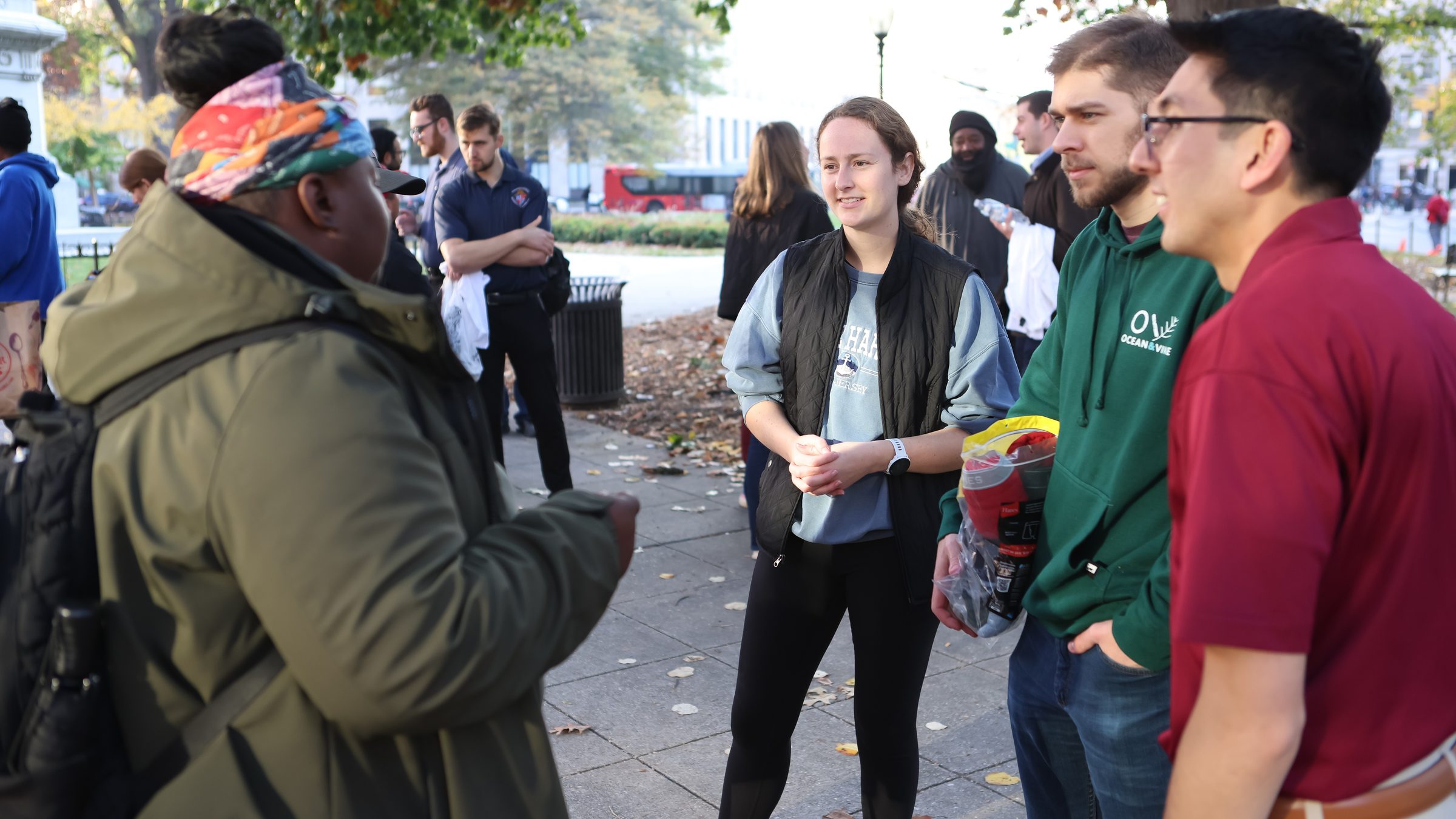
At the foundation’s most recent mission trip on Nov. 9, about 20 participants armed with crates of waters, Slim Jim snacks, belVita biscuits, T-shirts and underwear drove over to Dupont Circle before heading to McPherson Square.


Robert De Marcellus has been volunteering for four years with the foundation, and he believes the most valuable aspect of the trip is the person-to-person conversations that take place with those who “haven’t talked to someone in a while.”
On this Sunday, the group spread out across the parks with many such conversations happening. One man living in McPherson Square named Arthur explained that he appreciates the Dorsonville Foundation’s efforts, especially as it gets colder outside.
Having lived in the park for more than a year, and suffering from arthritis, anxiety and depression, Arthur said he can’t sleep at night and will “do what I need to survive.” Amongst the D.C. Sunday brunch goers sat Arthur, quietly on his bench. These conversations, he explained, help him get through this difficult experience.


The Dorsonville Foundation hopes to expand this mission trip to every week, according to Brown. Each trip costs several hundred dollars, so the foundation is engaged in ongoing money-raising efforts.
At a fundraiser dinner for the Dorsonville Foundation this October, supporters gathered at Cafe Milano in Georgetown to remember their late friend and aid the continuation of his life’s work.
“[Bishop Dorsonville’s] laughter, his energy, his passionate heart are still alive among us,” said Washington Auxiliary Bishop Evelio Menjivar at the dinner. “His legacy continues.”


Bishop Dorsonville was born Oct. 31, 1960, in Bogota, Colombia, the only child of Leonor and Carlos Dorsonville. He began his journey in the Catholic Church at a young age, applying to seminary at just 15. By age 24, he was a priest, and by 26 a pastor of a parish near Bogota. Further education opportunities at The Catholic University of America brought then-Father Dorsonville to Washington, D.C. in 1992. Father Dorsonville served as a parish priest in the Archdiocese of Washington at Our Lady of Lourdes in Bethesda and St. Mark the Evangelist in Hyattsville. He also served as the vice president for mission of Catholic Charities for the Archdiocese of Washington and as the director of the Spanish Catholic Center for 10 years.
In 2011, then-Father Dorsonville was appointed as one of the founding faculty members of the archdiocese’s new Blessed (now Saint) John Paul II Seminary, serving as the adjunct spiritual director for the men studying to be priests. In 2015, he was appointed by Pope Francis to serve as an auxiliary bishop in Washington, and eight years later, the pope named him as the bishop of Houma-Thibodaux in Louisiana.
An immigrant himself, Bishop Dorsonville’s involvement with migrant causes was at the core of his life’s efforts.
“Bishop Mario believed that the Gospel must always have a human face – that face is the face of the one who suffers, the one who hungers, the one who dreams and hopes for a better future,” said Bishop Menjivar.


As the chairman of the USCCB Committee on Migration, one of Bishop Dorsonville’s most publicized moments was his testimony before a congressional committee on immigration and citizenship in 2020. In his statement, he bluntly urged Congress to do more for immigrants and refugees seeking entry into the United States.
“We view assisting those in need as a fundamental Christian duty that is derived directly from the words and the life of Christ, who himself was a migrant and part of a refugee family, and that as Christians, we are called to welcome our new neighbors with the same love and compassion that we would want ourselves to be shown,” said Bishop Dorsonville in his testimony.
It was this willingness to speak boldly on critical issues which caught the attention of many even outside the Catholic Church. In 2021, Washingtonian magazine named Bishop Dorsonville to its “Most Influential People” list alongside CEOs, lobbyists and think tank leaders.
But beyond being a national advocate for immigration reform or a papal appointee or a prominent magazine awardee, Bishop Dorsonville was there for his friends and strangers alike, again and again, to stand up to life’s moments with what was perhaps his greatest asset: that quickly brandished grin.
One story that illustrates Bishop Dorsonville’s sense of humor occurred during the COVID-19 pandemic. With churches closed, he had agreed to perform the sacrament of Confirmation for a friend at a farm in Virginia. On the drive down, running late, the bishop stopped with some of the other Confirmation attendees at a McDonald’s to grab breakfast. “What are they going to do,” he asked, smiling. “Start without me?”
Bishop Dorsonville’s friends and the newcomers continuing his legacy through the foundation’s homeless mission reflect his relentless humanity, selfless engagement and ceaseless faith. As they stop and smile and have a conversation with homeless people in the city, they remember Bishop Dorsonville, their friend and the friend of the homeless, and the lessons he put into action – that the world can wait, that kindness is never wasted, and that the personal is ultimately universal.

(Information on the Mario E. Dorsonville Foundation and in volunteering and providing support to its homeless mission can be found at www.dorsonville.org. The foundation also provides support for youth, especially for Hispanic immigrants, to attend Catholic schools, and it supports vocations to the priesthood.)