Pope Leo XIV made a pilgrimage to Uruguay’s national Marian shrine Nov. 8, where he shared a message of hope for mothers who feel the grief of seeing their children fall away from practicing the faith they were raised in.
“I know that many of you carry a very specific sorrow. You taught your children to pray, and today they no longer do so. You used to attend Mass together, and it has been years since they entered a church. You spoke to your grandchildren about God, and now you do not know if those words left a mark. Sometimes you wonder if you did something wrong or if it was all futile,” Pope Leo said in his homily.
The pope pointed to the witness of St. Monica, who “prayed for years for a son who seemed to be drifting further and further from God, but she never stopped trusting in his grace.”
“Mothers and grandmothers: never tire of passing on the faith! Preach with your lives as well as with your words. Insist on prayer, love, and hope; insist on them in season and out of season (cf. 2 Timothy 4:2). Do so with patience, without harshness or discouragement. Even if your loved ones seem far from God, continue to place them before him. Do not stop blessing them, accompanying them, and simply reminding them of what they once received,” Pope Leo said.
“There are doors that you cannot open, but God can,” he added.
In his homily, the pontiff also offered words of encouragement to fathers and grandfathers, urging them to imitate St. Joseph.
“Dear fathers and grandfathers, young people need to see that you pray, receive the sacraments, treat your wives with respect, ask for forgiveness and live with integrity, even when doing so requires sacrifice. Children learn a great deal by seeing that their father can kneel before God without feeling that he is any less of a man for doing it,” Pope Leo said, to loud applause from those gathered at Mass.
“Your children and grandchildren need to see that the faith occupies a genuine place in the lives of the men in your family,” the pope added.
Pope Leo at the beloved Uruguayan pilgrimage site
The pope celebrated an outdoor Mass with 50,000 people in front of the National Shrine of Our Lady of the Thirty-Three, the cathedral basilica of the Uruguayan city of Florida on the morning of Nov. 8, the date of the country’s annual national pilgrimage to the Virgin Mary, which is closely tied to Uruguay’s historic struggle for independence from Brazil.
At this beloved pilgrimage site, Pope Leo renewed the consecration of Uruguay to the Virgin Mary, first made by St. John Paul II in 1988, imploring God that through Our Lady’s intercession “he may thwart the works of the evil one and preserve beloved Uruguay from whatever might lead it away from Christ.”
The unique Marian title of Our Lady of the Thirty-Three takes its name from the image from the 33 revolutionaries whose 1825 campaign sought to free the territory then known as the Eastern Province from the Brazilian Empire.
The Assembly of Florida, which declared independence Aug. 25, 1825, met beside the town’s church, and its members venerated the Marian image preserved there.
“This small image is linked to a decisive moment in Uruguay’s history. In 1825, those who were fighting for the freedom of this land also turned to Mary, to place the beginning of their efforts under her protection. That gesture reminds us that the history of peoples, too, cannot be fully understood without reference to God,” Pope Leo said.
“Since that time, generations have come and gone, circumstances have changed, including the relationship of many Uruguayans to the faith. Yet she has remained here.”
Virgin of the Thirty-Three, the liberator of Uruguay
The current cathedral basilica in Florida building was built in 1887, but the wooden image of the Virgin Mary preserved inside the national shrine traces its history back further to the late 18th century and has become closely associated with Uruguay’s national story. Carved from Paraguayan cedar, it is a small representation of the Immaculate Conception believed to have originated in the nearby Jesuit missions.
“This devotion did not originate in any miraculous event or an apparition, as many Marian devotions do,” Father Gabriel González Melano, a priest of the Diocese of Florida, told OSV News.
“It was the people who began to identify her with that campaign,” Father González said. “From 1825 onward, they gradually began to call her the Virgin of the Thirty-Three, with many also dubbing her the liberator of Uruguay.”
Pilgrims overjoyed to meet the pope
Martín Lage Ponce de León, who came on pilgrimage to the shrine with his family from the capital city of Montevideo, told OSV News that Our Lady of the Thirty-Three “represents a lot for all the people in Uruguay.”
“We are really excited about receiving Pope Leo,” he said. “It’s something that we are really grateful that he chose Uruguay to start his trip in South America. And we consider that this is because of something Uruguay really needed ... his words of mission.”
Twenty-six-year-old Ximena Tejeria watched eagerly from her wheelchair as Pope Leo greeted the crowd of thousands waving Vatican flags from the popemobile. “This is my first time seeing the pope,” she said of Pope Leo. “I previously met Pope Francis, and now we get to see (Pope Leo) up close, which is wonderful for all of Uruguay, too. It’s been many years since a pope visited, so this whole event is a source of joy for everyone.”
Natalia Baccino, 45, from the capital city of Montevideo has made many pilgrimages to Florida’s Virgin in her life, but this was the first papal Mass at the shrine.
“I woke up really early at 4:30 a.m. to arrive here because ... the routes, there were too many people coming here,” Baccino told OSV News.
Argentina is next stop for Pope Leo after Uruguay
The pope traveled about 60 miles by car from Montevideo to arrive at the shrine. The road included one pit stop to pray in the parish of St. Thérèse of the Child Jesus, or Santa Teresita, in Juanicó, to greet the mayor and to offer a blessing to people gathered there.
“The principal reason for Leo visiting the shrine is, of course, that the pope is coming to Uruguay, so he had to visit the country’s patroness,” Father González said. The convergence of her feast and the national pilgrimage, he added, makes the occasion particularly significant.
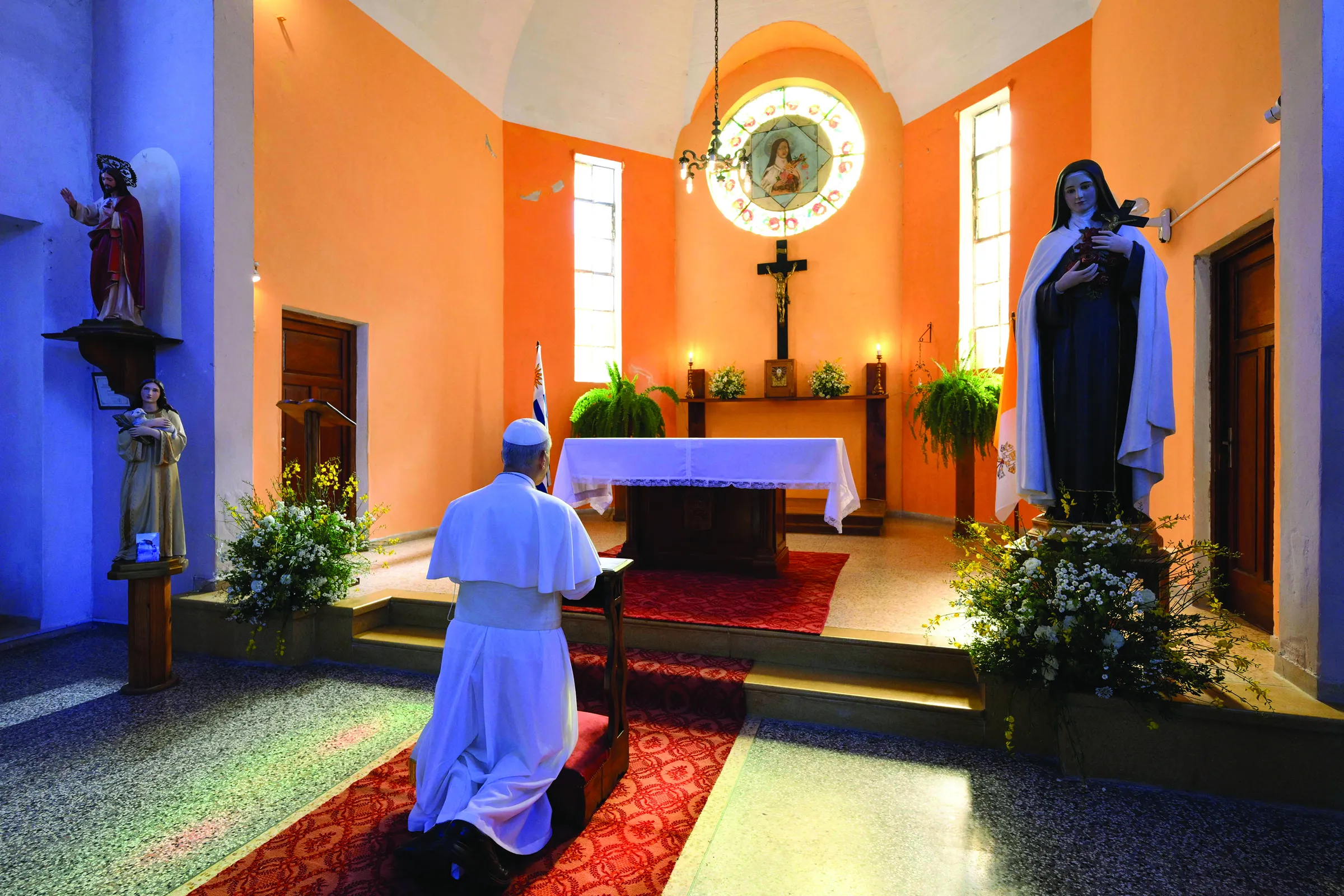
St. John XXIII authorized the image’s canonical coronation in 1961 and declared Our Lady of the Thirty-Three patroness of Uruguay in 1962. In 1975, Uruguay’s government designated the cathedral and the image national historic monuments, and in 1994 the cathedral became the National Shrine of Our Lady of the Thirty-Three.
At the end of Mass, Bishop Alfonso María Bauer Ormazábal of Florida told Pope Leo, “We are a country of close-knit communities, of sharing mate, and of gatherings of friends. And that country was born here, in Florida: next to the so-called ‘Altar of the Motherland,’ our Independence was declared, under the gaze of the Virgin of the Thirty-Three.”
“Today, we face different struggles, and we ask Mary to accompany us in these as well:
the poverty of so many children and the lack of work, loneliness and a sense of meaninglessness, addictions and mental health issues, social fragmentation, and violence. With her, we wish to defend the dignity of every person, daughter and son of God,” the bishop said.
The Mass in Florida marked the final public event of Pope Leo’s Nov. 7-8 visit to Uruguay. After Mass and lunch with local bishops, he is scheduled to fly to Buenos Aires, Argentina, where he will meet President Javier Milei in the afternoon.
Uruguay’s national Marian shrine is one of three Latin American pilgrimage sites Pope Leo is visiting during his Nov. 6-17 tour of South America.
In Argentina, Pope Leo is expected to celebrate Mass at the Basilica of Our Lady of Luján, the country’s national Marian shrine. In Peru, he intends to visit Zaña, where relics of St. Turibius of Mogrovejo, the missionary archbishop of Lima and patron of the Latin American episcopate, are preserved.