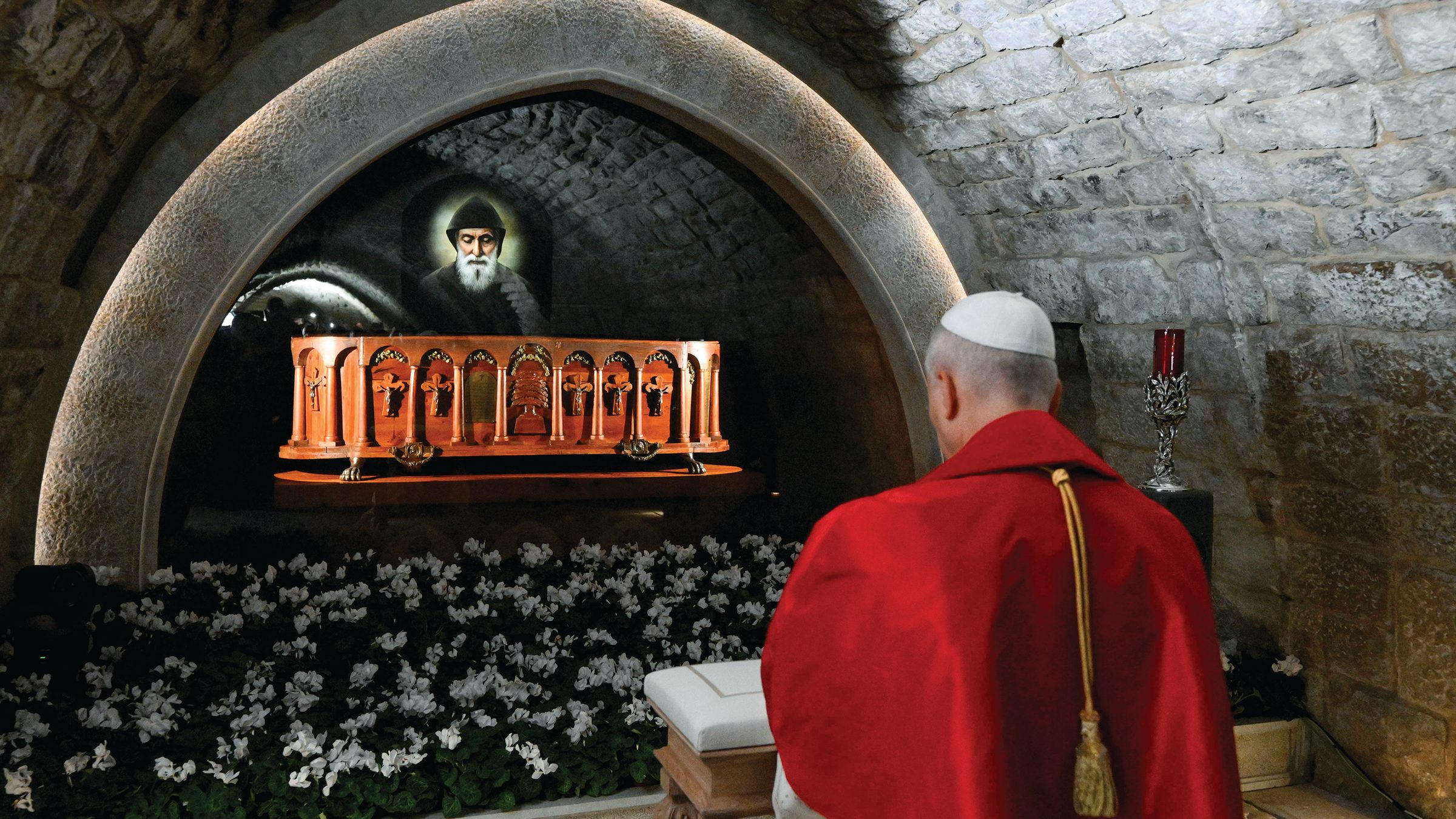

At a shrine topped by a 28-foot-tall statue of Our Lady of Lebanon, Pope Leo XIV listened to stories of unshakable faith amid war, injustice and suffering.
The pope began Dec. 1 at the tomb of St. Charbel at the Monastery of St. Maron in Annaya, a place known for its atmosphere of silent prayer, especially in difficult moments.
Despite intermittent rain, thousands of people gathered along the road leading to the monastery, tossing rose petals or rice as a sign of welcome.
After entrusting the Catholics of Lebanon and the entire country to St. Charbel’s care, Pope Leo went to the Shrine of Our Lady of Lebanon in Harissa and listened, like St. Charbel often did, to the cries of people’s hearts.
Father Youhanna-Fouad Fahed, a married Maronite Catholic priest and pastor of a parish near the Syrian border, spoke first. His village welcomed Syrian refugees from the war that began in 2011 and was repeatedly struck by shelling from the Syrian side of the border. In December 2024, when the Syrian civil war officially ended, more refugees came.
“The collection bag during Sunday Mass revealed to me a first, silent cry: I noticed Syrian currency inside: It was an offering mingled with pain,” Father Fahed told the pope.
“Alone, feeling my people’s suffering smothered by fear, the misery concealed by the shame of asking for help, I went in search of them,” the priest said. Some told him they had fled to protect their daughters from forced marriage, and many arrived in Lebanon hoping to eventually migrate to Europe, even if that meant “entrusting their dreams to migrant smugglers who stole their savings.”
All Father Fahed asked of Pope Leo was a word of comfort so the people would not feel forgotten and alone.

Sister Dima Chebib is a member of the Sisters of the Sacred Hearts of Jesus and Mary and director of a school in Baalbeck, which is considered by many to be a stronghold of the Hezbollah militia and has been struck repeatedly by Israeli shelling in the past year.
While many people fled the town, she said, the priests and religious of the Melkite Catholic diocese “decided to stay and welcome the refugee families – Christian and Muslim – who came seeking safety and peace. We shared bread, fear and hope. We lived together, prayed together and supported one another in fraternity and trust.”
“In the heart of war,” she told the pope, “I discovered the peace of Christ. And I give thanks to God for this grace of remaining, loving and serving to the end.”
Loren Capobres, who came to Lebanon from the Philippines as a domestic worker and now works with Jesuit Refugee Service, described the people she helps as “people who had left everything behind – broken not just by war, but by betrayal and abandonment.”
Vincentian Father Charbel Fayad, a prison chaplain, told the pope of the repentance and conversion of prisoners who are amazed anyone cares enough to minister to them.
“Even in the darkness of the cells, the light of Christ never goes out,” Father Fayad said.
Pope Leo responded to the testimonies by saying that just as for St. Charbel in the 19th century, so today “it is in being with Mary at the foot of Jesus’s cross that our prayer – that invisible bridge which unites hearts – gives us the strength to continue to hope and work, even when surrounded by the sound of weapons and when the very necessities of daily life become a challenge.”
Father Toni Elias, the Maronite pastor of Rmaych, near the Israeli border, did not speak to the pope, but told reporters, “We have basically been living in war for the past two, two and a half years but never without hope.”
The visit of the pope, he said, is confirmation for believers that “what we have lived” – the fear and the hope combined – “has not been in vain.”
Pope Leo’s speech to government and civic leaders Nov. 30 had focused on the Lebanese people and did not mention Israel at all. But Father Elias said that was “beautiful” because peace and harmony among Muslims, Christians and Druze “are our roots, our culture. That is Lebanon.”
Meeting the country’s bishops, priests, religious and pastoral workers – a crowd of about 2,000 people – Pope Leo told them, “If we wish to build peace, we must anchor ourselves to heaven and, firmly set in that direction.”
“Let us love without being afraid of losing those things which pass away and let us give without measure,” the pope said. “From these roots, strong and deep like those of cedars, love grows and with God’s help, concrete and lasting works of solidarity come to life.”
Pope Leo was scheduled to end his morning with a private meeting with Catholic patriarchs from throughout the Middle East.