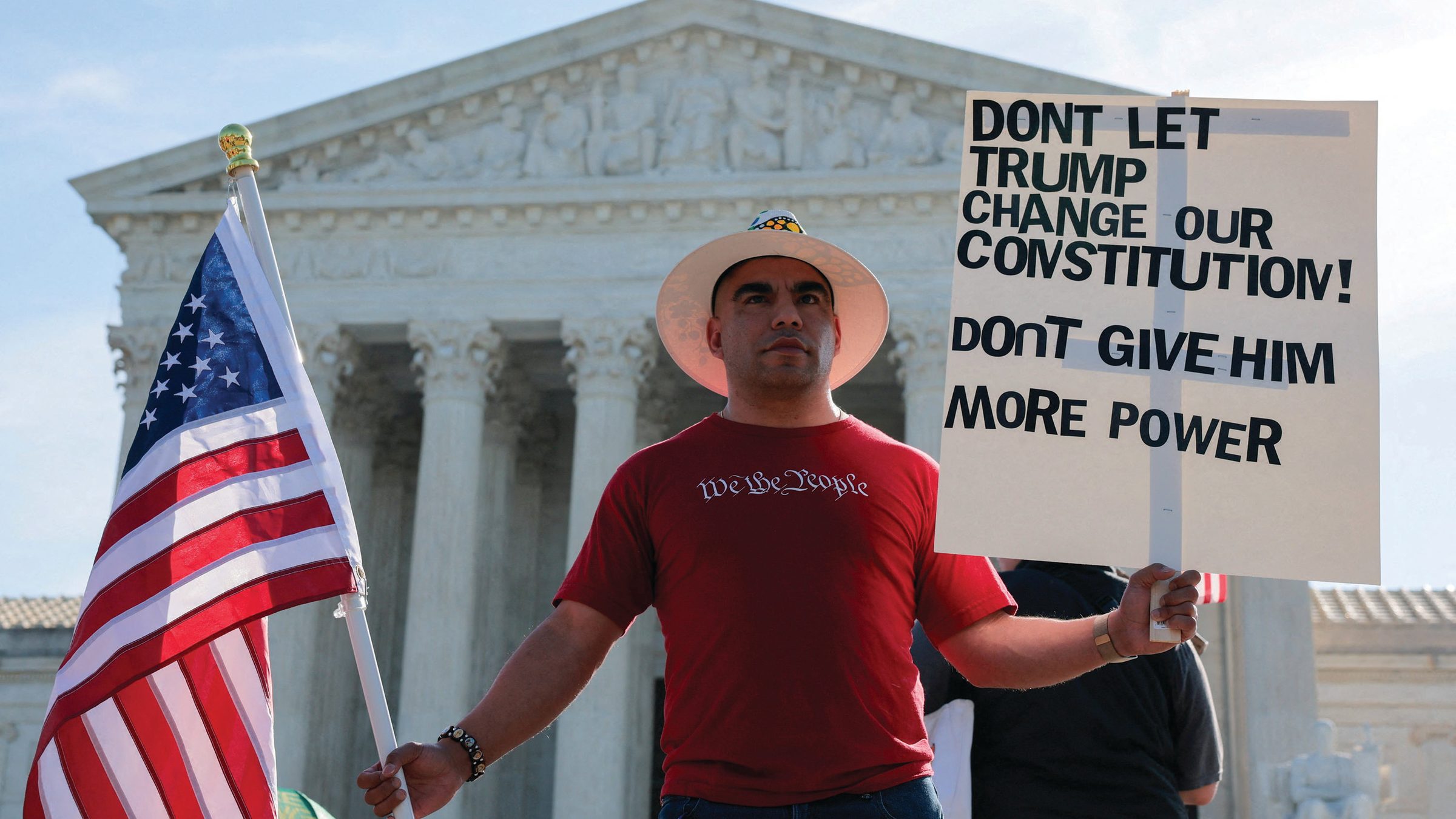

The U.S. Supreme Court heard oral arguments April 1 on President Donald Trump’s executive order limiting birthright citizenship, with the president in attendance.
Trump’s presence for oral arguments in the case, Trump v. Barbara, marked the first time a sitting president has attended oral arguments at the Supreme Court, according to records from the high court and the nonprofit Supreme Court Historical Society.
Robert Schmuhl, professor emeritus of American studies at the University of Notre Dame, who critically observes the modern American presidency, noted Trump’s recent sharp criticism of the justices who ruled against his preferred outcome in the tariff decision. The president might be attempting to “make the point that he should have the ultimate say on cases he considers most important to his presidency,” Schmuhl told OSV News.
“His attendance, however, raises profound questions about the American constitutional system, with its separation of powers among the executive, legislative and judicial branches of government,” Schmuhl said. “If the president is trying to ‘work the refs,’ as they say in sports, one can only hope that the justices concentrate on the case and the arguments rather than one person sitting in the audience.”
Trump v. Barbara concerns an executive order signed by Trump within hours of returning to the Oval Office Jan. 20, 2025, that sought to change the longstanding legal interpretation of the 14th Amendment, which states, “All persons born or naturalized in the United States, and subject to the jurisdiction thereof, are citizens of the United States and of the State wherein they reside.”
Trump’s order, part of his administration’s broader efforts to restrict immigration, sought to end birthright citizenship for children born in the U.S. to parents who either lack permanent legal status or are temporary visa holders. The order said that after 30 days from the executive order’s date, only children born to at least one U.S. citizen or lawful permanent resident parent would automatically acquire citizenship. It was promptly challenged in court.
Previously, the Supreme Court limited the ability of federal judges to issue nationwide injunctions against the order while litigation over it proceeds, but did not directly address the merits of the order itself.
Anna Gallagher, executive director of the Catholic Legal Immigration Network, also known as CLINIC, said in written comments shared with OSV News, “Today’s arguments before the Supreme Court of the United States underscore what is at stake, not just a legal doctrine, but a defining promise of our Constitution.”
“Birthright citizenship affirms that all people born on this soil belong here, fully and equally. At CLINIC, we were proud to submit an amicus brief in defense of this principle, because any effort to weaken it threatens both the rule of law and the dignity of our communities,” Gallagher said. CLINC said Gallagher was present at the court during arguments to show solidarity.
The Trump administration has argued that the phrase “subject to the jurisdiction thereof” makes the president’s order lawful, despite longstanding legal interpretation that children born in the U.S. are granted citizenship with only narrow exceptions. But some of Solicitor General John Sauer’s arguments were described as “quirky” by Chief Justice John Roberts, and Justice Elena Kagan called some of his sourcing “obscure.”
“We’re talking about ‘subject to the jurisdiction thereof,” Justice Amy Coney Barrett said at one point. “But it also says ‘born’ in the United States.”
In a notable exchange with Roberts, Sauer was asked to clarify how common “birth tourism,” or instances of pregnant women who travel to the U.S. to give birth so that their babies can have American citizenship, is in the U.S.
In 2024, the Centers for Disease Control and Prevention estimated there were about 9,500 births to parents who reported a non-U.S. address as their residence that year. However, that number is believed to be low, as people may not self-report, according to think tank estimates on both sides of the issue.
Sauer claimed “there are 500 birth tourism companies in the People’s Republic of China, whose business is to bring people here to give birth and return to that nation,” a number that appeared to come from a Shanghai newspaper in 2015.
Sauer said the scenario placed the nation “in a new world” where “a billion people are one plane ride away from having a child who’s a U.S. citizen.”
“Well, it is a new world,” Roberts replied. “It’s the same Constitution.”
Trump left oral arguments shortly after Sauer’s arguments concluded.
Cecillia Wang, national legal director of the American Civil Liberties Union, who led the argument against the executive order, argued, “ask any American what our citizenship rule is, and they’ll tell you, everyone born here is a citizen alike.”
“That rule was enshrined in the 14th Amendment to put it out of the reach of any government official to destroy,” she said.
At another point, Justice Brett Kavanaugh asked Wang if the narrow exceptions to birthright citizenship are “frozen forever” in law and court precedent.
“The way I would put it is that the citizenship clause of the 14th Amendment, again, has a universal rule with a closed set of exceptions,” she said, adding it sets “a floor so the Congress has, under the naturalization clause, the power to expand citizenship to other people not covered by the 14th Amendment.”
“And obviously they have, in many ways, but they can’t go below that floor that the Constitution sets,” she argued.
Catholic social teaching on immigration balances three interrelated principles – the right of persons to migrate in order to sustain their lives and those of their families, the right of a country to regulate its borders and control immigration, and a nation’s duty to regulate its borders with justice and mercy.
A decision in the case is expected by the end of the court’s term, which typically ends in June.