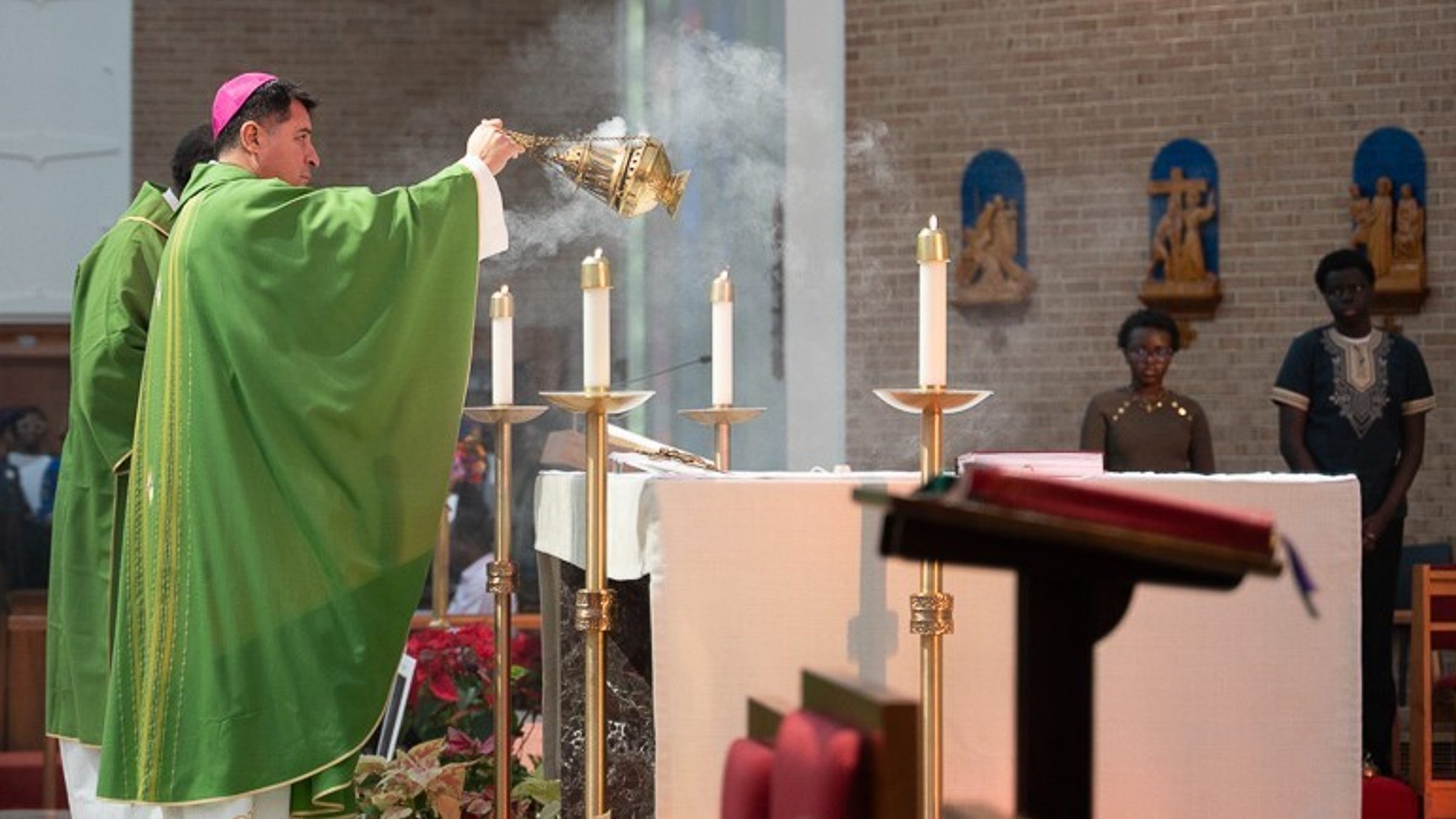

The life of St. Josephine Bakhita, who endured enslavement as a child in Sudan before becoming a Canossian religious sister, stood at the center of a Feb. 7 vigil Mass at Saint Mary’s Catholic Church in Landover Hills, Maryland, marking her feast day and the Church’s World Day of Prayer and Awareness Against Human Trafficking.
Washington Auxiliary Bishop Evelio Menjivar presided at the liturgy that was celebrated in English and Arabic. The Mass was organized by the Roman Catholic Archdiocese of Washington in collaboration with the United States Conference of Catholic Bishops and the African Catholic Association.
In his homily, Bishop Menjivar reflected on St. Josephine Bakhita as “a daughter of Africa and a witness of faith and spiritual freedom,” and as the patron saint of victims of slavery and human trafficking.
Quoting Pope Leo XIV’s message for the 12th World Day of Prayer and Awareness Against Human Trafficking, the bishop said, “True peace begins with the recognition and protection of the God-given dignity of every person.” He warned that political instability and armed conflict create “a fertile ground for traffickers to exploit the most vulnerable, especially displaced persons, migrants and refugees,” and referenced what Pope Leo has described as “cyber slavery,” in which individuals are lured into fraudulent schemes and criminal activity online.
Yet St. Bakhita’s story, he said, reveals that “no chain is stronger than God’s grace.”
Abducted as a child in what is now South Sudan and sold multiple times, St. Bakhita endured brutal treatment. “And still, she did not allow hatred to take root in her heart,” Bishop Menjivar said. Even before her physical liberation, “her heart had found freedom in God.”
Drawing from the day’s readings, he described her as salt and light, one whose gentleness, forgiveness and joy transformed the community around her. Her forgiveness, he said, “is not weakness. It is the strength of one who has learned to trust not in power, but only in the power of God.”
The bishop also shared a personal reflection on a 2023 visit to South Sudan, where he encountered “deep faith, resilience, contagious joy” amid poverty and suffering. He told villagers there, “I will be your ambassador,” a promise he said he continues to carry.
“In a sense, brothers and sisters, we are all ambassadors,” he said. “Above all, we are ambassadors of Christ’s love.”
He cautioned against indifference, calling it “very dangerous” and “a silent way of condoning injustice.” Indifference itself, he said, can become “a form of slavery.”
The universality of the Church was visible throughout the liturgy. Deacon Francis Chan, a permanent deacon in the Diocese of Des Moines who is originally from South Sudan, proclaimed the Gospel in English and Arabic.
The Prayers of the Faithful were offered in multiple languages reflecting both the diversity of Africa and the local Church: English; Collo (also known as Acholi), spoken in South Sudan and northern Uganda; Bari, spoken in South Sudan; Twi, spoken in Ghana; Arabic; Lugbara, spoken in northwestern Uganda and parts of the Democratic Republic of the Congo; French; and Amharic, the official language of Ethiopia. Music was provided by the Sudan and South Sudan Choir and members of the African Catholic Association.
Following the Mass, Sister Joanna Okereke of the Handmaids of the Holy Child Jesus introduced the evening’s presentation and led a prayer seeking the intercession of St. Josephine Bakhita. Bishop Menjivar concluded a novena the group had prayed in preparation for the feast.
Rosemary Gonda and her daughter, Joy Bakhita Julius, offered reflections on the life and legacy of St. Josephine Bakhita.
Deacon Paul Kipfstuhl of the Diocese of Cleveland then outlined the Church’s seven themes of Catholic Social Teaching, emphasizing that the dignity of the human person is foundational.
“Dignity is inherent in each and every one of us, and it can never be taken away by anybody,” he said, noting that trafficking attempts to erase a person’s name and identity. He highlighted solidarity, participation in community, rights and responsibilities, the dignity of work, care for creation and the preferential option for the poor and vulnerable as principles that call Catholics to respond to exploitation.

Felicitas Brugo Onetti, anti-trafficking education and outreach coordinator for Migration and Refugee Services at the United States Conference of Catholic Bishops, provided an overview of how U.S. law defines human trafficking as the use of force, fraud or coercion to induce someone into commercial sexual activity or labor. Any minor engaged in commercial sex, she noted, is legally considered a trafficking victim.
Citing the Global Slavery Index, she said an estimated 49.6 million people worldwide are living in situations of modern-day slavery, with roughly one million in the United States.
She clarified that trafficking is distinct from human smuggling, which is typically a consensual arrangement involving transportation across borders. Trafficking, she said, is a crime against a person and does not require movement across state or national lines.
Onetti focused particularly on how major sporting events can intensify existing vulnerabilities. With the Super Bowl held annually and upcoming events including the World Cup and the Olympics, she said increased tourism and demand for services can exacerbate labor and sex trafficking risks.
“It’s not to say that trafficking occurs because of sporting events,” she said. “It’s that events intensify tourism and population movement, which can exacerbate existing patterns.”
She pointed to documented labor abuses during stadium construction for the 2022 FIFA World Cup in Qatar and increased trafficking investigations around Super Bowl host cities. In the United States, she said, risks may surface in hotels, restaurants, temporary labor and informal service sectors.

Felipe Urquilla, the human trafficking division manager for the Prince George’s County Office of Human Rights, outlined local resources, including partnerships with law enforcement, hospitals and the regional navigator program operated by the University of Maryland SAFE Center for Human Trafficking Survivors.
Immigrants make up a large portion of those served in the county, he said, and legal and immigration support are often critical.
“When you see something and you discern that it’s human trafficking, you can actually do something about it,” Urquilla said. The county task force provides training for schools, community groups and parishes to help identify warning signs.
Bishop Menjivar closed his homily with a direct appeal rooted in St. Josephine Bakhita’s witness.
“So let us work together to end all forms of slavery and human trafficking, old and new, everything that violates the inherent dignity of every human person,” he said. “And let us never forget that the brightest light often shines from the deepest darkness.”

Reporting suspected human trafficking
To report a suspected human trafficking situation or to seek help, contact the National Human Trafficking Hotline at 1-888-373-7888 or text 233733.
To report information about a missing or exploited child, call 1-800-THE-LOST (1-800-843-5678) 24-hour hotline, or to report child sexual abuse or exploitation online visit, CyberTipline.org
To visit Prince George’s County Human Trafficking Taskforce, for a list of local resources in the Archdiocese of Washington, please visit: https://www.princegeorgescountymd.gov/human-rights/-human-trafficking-task-force-/resources--partners
Copy Permalink
slavery