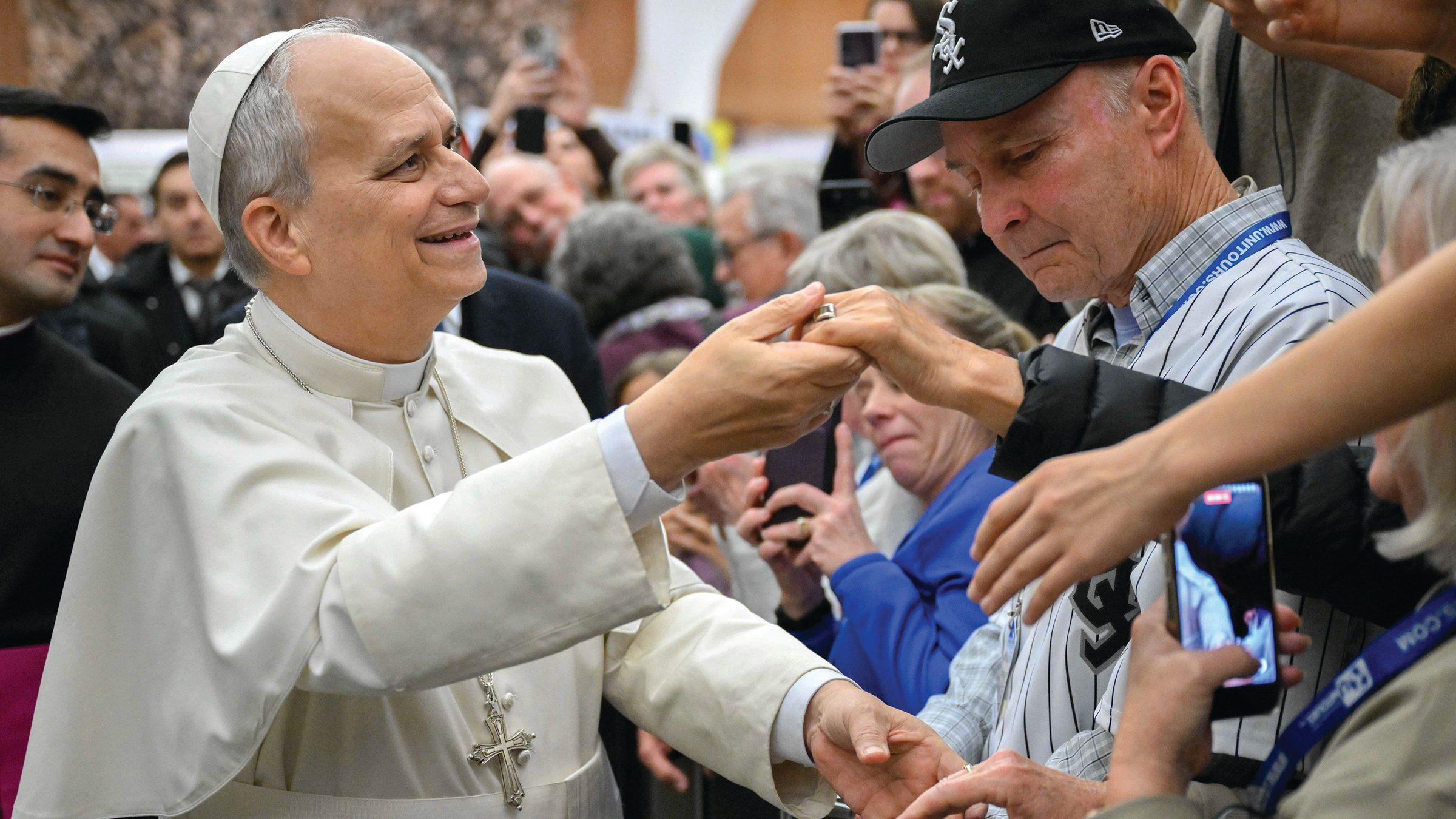

This is the text from Pope Leo XIV’s Feb. 4, 2026, general audience given in the Paul VI Hall.
Dear brothers and sisters, good morning and welcome!
The Conciliar Constitution Dei Verbum, on which we are reflecting during these weeks, indicates in the Sacred Scripture, read in the living Tradition of the Church, a privileged space for encounter where God continues to speak to the men and women of every time, so that, by listening, they can know him and love him. The biblical texts, however, were not written in a heavenly or superhuman language. Indeed, as daily life teaches us, two people who speak different languages cannot understand each other, cannot enter into dialogue, and are unable to establish a relationship. In some cases, making oneself understood to others is a first act of love. This is why God chooses to speak using human languages and thus, various authors, inspired by the Holy Spirit, have written the texts of Sacred Scripture. As the Conciliar document reminds us, “the words of God, expressed in human language, have been made like human discourse, just as the word of the eternal Father, when He took to Himself the flesh of human weakness, was in every way made like men” (DV, 13). Therefore, not only in its content, but also in its language, the Scripture reveals God’s merciful condescension towards men, and his desire to be close to them.
Throughout the course of Church history, the relationship between the divine Author and the human authors of the sacred texts has been studied. For several centuries, many theologians were concerned to defend the divine inspiration of the Sacred Scripture, almost considering the human authors merely as passive tools of the Holy Spirit. In more recent times, reflection has re-evaluated the contribution of hagiographers in the writing of sacred texts, to the point that the Conciliar document speaks of God as the principal “author” of Sacred Scripture, but also calls hagiographers “true authors” of the sacred books (cf. DV, 11). As a keen exegete of the last century observed, “to reduce human activity to that of a mere amanuensis is not to glorify divine activity”. God never mortifies human beings and their potential!
If, therefore, the Scripture is the word of God in human words, any approach to it that neglects or denies one of these two dimensions proves to be partial. It follows that a correct interpretation of the sacred texts can dispense with the historic environment in which they developed and the literary forms that were used; on the contrary, to renounce the study of the human words that God used risks leading to fundamentalist or spiritualist readings of the Scripture, which betray its meaning. This principle also applies to the proclamation of the Word of God: if it loses touch with reality, with human hopes and sufferings, if an incomprehensible language is used, uncommunicative or anachronistic, it is ineffective. In every age, the Church is called to re-propose the Word of God in a language capable of being embodied in history and reaching hearts. As Pope Francis reminds us, “Whenever we make the effort to return to the source and to recover the original freshness of the Gospel, new avenues arise, new paths of creativity open up, with different forms of expression, more eloquent signs and words with new meaning for today’s world”.
Equally reductive, on the other hand, is a reading of Scripture that neglects its divine origin and ends up understanding it as a mere human teaching, as something to be studied simply from a technical point of view or as a text “only of the past”. Rather, especially when proclaimed in the context of the liturgy, Scripture is intended to speak to today’s believers, to touch their present lives with their problems, to enlighten the steps to be taken and the decisions to be made. This becomes possible only when believers read and interpret the sacred texts under the guidance of the same Spirit who inspired them (cf. DV, 12).
In this regard, the Scripture serves to nurture the life and charity of believers, as Saint Augustine recalls: “Whoever … thinks that he understands the Holy Scriptures … but puts such an interpretation upon them as does not tend to build up this twofold love of God and our neighbor, does not yet understand them as he ought”. The divine origin of the Scripture also recalls that the Gospel, entrusted to the witness of the baptized, despite embracing all the dimensions of life and reality, transcends them: it cannot be reduced to a mere philanthropic or social message, but is the joyful proclamation of the full and eternal life that God has given to us in Jesus.
Dear brothers and sisters, let us thank the Lord because, in his goodness, he ensures our lives do not lack the essential nourishment of his Word, and let us pray that our words, and even more so our lives, do not obscure the love of God that is narrated in them.
Appeal
I urge everyone to support with prayer our brothers and sisters in Ukraine, who are being severely tested by the consequences of the bombings which have resumed, also striking energy infrastructure. I would like to express my gratitude for the solidarity initiatives promoted by Catholic dioceses in Poland and other countries, which are working to help the people endure this time of extreme cold.
Tomorrow marks the expiry of the New START Treaty signed in 2010 by the Presidents of the United States and the Russian Federation, which represented a significant step in containing the proliferation of nuclear weapons. In renewing my encouragement for every constructive effort in favor of disarmament and mutual trust, I urgently call for this instrument not to be abandoned without seeking to ensure its concrete and effective follow-up. The current situation requires that everything possible be done to avert a new arms race that would further threaten peace among nations. It is more urgent than ever to substitute the logic of fear and distrust with a shared ethos capable of guiding choices towards the common good and to make peace a treasure to be cherished by all.
Special greetings in English
I greet all the English-speaking pilgrims and visitors taking part in today’s Audience, especially the groups from Ireland, Denmark, Japan, South Korea and the United States of America. I greet in particular the students from the Junshin Junior and Senior High School and the students and faculty from Franciscan University of Steubenville. Upon all of you, and upon your families, I invoke the joy and peace of our Lord Jesus Christ. God bless you!