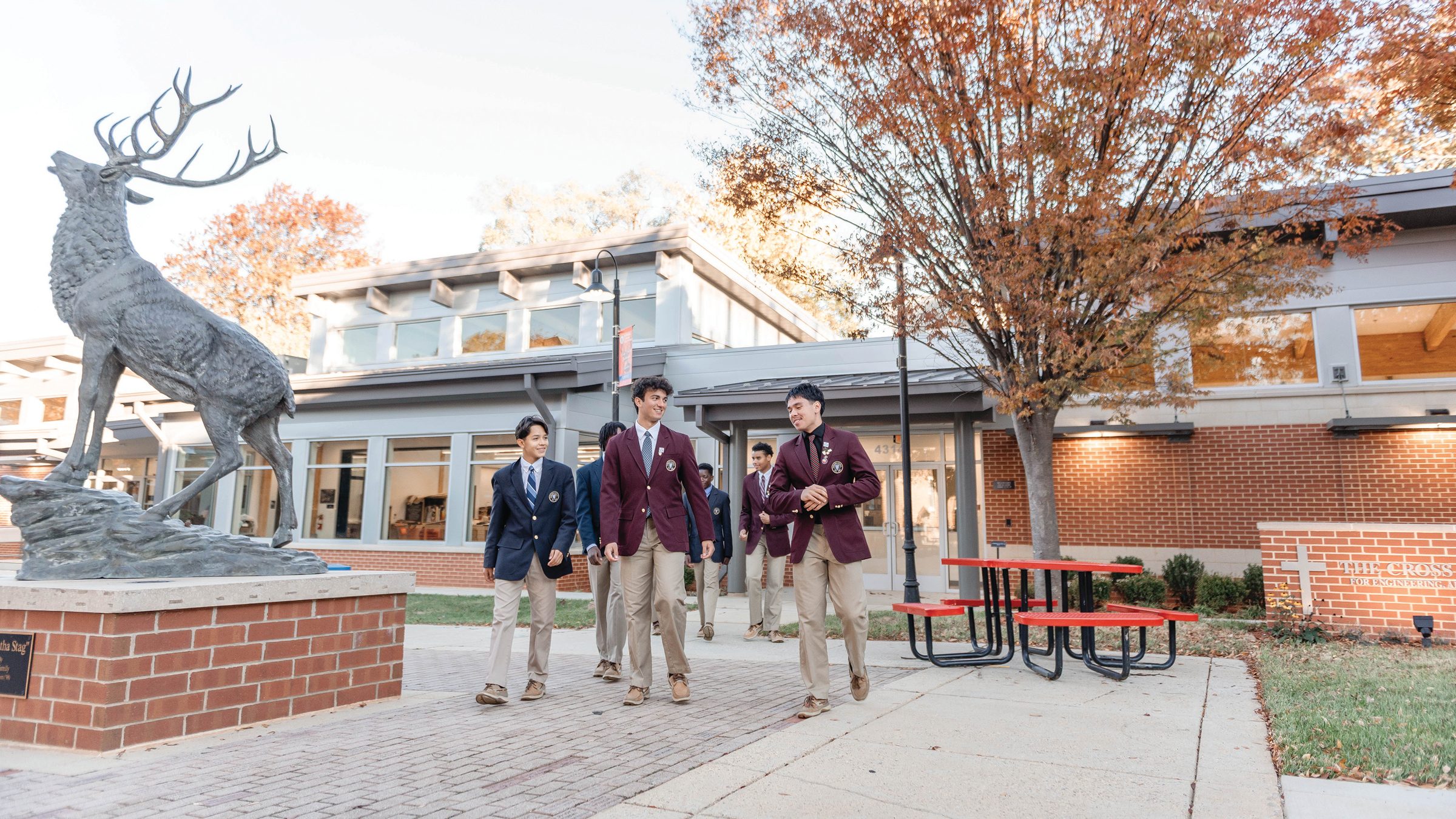

When students walk into DeMatha Catholic High School’s new Cross Center for Engineering, Arts & Robotics, they enter a facility designed to support hands-on learning across disciplines.
With vaulted ceilings, high-set windows that flood the interior with natural light, exposed wood beams and fabric-based air dispersion to reduce noise, the building reflects a deliberate balance of beauty and instructional function.
The Cross Center for Engineering, Arts & Robotics, a $4.5 million, 6,000-square-foot facility at DeMatha Catholic High School in Hyattsville, Maryland, opened to students in November following a Sept. 9, 2025, dedication. School leaders said the building represents more than an investment in technology or academics. Instead, it reflects DeMatha’s broader mission of forming young men not just for college or careers, but for life, emphasizing creativity, responsibility and purpose across disciplines.
The facility includes three primary instructional spaces dedicated to engineering, art, and robotics, each intentionally designed around how students learn and work. But school leaders say the most important work happening there cannot be measured in square footage or equipment lists.
The Cross Center replaces a 1910 carriage house that previously housed the school’s art program. Designed by DeMatha alumnus Michael Johnson of CW Architects Inc., the building was developed in close collaboration with faculty members to ensure the space served instruction rather than aesthetics alone.
Teachers contributed input on wall placement, outlet height, storage systems and furniture design. Robotics tables include curved edges to prevent small components from falling. Power outlets were placed at eye level and near workstations to reduce safety risks. Tools and materials are organized through an alphanumeric inventory system that requires students to return items to designated locations.
“These decisions weren’t aesthetic afterthoughts,” said Dr. Daniel McMahon, principal of DeMatha Catholic High School. “They were pedagogical,” relating to the teaching there.
Faculty members said the building allows for seamless movement between theoretical instruction and practical application. Engineering students design and test physical projects. Art students work with painting, sculpture and kilns. Robotics students engage in hands-on experimentation involving automation and coding.
In the engineering classroom, students are introduced to the engineering design process through iterative, project-based work. They build, test, fail and revise.
“This isn’t about getting the right answer,” said Richard Blorstad, a 2010 DeMatha graduate who teaches engineering and coaches the school’s rowing program. “It’s about learning how to improve something, how to respond when your first idea doesn’t work.”
Blorstad said that mindset is increasingly important in a world shaped by automation and artificial intelligence.
“We don’t want students to rely on tools that do the thinking for them,” he said. “We want them to wrestle with problems and understand the process.”
Michael Roberts, who teaches mathematics, computer science and robotics, said hands-on learning helps students connect abstract concepts to real-world applications.
“We’re trying to remove as much technology as possible while still helping them understand it,” Roberts said. “Otherwise, you lose the human capacity that technology is supposed to serve.”
In the same room where students study robotics, physical models and tools fill the space. In Roberts’ honors geometry class, lessons move quickly from the whiteboard to worktables, where students use physical models to explore mathematical concepts. On one table, a 3D-printed linkage sits beside sketches and measurements, requiring students to think in two dimensions while accounting for motion and rotation.
“If you want to understand linkages in a real system, you have to understand the Pythagorean theorem,” Roberts said. Students were not building electronics, he explained, but designing the physical components that make motion possible.
“Being in the room with physical objects allows me to show the application of math,” he said.
Roberts said technology itself is not the problem, but the problem is how it can distance students from the thinking process.
“The metrics haven’t changed,” he said. “But the ways we achieve them are being replaced by technology, and that removes the student from the work.”
Dr. Christopher Hurst, one of DeMatha’s assistant principals, said the Cross Center reflects the school’s belief that the arts and sciences are complementary rather than competitive.
“There’s a temptation to think students must choose between the arts and the sciences,” Hurst said. “We reject that. Human formation requires both.”
He said the growth of artificial intelligence tools in education reinforces the need to focus on formation rather than outcomes.
“Education is about process, not product,” he said. “That’s true in music, in athletics and in academics. It’s also true in life.”
“We want students to have as many opportunities as possible,” McMahon said, adding that engaging deeply with ideas, people and disciplines remains essential regardless of the paths students ultimately pursue.
The Cross Center presents engineering, robotics and the arts as disciplines that demand perseverance, creativity and responsibility rather than as isolated career paths.
“That approach aligns closely with Catholic social teaching,” McMahon said. “Charity is important, but justice requires knowledge. Stewardship of the environment, technology and culture depends on understanding how systems work.”
Blorstad said the goal is not to funnel students toward a single outcome, but to equip them with habits of mind that translate across disciplines and professions.
“We’re not trying to turn students into engineers or artists by the time they leave,” he said. “We’re helping them develop the discipline and sense of purpose they’ll need to lead, wherever they’re called.”
School leaders said the Cross Center’s open design supports collaboration among students and faculty across disciplines, reinforcing relationships that are central to DeMatha’s approach to formation.
As students move through the Cross Center’s bright halls, carrying tools, sketches and half-finished projects, DeMatha’s vision is on display. The work of formation is embedded in the work itself, where intellectual rigor, moral formation and craftsmanship converge, shaping young men not only for the lives they will build, but for what they will become.
Hurst said he often shares a story with students about three people doing the same work.
“One says, ‘I’m dragging stones.’ Another says, ‘I’m making a living.’ The third says, ‘I’m building a cathedral,’” he said. “From the outside, it looks the same. What matters is how you understand what you’re building.”
At DeMatha, McMahon said, the goal is for students to see their education as part of a larger purpose.
“If you’re going through high school,” he said, “build cathedrals.”