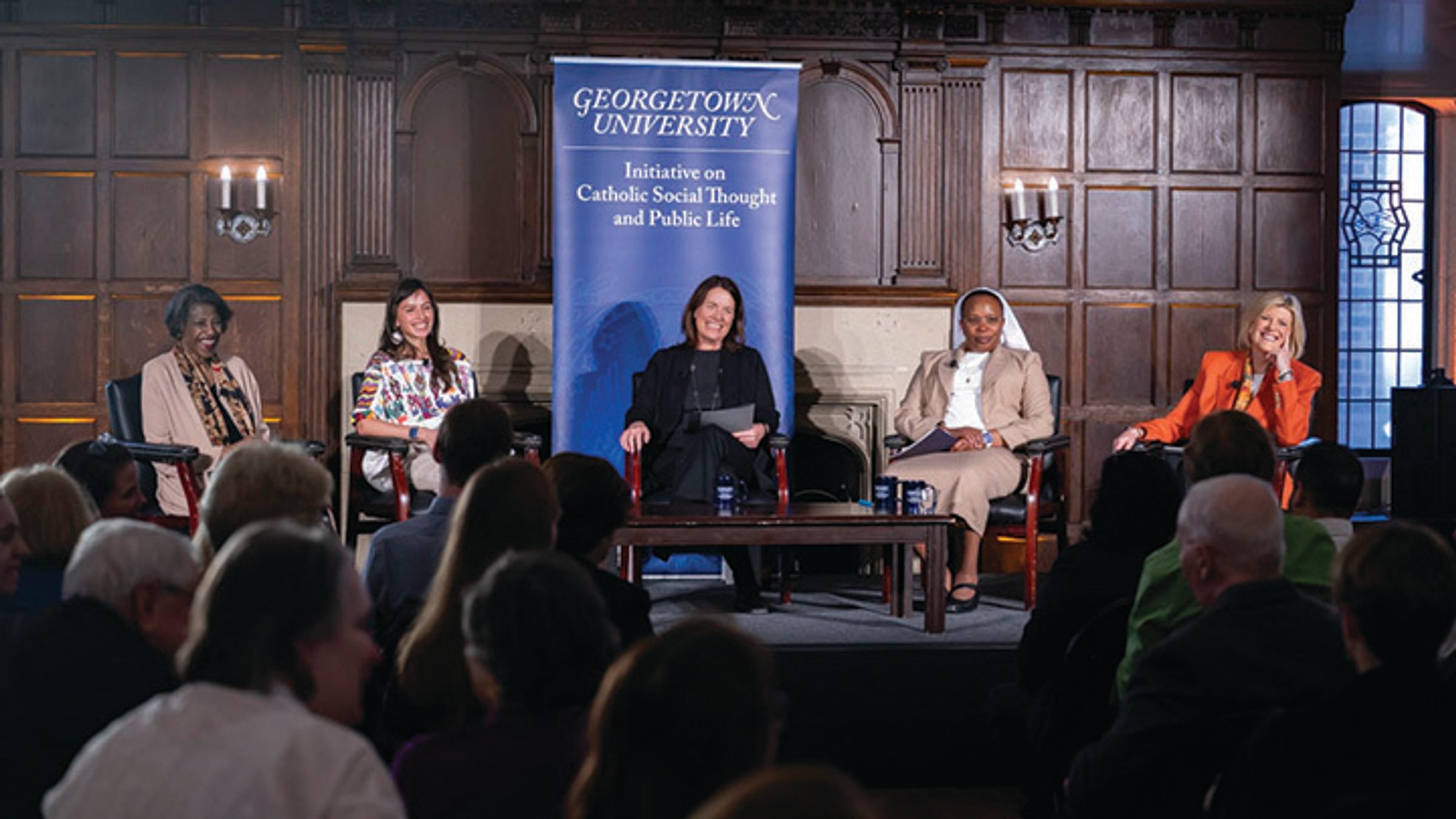

Catholic women leaders from journalism, religious life, parish ministry and grassroots organizing discussed the expanding – but still evolving – role of women in the Catholic Church during a Mar. 9, panel at Georgetown University in Washington that focused on women’s leadership and the Church’s mission in public life.
The event, titled “Catholic Women’s Leadership to Advance the Common Good,” was hosted by Georgetown’s Initiative on Catholic Social Thought and Public Life and co-sponsored by the university’s Berkeley Center for Religion, Peace and World Affairs. Kim Daniels, director of the Initiative, moderated the discussion.
Panelists said recent years have brought visible progress for women in the Church, particularly through leadership opportunities expanded during the pontificate of Pope Francis. But they emphasized that women’s participation in decision-making roles is still developing.
“We’re seeing the ground being laid, but it’s not cemented,” said Anne Thompson, an NBC News reporter who covers the Vatican and the Catholic Church. “Women’s leadership, the ground is being laid, but it’s not cemented. It’s not part of the tradition yet.”
The discussion comes amid ongoing conversations in the global Church following the Synod on Synodality, the multi-year consultation process initiated by Pope Francis that invited bishops, clergy and lay Catholics to discuss the Church’s future and repeatedly highlighted calls for greater leadership opportunities for women.
Thompson said she saw firsthand how uncertain progress can feel for women serving in Vatican leadership roles.
While reporting in Rome around the death of Pope Francis and the conclave that elected Pope Leo, she recalled speaking with a woman whom Francis had appointed to a leadership position.
“There was this cloud of concern that came over her face,” Thompson said. “She said, ‘Well, I don’t know. It depends on what happens.’”
The moment underscored how fragile some of the progress can feel, she said. “For all the efforts that Pope Francis had made to elevate women, how tenuous that was.”
Still, Thompson pointed to early signs she described as encouraging under Pope Leo’s pontificate, including women serving as lectors during his first Mass in the Sistine Chapel and women being appointed to senior roles in Vatican offices.
“I’m more optimistic than I ever have been,” she said. “But there’s much more work to be done.”
Other panelists highlighted the work Catholic women already carry out through ministries and service around the world.
Sister Jane Wakahiu, a member of the Little Sisters of St. Francis of Kenya and a leader of the Conrad Hilton Foundation’s Catholic Sisters Initiative, described Catholic sisters serving people in difficult conditions across multiple countries.
“You go to Ukraine, where conflict is raging, they are there,” she said. “Go to South Sudan, where it is very difficult, they are there.”
Sister Wakahiu said the work of women religious reflects the Gospel call to serve people living on the margins.
“The Spirit of the Lord is upon me … to bring good news to the poor,” she said, quoting the Gospel of Luke.
Cynthia Bailey Manns, director of adult learning at St. Joan of Arc Catholic Community in Minneapolis, Minnesota, and one of four U.S. lay participants in the Synod on Synodality, said women often experience institutional barriers even though they play central roles in parish life.
“One of the biggest obstacles is that we still have an unwillingness to admit the truth that women’s baptism is not inferior to men’s baptism,” she said.
Manns said some women experience “a serious, deep spiritual wound” when they feel unable to fully use their gifts in the Church. At her Minneapolis parish, she said women serve in many leadership roles, including directing adult formation, finance, communications and social justice ministries.
“We have been empowered to use our gifts and our talents and our skills to serve from a place of love and compassion,” Manns said.
Panelist Joanna Arellano-Gonzalez, co-founder of the Coalition for Spiritual and Public Leadership in Chicago, said women have long played central roles in parish life and Catholic social activism even when their leadership is not formally recognized.
“Women make up more than half of the Church,” she said. “But for so long women’s voices and leadership have been unexplored, silenced or made invisible.”
Arellano-Gonzalez described organizing efforts supporting immigrant communities in Chicago, including demonstrations and legal advocacy related to pastoral care access for detainees at a federal immigration detention facility.
She credited women, including Catholic sisters and immigrant parish leaders, with mobilizing thousands of Catholics to participate in those efforts.
“The work wouldn’t be possible without them,” she said.
Panelists also encouraged young Catholic women to pursue leadership and service in the Church.
“Don’t wait to be asked,” Thompson said. “If you see a need and you think you can help, do it.”
Sister Wakahiu urged persistence when facing obstacles.
“When you find a roadblock, it doesn’t mean you cannot go where you need to go,” she said. “It only tells you to take a different direction.”
Panelists said continued participation by Catholic women will play an important role in shaping the future of the Church.
“If something doesn’t exist,” Arellano-Gonzalez said, “go start it.”
To view a recording of the conversation, and for more resources on this event, please visit, the event page for the Catholic Women’s Leadership to Advance the Common Good - on The Initiative on Catholic Social Thought and Public Life's website.