On June 19, 1838, the Maryland Society of Jesus, the Jesuits, signed an article of agreement to sell 272 enslaved men, women and children to two sugar plantation owners in Louisiana, a sale that helped ensure the financial survival of Georgetown College, now Georgetown University.
On Nov. 15, 2026, another document offered respect to those enslaved people that they had been denied in life and in death, as a citation from Maryland Governor Wes Moore was proclaimed acknowledging “the dignity, strength and resiliency” of the GU272 and honoring them and their descendants.
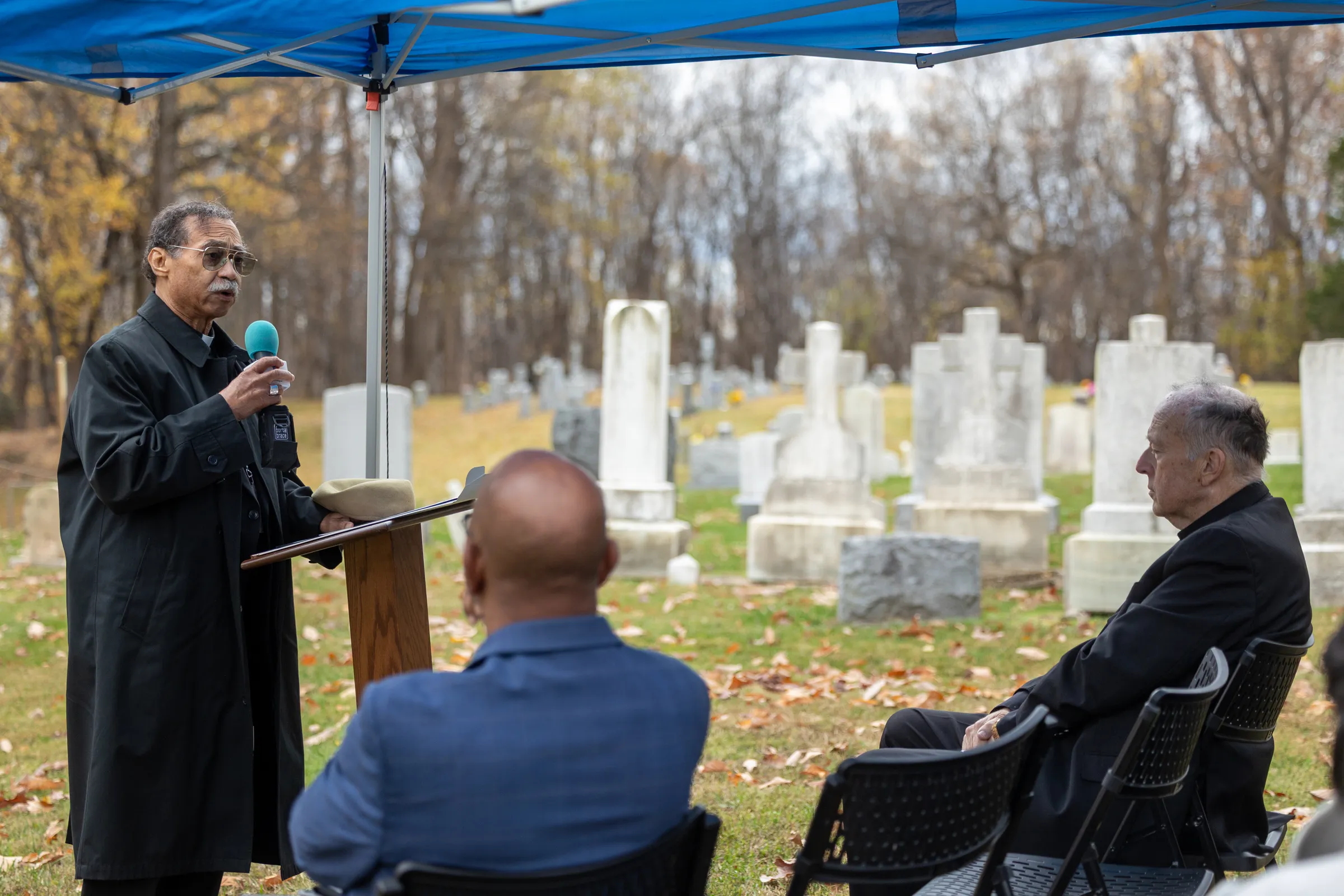
Poignantly, the ceremony took place at Sacred Heart Cemetery in Bowie, Maryland, in an area that was once part of the Jesuits’ White Marsh Plantation, one of their seven missions in Maryland, where from colonial times through the first decades of the new United States of America until Emancipation, enslaved men, women and children lived, worked and died. In recent years, archaeological surveys on that cemetery’s hillside have uncovered what are believed to be the unmarked graves of hundreds of enslaved people who once toiled at the White Marsh Plantation.
At the ceremony, Maryland Delegate N. Scott Phillips from District 10 in Baltimore County, the chairman of the state’s Legislative Black Caucus, read the Governor’s Citation, which noted the infamous sale by the Jesuits and said, “On this day, Maryland honors the GU272 and their descendants, whose lives, faith, labor, suffering, courage, and perseverance form an enduring part of the American story.”

In his remarks, Del. Phillips said the 1838 sale to help “extinguish the debt of Georgetown College,” generated $115,000, which would be equivalent to about $3.3 million today.
“But the true cost of that transaction cannot be measured in dollars. It must be measured on the impact of those who were sold, those families that were separated,” he said. Then he noted, “Eighty-nine of those individuals came from right here, from these grounds. This is Maryland history, it’s Catholic history, it’s American history.”
Concluding his remarks, Del. Phillips emphasized that history must be remembered and taught and never repeated. “I want to acknowledge that nothing that we do today will change the past, but it is an essential step toward healing, and it must always be accompanied by meaningful action,” he said.

The delegate was introduced by Bishop Roy Campbell Jr., a retired auxiliary bishop of Washington who leads an initiative of the Roman Catholic Archdiocese of Washington to honor those who were enslaved. Bishop Campbell noted that the enslaved died without recognition, but on that day, they were being honored.

Offering opening remarks at the gathering, Maryland State Senator Ron Watson, who represents District 23 which includes that part of Prince George’s County, said, “Today we gather on sacred ground, ground that holds not only the remains of those who came before us, but also the memories, sacrifices, prayers and untold stories of generations whose lives helped shape the Maryland that we know today.”
The 272 enslaved men, women and children in that 1838 sale were separated from their communities, their homes and their loved ones, he said, adding, “But while history records that they were sold, we must never forget that their humanity was never for sale. They were not simply a number. They were mothers and fathers, sons and daughters, brothers and sisters. They had names, dreams, faith and aspirations for their children, the same as we do today. And although their freedom was denied, their dignity could never rightfully be taken away.”

Senator Watson said that this year as the United States marks its 250th anniversary, while celebrating its triumphs, it must acknowledge its injustices, including how the promise that all people were created equal was denied to millions of Americans for generations.
He said the gathering that day should “be more than a commemoration. Let it be a commitment, a commitment to remember those whose voices were silenced, a commitment to honor the descendants who have worked to preserve their ancestors’ stories, and a commitment to ensure that the lessons of our past help shape a more just and compassionate future.”
The state senator said it is important to preserve this history, so future generations understand it and help build a society reflecting the ideals of human dignity and equality.
Praising the descendants of the enslaved who attended the ceremony, he said they stand “as living testimony to the perseverance of your ancestors. Their stories did not end in 1838. Their stories continued through you, through your families, through the generations that followed, and through the contributions you continue to make to our communities and our nation.”
Expressing respect and gratitude to the descendants, Senator Watson said, “You are not merely descendants of a painful history, you are the living continuation of a remarkable legacy of humanity, perseverance and hope. May we honor your ancestors not only through the words we speak today, but through the actions we take tomorrow.”

The U.S. Catholic Church’s ‘original sin’
Cardinal Robert W. McElroy, the archbishop of Washington, offered a prayer and a reflection at the gathering, after earlier that morning celebrating a special Mass at Sacred Heart Church for those who were enslaved at White Marsh, and blessing a plaque at the church to honor them.


The cardinal said that the ground where they stood had been made sacred by the lives of the enslaved who once endured “that soul-crushing institution” there.
Pointing out that President James Madison once called slavery the original sin of the American Constitution, the cardinal said, “I believe in a real way, that slavery in this place was the original sin of the Catholic Church in the United States. That’s why we come here today, the archdiocese and the Society of Jesus, to memorialize where we failed so deeply in our history in those early years of the Church here in Maryland and to apologize for that, and more importantly, by this project of locating graves and naming as best we can, the names of those who lie here, restoring some of the dignity which was robbed from them here on this earth, here in this life.”
Cardinal McElroy praised the legacy of the enslaved people who remained resilient while living through the barbarism of slavery, and he said their spirit continues in their descendants, who “are the truest sign of what was there that they maintained, and they refused to give up, even amidst the darkness… And so I welcome you all today as the true testimony of that community which lives on, and in this place, as we mark it today, this sacred ground, we remember always the lives, the hearts, the souls, the beauty which those who were enslaved managed to carve out despite the darkness which was visited upon them.”


In his prayer, the cardinal asked God to bless the souls of all who were buried in that place, especially the enslaved, that they would be honored not only in that place, but in the kingdom of heaven. “Bless them, bless those who they brought into the world and their descendants for generation after generation, and bless too the racial justice which we are called to strive for with ever more depth at this moment in our nation’s history,” the cardinal prayed.
Descendants and their family stories

Next descendants of the enslaved reflected on their family stories.
Kevin Porter, the president and founder of the White Marsh Historical Society, recited the names of four of the first matriarchs and patriarchs of the enslaved community at White Marsh, generations before the 1838 sale.
“Nelly was a cook. Isaac was a blacksmith. Tom was a carpenter. Mary Queen was a domestic servant,” he said, adding, “They were my ancestors.”
Porter noted that the land there was once part of a 2,000-acre tobacco plantation owned by James Carroll – “a merchant, planter and slave trader from Ireland,” who in 1718 commissioned a voyage that forcibly brought 130 enslaved men, women and children from Sierra Leone, Africa, to the Chesapeake, including a 9-year-old girl named Nanny who was later enslaved at White Marsh. After Carroll’s death in 1729, he bequeathed that land and dozens of enslaved people, including Nelly, Isaac, Tom, Mary Queen and Nanny, to the Jesuit priests of White Marsh.
The 1838 sale by the Jesuits was not the only example of enslaved families being uprooted from White Marsh. Porter said in 1765, his ancestor Nanny and her family were relocated by the Jesuits to work in the Eastern Shore, where their labors assisted in the formation of what became the Diocese of Wilmington, Delaware, and decades later the Jesuits also sent 30 enslaved people from White Marsh to help develop their mission in St. Louis, including St. Louis University.
Kevin Porter’s search for the names and stories of his enslaved ancestors led him to the Sacred Heart Cemetery, on part of the grounds of what had been the White Marsh Plantation, and spurred the archaeological work that uncovered what are believed to be the hundreds of unmarked graves on that hillside.
“Many of my ancestors are buried on this land. Most of their graves are marked with simple fieldstones. Only a handful bear their names,” he said.

One headstone that he found bore the name of Joshua T. Clarke – the overseer at White Marsh, an enslaver who it turned out was also one of Porter’s ancestors. Porter discovered that in November 1838, Clarke transported the enslaved people from White Marsh who were part of the GU272 sale to a brig in Alexandria, Virginia, where they were later transported on the ship the Katherine Jackson to Louisiana and lives of grueling work on the sugar plantations there.
Porter said he was mortified to learn of that family connection with that man whose headstone was covered in algae and mildew, making Clarke’s name barely readable.
“As I stood over his grave, I said a prayer and forgave him. Then I decided to clean his headstone. I wanted people to read his name, and I wanted people to remember what happened at this site in November of 1838,” he said.
Porter also found the headstone of another ancestor, Monica Queen. “She is descended from Nelly the cook, Isaac the blacksmith, Tom the carpenter, and Mary Queen, who fought to the bitter end to recover her freedom and died enslaved by the Jesuits. I cleaned Monica Queen’s headstone, too,” Porter said.
Concluding his remarks, the president of the White Marsh Historical Society said, “We still have work to do here at White Marsh. My life’s mission now is to recover more names, tell their stories, and protect the grounds of their final resting place.”
Next three more descendants of enslaved ancestors spoke at the gathering.
“I would like to stand here as a physical manifestation of my ancestors, and I call out their names. We’re on hallowed ground,” said Robin Proudie, the founder and executive director of Descendants of the St. Louis University Enslaved, whose ancestors were trafficked by the Jesuits from White Marsh to St. Louis to support the order’s mission there.

The work in uncovering the enslaved ancestors’ names and stories has also helped descendants restore connections with their present-day family members in other parts of the country. “The restoration has begun,” said Proudie, who discovered that Kevin Porter is one of her cousins, and she has since visited the Sacred Heart Cemetery to see the abandoned graves on the hillside and honor her ancestors who lived and died at White Marsh.
Proudie said she uses money from her veteran’s pension to support her research on enslaved ancestors, and she encouraged Catholic Church officials to assist descendants in that effort. “We’re out here doing the work… I would ask you to reach out and ask what we need… We are all His (God’s) children, and He loves us all,” she said.

Rochell Sanders Prater – a GU272 descendant who grew up in Louisiana and now lives in Cincinnati – said when she learned of her ancestry, she felt like she won the lottery. But the payoff wasn’t money – it was learning the story of her family’s roots and being connected to contemporary family members whom she didn’t know. Her ancestors include Isaac Hawkins, the enslaved man whose name was listed first on the 1838 sale document. As part of their reconciliation effort, the Jesuits at Georgetown University renamed a campus building in his honor that had previously been named for Jesuit Father Thomas Mulledy, a former president of Georgetown College who as the superior of the Maryland Jesuits had brokered the sale.

Her cousin Carlos Scott – a fellow GU272 descendant – said, “As I boy I grew up in Louisiana, and I would walk the railroad tracks, and ask God, ‘How did we get here?’”
Now he is convinced that “it was a question that God gave me to ask.”
Five decades later after he had moved to Bowie, Maryland, he got a call from his cousin Rochell, telling him that his enslaved ancestors once lived in that area. Later his cousin Kevin Porter visited his home and told him, “This house is on the plantation of your ancestors.”
Scott – who is a senior minister at D.C. Regional Christian Church in Suitland, Maryland – also encouraged support for descendants in their quest for recovering their families’ stories.
“I have a lot to get done on behalf of my ancestors. I believe that my great-great-great grandfather, his spirit lives in me. I carry his DNA. I’m here. I’m ready to speak, if you’re ready to listen,” Scott said.
‘Sacred ground, and a sacred memory’

Then Jesuit Father Sam Sawyer – the editor in chief of America magazine – spoke at the gathering on behalf of the Jesuits USA East Province.
“This sacred memory, this sacred ground we stand on is living memory, because it lives in the descendant community as we just heard so beautifully, and it also needs to live for the Society of Jesus as well,” Father Sawyer said. “We are slowly but truthfully learning to live not only with the memory, but also to try to live in right relationship.”
As a sign of hope, he noted that work of reconciliation is being carried forward in the next generation, by young descendants and young Jesuits who are entering into conversations together in a special program.
“I hope we can continue to do that work together, and that we can continue to walk together… to the salvation that God calls us toward. May we continue to walk that path of justice, peace and reconciliation,” Father Sawyer said.
Then a moment of silence and remembrance was held.
In closing remarks, Bishop Campbell said, “This is a living history, and all of us can be a part of bringing justice, recognition and peace, not just to those who were enslaved, but to those they have left behind. May God bless all of us in this work, in this work that brings us together as one family, one family in Christ, one family in the human race, one family to move forward together.”
In an interview before the gathering at Sacred Heart Cemetery, Cardinal McElroy spoke about what it meant for him to participate in that event honoring the enslaved and their descendants. “For the men, women, children and families for whom society tried to obliterate their identity, dignity and freedom, we stand here at this moment honoring the graves at which they lie. It’s a symbol of our respect. It’s a sadness at the complicity of the Church in slavery, and it’s a call for a major renewal of racial justice in our country in this moment,” the cardinal said.
Maryland Delegate Pamela Queen from District 14 in Montgomery County, who helped organize the gathering, is related by marriage to the Queen family of descendants. “This is such an important part of what we need to share in our Maryland history, and bring families together… They (the enslaved) showed such great resilience, and they were still faithful,” she said.
Also attending the gathering was Dr. Laura Masur, an assistant professor of anthropology at The Catholic University of America who led the archaeological field work on the grounds of Sacred Heart Cemetery and at the sites of former Jesuit plantations in Maryland. Speaking of the effort to remember and honor the enslaved men, women and children and to discover their gravesites, Masur said, “That’s why we do what we do as archaeologists – we want people to be remembered.”

After the ceremony, several of the participants quietly walked the cemetery grounds and hillside, walking where the enslaved people of the White Marsh Plantation once lived, worked and were laid to rest.
Link to related article:
Cardinal blesses plaque at Sacred Heart Church honoring legacy of the enslaved at the Jesuits' former White Marsh Plantation