
Members of the John Carroll Society gathered Jan. 11 to celebrate the Feast of the Baptism of the Lord at St. Patrick’s Church in Washington, D.C., followed by the society’s annual January Brunch, an event that traditionally highlights Catholic education and the role of faith in professional life.
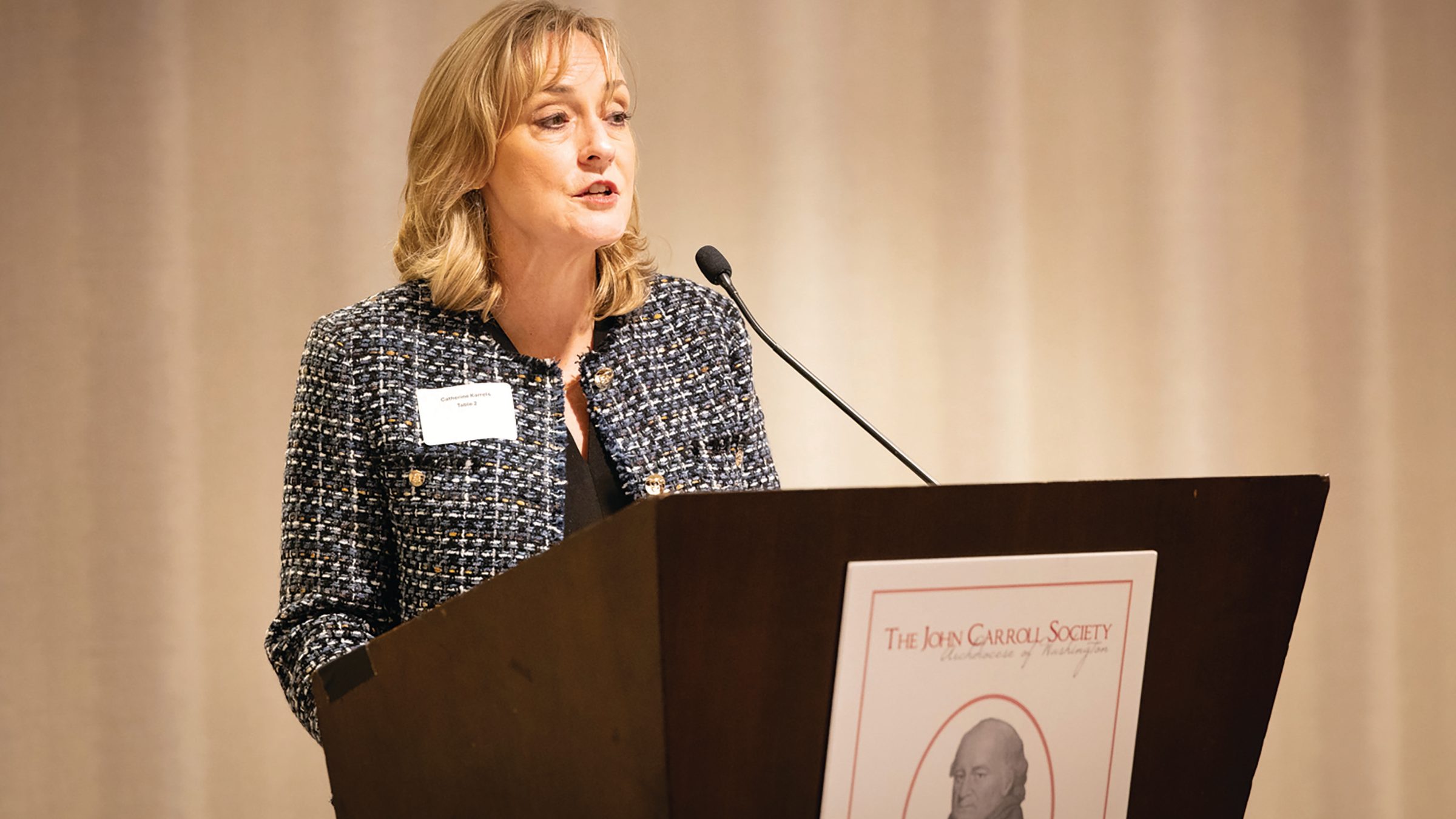
This year’s keynote address, “Faith and Learning in the Age of AI,” was delivered by Catherine Ronan Karrels, the Head of School at Stone Ridge School of the Sacred Heart in Bethesda, Maryland. Karrels, who serves on the society’s Board of Governors, reflected on how rapidly advancing technology, particularly artificial intelligence, is reshaping education and why Catholic schools are uniquely positioned to respond with clarity and hope.
Karrels opened her remarks with a personal story about encountering early GPS technology years before it became commonplace, recalling the excitement of realizing that daily life was about to change. That same sense of transformation, she said, returned when she first experimented with large language models such as ChatGPT.
“This isn’t just going to change my life,” she said. “This is going to change life as we know it.”
As an educator, Karrels said her immediate response was to consider how AI would affect schools that for decades had been slow to evolve. She noted that classrooms today are already far more student centered, inquiry based and adaptive than in previous generations, a shift accelerated by lessons learned during the COVID-19 pandemic.
Artificial intelligence, she said, represents an even more dramatic shift, one filled with promise and complexity.
“I speak from a place of great humility, not from a place of certainty,” Karrels said, describing a moment that is both exhilarating and disorienting. “Our children deserve an education that is both timeless and timely.”
Throughout her address, Karrels returned to the idea that Catholic education offers a moral framework capable of holding innovation and caution together. Catholic schools, she said, are grounded in centuries of ethical reflection and discernment, shaped by prayer, community life and an integrated approach to faith and reason.
Quoting Pope Leo XIV from his apostolic letter “Drawing New Maps of Hope,” Karrels emphasized that the central issue is not technology itself, but how it is used. Artificial intelligence, she noted, must be oriented toward protecting human dignity, justice and work, and must be accompanied by serious theological and philosophical reflection.
“At every decision point,” she said, “our Catholic foundation calls us to ask not only what we can do, but what we should do.”
Karrels outlined how Stone Ridge is approaching AI with what she described as a learner’s stance, allowing the school’s mission to guide policy, professional development and classroom practice. She offered concrete examples of how teachers are using AI tools to support differentiated instruction while maintaining academic integrity and meaningful teacher/student relationships.
At the same time, she acknowledged concerns shared by educators and families, particularly around academic honesty, bias, data privacy and environmental stewardship. Struggle, she said, remains essential to learning, and Catholic schools must design assignments and expectations that reinforce trust and responsibility.
Hope, Karrels said, comes not from technology but from community.
She described moments familiar to anyone formed in Catholic schools: students performing on stage, athletes lifted by teammates, classrooms buzzing with creativity, and entire schools gathered in prayer and song. She noted that alumnae rarely remember specific content. They remember relationships, confidence, faith and belonging.
“It is through these experiences of love and community that students come to know themselves as beloved children of God,” she said.
Earlier that morning, Father Anthony Lickteig, the Episcopal Vicar for Clergy and Secretary for Ministerial Leadership for the Roman Catholic Archdiocese of Washington, preached the homily at the Mass for the Feast of the Baptism of the Lord, drawing attention to Christ’s willingness to enter fully into human experience.
Because of Jesus’s baptism, Father Lickteig said, there is no part of human life beyond the reach of God’s grace. Christ enters not to remain in brokenness, he said, but to heal and transform.
“Our Lord does not enter into our fallen world just to remain stuck with us,” Father Lickteig said. “He enters to show us the way out.”
Father Lickteig invited the congregation to respond by freely allowing Christ into every aspect of life and by accepting the mission entrusted to the baptized. For members of the John Carroll Society, he said, that mission includes bringing Christ into professional fields such as law, medicine and education.
The John Carroll Society, founded in 1951, includes nearly 900 Catholics in the Archdiocese of Washington who work in legal, medical and other professions and businesses and assist the archbishop of Washington in charitable and community projects. They also participate in spiritual, intellectual and social activities together. The society is named for Archbishop John Carroll, who in 1789 was named as the first Catholic bishop in the new United States, leading the Diocese of Baltimore which then included the territory of all 13 original states.
Following the brunch, retired U.S. Magistrate Judge John M. Facciola in an interview reflected on the legal implications of artificial intelligence, particularly around privacy, evidence and free speech.
Facciola, an adjunct professor of law at Georgetown University, said states are already moving ahead with AI regulation rather than waiting for Congress to act. He noted that questions surrounding AI-generated evidence and privacy protections will pose serious challenges for courts.
“We have tremendous problems with privacy,” he said, calling it a central concern in discussions about AI.
Facciola also noted that the Supreme Court has treated AI-related communication as protected speech under the First Amendment, raising difficult questions about regulation and civil liberties.
As the Feast of the Baptism of the Lord brought the Christmas season to a close, Karrels – a 1986 graduate of Stone Ridge – concluded her address by recalling a phrase she learned growing up in the Archdiocese of Washington: “Keep the faith” and “Go forth renewed.”
In an age shaped by rapid technological change, she said, Catholic schools and families remain places where faith is lived, modeled and handed on, one day at a time.
(The Catholic bishops of Maryland issued a pastoral letter on artificial intelligence, “The Face of Christ in a Digital Age,” on Pentecost 2025. A link to the letter can be found on the Maryland Catholic Conference’s website.)