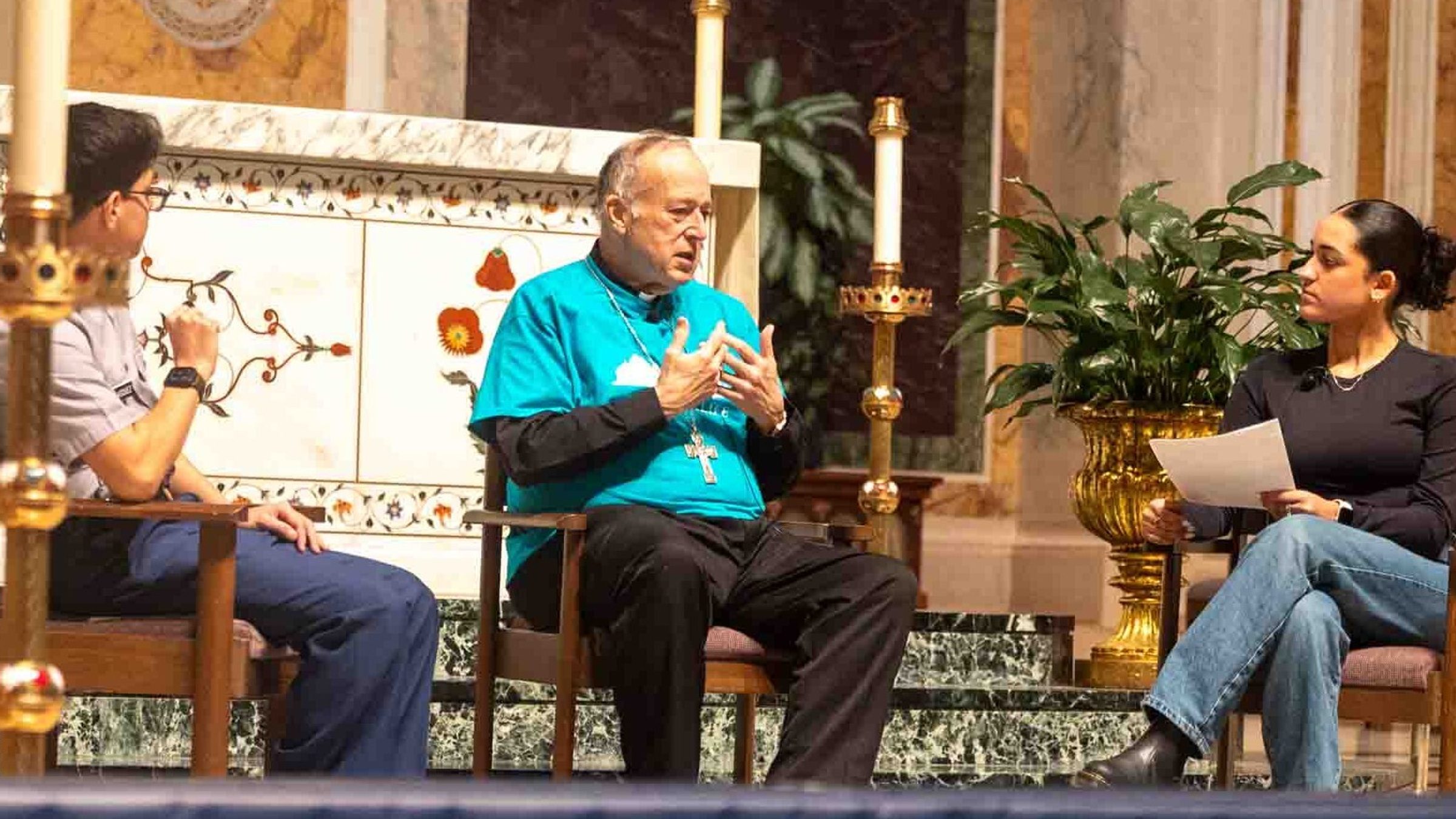

Before the Youth Mass for Life began Jan. 23 at the Cathedral of St. Matthew the Apostle in Washington, D.C., two high school juniors addressed hundreds of their peers and spoke about how they came to understand the value of human life.
Jorge Velasquez, an 11th grader at St. John’s College High School in Washington, D.C., spoke first. Dressed in his military Junior ROTC uniform, his testimony began not with certainty, but with reluctance.
He told the crowd that, for a long time, he participated in the faith out of obligation rather than personal commitment. As an eighth grader attending a parish retreat, Velasquez said he felt emotionally distant.
“I had been baptized as a baby, and a lot of the faith stuff growing up felt like something I was just supposed to do,” he said in an interview following the testimonies. “It felt more like something I had to do than something I wanted to do at the time.”
At the retreat, Velasquez said he was going through the motions during the scheduled activities. During a period of silent reflection, he described the moment when he first spoke honestly to God, asking for a sign. He asked for a star.
When one appeared in the night sky, Velasquez said the moment stayed with him.
“That one small sign reminded me that my life mattered,” he told the congregation.
Asked what he would say to students who attend retreats or Church events feeling pressured or resistant, Velasquez encouraged them to remain open.
“Even though it might feel hard or uncomfortable at first,” he said, “sometimes those experiences end up meaning more than you expect.”
Velasquez said he tries to recognize the dignity of others through everyday actions.
“I look for how people show kindness,” he said. “How they treat others, especially people who might be different from them.”

Andrea Patiño, also an 11th grader, attends the Academy of the Holy Cross in Kensington, Maryland, where she is president of the Pro-Life Club. Her testimony traced the beginning of her pro-life convictions to a classroom assignment rather than a personal turning point.
Two years ago, she said, she did not know abortion existed.
That changed during her freshman year, when a government class assignment on current events included a presentation on abortion and the overturning of the Supreme Court’s 1973 Roe v. Wade decision that had legalized abortion on demand.
As classmates described abortion as “necessary and empowering,” Patiño said what unsettled her most was not the argument itself, but the absence of dissent.
“Everyone was nodding along,” she said during her testimony. “That’s what really shocked me.”
After her testimony, Patiño explained how Holy Cross encourages students to speak openly, even when opinions do not align neatly with Catholic teaching. That environment, she said, forced her to examine what she believed and why.
At first, language such as “terminating a pregnancy” felt distant and abstract. Learning more about the physical realities involved changed that.
“When you dig deeper and actually take time to understand what that means,” she said, “you really have to decide where you stand.”
That process led Patiño to see the pro-life position as inseparable from a broader commitment to human dignity. In her testimony, she spoke about opposing not only abortion, but also assisted suicide and the death penalty, framing the issue as one of moral consistency rather than politics.
“If I decide that some lives are more worthy of protection than others,” she said, “then no life is truly safe.”
Patiño also tied her beliefs to her personal history. She immigrated to the United States from Venezuela at age four, an experience that continues to shape how she understands the dignity of the human person.
“Everyone has the right to life, regardless of where they come from,” she said. “We shouldn’t judge people based on their country, their background or their circumstances.”

Following their testimonies, Velasquez and Patiño joined Cardinal Robert W. McElroy, the archbishop of Washington, for a question-and-answer session on the right to life and the future of the pro-life movement.
Cardinal McElroy reflected on his own college years, when the Supreme Court’s Roe v. Wade decision shaped the national conversation. At the time, he said, there was little sense of momentum or optimism.
“There wasn’t much hope,” he told the students. “If you had asked me then whether I would be sitting here 50 years later talking about this, there wasn’t much hope back then.”

Addressing how Catholics engage those who do not share their faith, Cardinal McElroy emphasized grounding those conversations in both reason and science. He encouraged students to focus on the question of when life begins, noting that scientific understanding affirms that a fetus is genetically a distinct human being.
“Any loss of human life is a tragedy,” he said.
Belief in God, he added, is not a prerequisite for recognizing human dignity.
At the same time, Cardinal McElroy stressed that compassion must remain central to any pro-life witness, including support for women facing crisis pregnancies through emotional, physical and financial assistance.
“If we say we’re pro-life but don’t show compassion,” he told the students, “then we’re not truly witnessing to life.”