As Advent nears, parishes will soon echo with familiar and beloved hymns anticipating a baby to be born in Bethlehem.
But the Palestinian Christians in that city are – along with Taybeh, the last entirely Christian community in the Israeli-occupied West Bank – struggling for their very existence, said a group of speakers during a Capitol Hill press conference on Nov. 16.
In an effort to raise awareness of the plight of Palestinian Christians in the Holy Land, a coalition of organizations and clergy – declaring, “Not in Christ’s name!” – gathered in front of the United Methodist Building in Northeast Washington, D.C., before meeting with members of Congress.
Honey Thaljieh – co‑founder and first captain of the Palestine women’s national soccer team – told the crowd she was representing her brother, Father Issa Thaljieh, a parish priest at the Church of the Nativity in Bethlehem.
“He should be standing here today, speaking for himself and for the people he serves – but he was denied a visa to enter the United States,” Thaljieh shared. “You can deny a priest a visa, but you cannot deny the truth he carries.”
The truth, she emphasized, is that the Palestinian Christian community – which daily navigates Israeli checkpoints, road closures, movement restrictions, and permits – is becoming less and less viable.
Both Bethlehem and Taybeh are located in the West Bank of Palestine – which has been under military occupation by Israel since June 7, 1967.
On Oct. 7, 2023, Hamas — an armed political movement combining Palestinian nationalism with Sunni Islamist principles — attacked Israel, resulting in 1,200 deaths and 251 hostages. The assault in turn triggered an Israeli military campaign that has — according to the Council on Foreign Relations — since killed over 70,000 Palestinian civilians and fighters and displaced nearly the entire population of Gaza, a small coastal territory home to about 2.1 million Palestinians.
In his Aug. 16, 2026, Angelus address in Rome, Pope Leo XIV renewed an appeal “for an end to the ongoing violence against the Palestinian civilian population in the West Bank,” adding he was urgently calling on the international community “to work toward advancing the two-state solution, for a just and lasting peace.”
Among the 70,000-plus Palestinian dead are an estimated 20,179 Palestinian children, as reported by a June 2026 United Nations Human Rights Council report. They are memorialized on the Gaza Children's Shroud, a 120-yard cloth bearing their handwritten names and ages. Portions of the shroud were on display at the press conference.
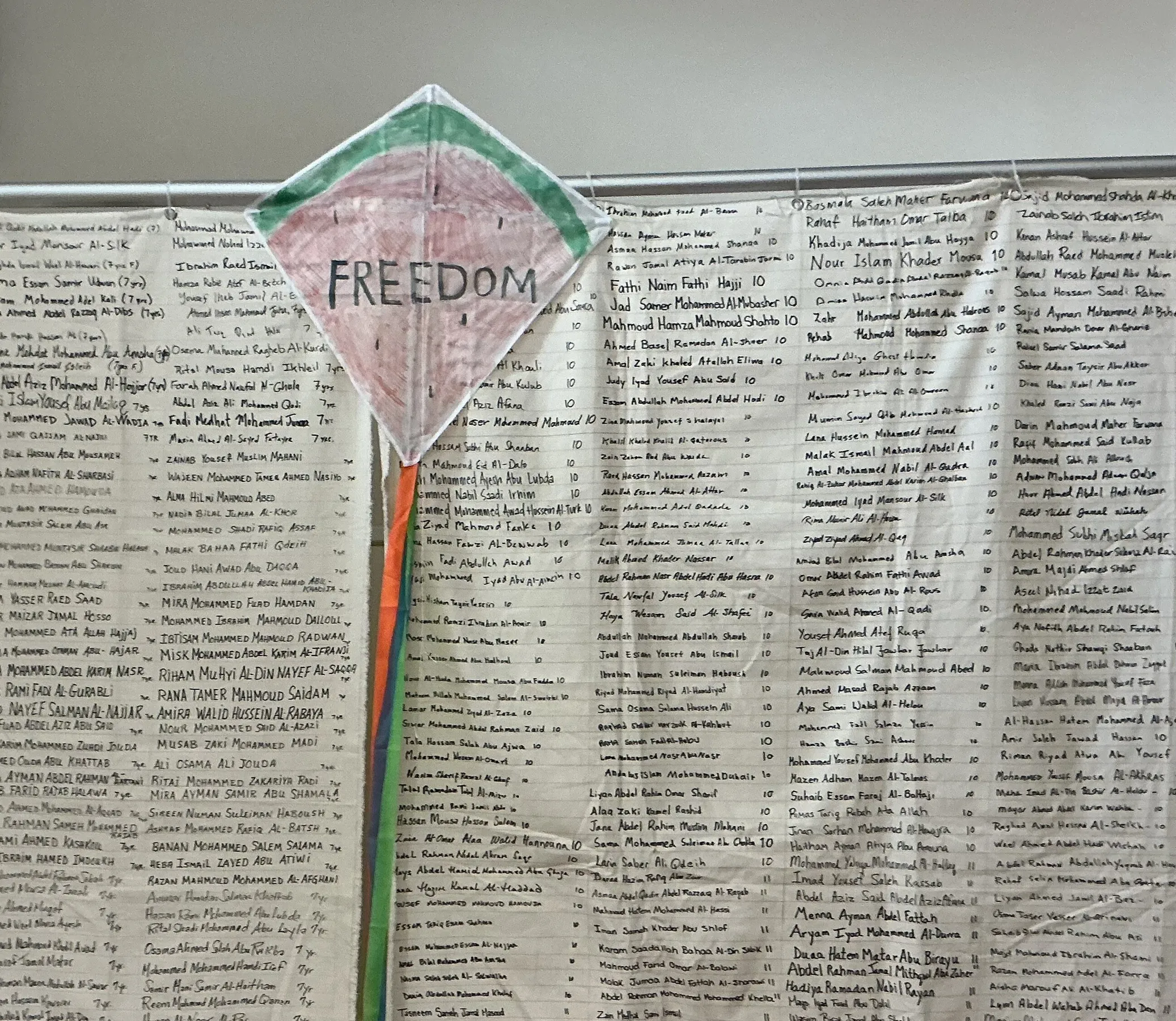
“This is how a community disappears – not all at once,” Thaljieh noted. “Family by family; home by home; generation by generation.”
In the 1950s Christians accounted for 86% of Bethlehem’s population; today, that number hovers at less than 10% – fewer than 30,000 individuals.
“We are not relics of Christianity’s past. We are the living stones of the Holy Land,” asserted Thaljieh. “We continue to pray, to worship, serve, and raise our children in the land where Christianity began.”
She then had a request.
“To American Christians – especially those who use Christianity to justify weapons, occupation, and displacement – I say, do not sing about Bethlehem while supporting the policies that are emptying Bethlehem of its people,” Thaljieh implored. “This is not done in Christ’s name. We are not asking for pity, and we are not asking only for prayers. We are asking you to act.”
Father Bashar Fawadleh – a parish priest of the Latin Patriarchate of Jerusalem and pastor in Taybeh, who said he had just come from that town – echoed Thaljieh’s urgency.
“We don’t want to become the last generation of Christians in the Holy Land – and especially also in Taybeh, the last Christian village in the area,” he explained. “We want our children to inherit a living community, not a museum of Christianity.”
However, those children “are growing up surrounded by fear. Our farmers are struggling to reach their olive groves,” Father Fawadleh added.
As Vatican News reported on Oct. 21, 2026, “The patriarchs and heads of churches in Jerusalem have issued a statement firmly condemning the ‘heinous attack’ carried out on Saturday, Oct. 17, by ‘masked settlers’ in the Christian village of Taybeh. The attack targeted residents harvesting olives, as well as diplomats and officials from European countries who were visiting the area on a solidarity mission.”
The United Nations Office for the Coordination of Humanitarian Affairs noted in an Oct. 22 situation report that since Sept. 1, 272 olive-harvest-related Israeli settler attacks have been documented, “exceeding the totals recorded during the entire 2024 and 2025 harvest seasons.”
“The world cannot celebrate the Holy Land while remaining silent about the suffering of its people,” declared Father Fawadleh. “We don’t ask you simply to remember our Holy Land, the homeland of Jesus. We ask you to help our homeland remain alive – because Christianity in the Holy Land must have not only a past, but also a future.”
The Reverend Doctor Mitri Raheb – a Palestinian Lutheran pastor, and founder and president of Dar al-Kalima University in Bethlehem – said the Gaza Training Center satellite of his institution was heavily damaged during Holy Week 2024.
“Every day, Israel is bombing Gaza,” he informed the gathering, citing statistics that 70% of infrastructure has been destroyed, including all universities; 80% of schools; and 33 out of 36 hospitals.
“I come from Bethlehem,” Reverend Raheb concluded. “Bethlehem gave Jesus to the world. It is high time for the world to give peace to Palestine.”
Mother Agapia Stephanopoulos – an Orthodox Christian nun and Palestinian advocate – also urged engagement.
“We have to end the occupation – which means the U.S. must stop providing weapons, and instead put their weight behind humanitarian acts and diplomatic initiatives for peace,” she counseled, adding that a delegation would be visiting Congress that afternoon.
“We will ask them,” said Mother Agapia, “to do what Jesus would do: Hear the stories of the Christians of Christ’s homeland, and take actions of mercy and peace – for their sake, and for the sake of a better United States.”
While 20,000-plus Palestinian children have been killed, another 44,000-plus are estimated injured according to that June 2026 United Nations Human Rights Council report.
Father John Heagle – coordinator of Priests Against Genocide, USA – invited more U.S. priests to speak out on the issue.
“I have learned – even though I am a celibate and have no children – that there’s no such thing as someone else’s children,” Father Heagle declared. “My experience with the shroud – and the sacred experience of the children who have been lost – is heartbreaking, and I verge between tears and rage as I think about what has happened to the children.”
“This tragedy that we’re witnessing together is not only a Palestinian tragedy, or a loss for Christians in the Holy Land – though it is certainly and especially those things,” said Bishop Philip Hirsch of the Metro D.C. Synod of the Evangelical Lutheran Church in America. “It is a loss for all of us, as a human community together.”
Bishop Hirsch added his synod “decided to stop supporting companies that do business with those who are settlers in the West Bank.”
The press conference closed a weekend of Christian witness, including events on the National Mall, Orthodox Christians for Palestine’s “Not in Christ’s Name” Summit in Potomac, Maryland, and parish gatherings.