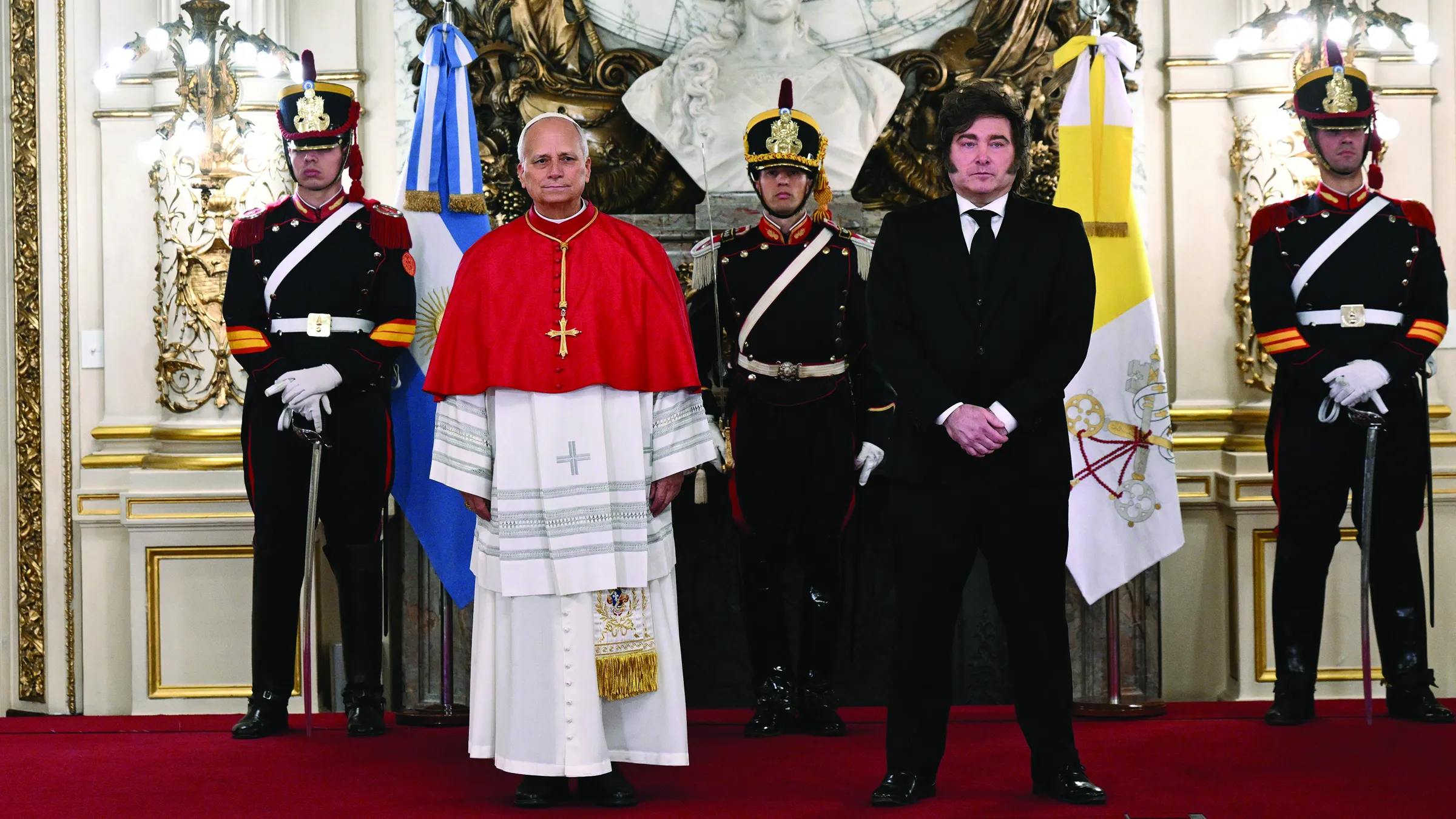


Pope Leo XIV arrived in Buenos Aires Nov. 8 urging Argentina’s civil leaders to safeguard democracy, protect the unborn, and engage in respectful dialogue across political divides after meeting with President Javier Milei at the Casa Rosada presidential palace.
The papal flight from Uruguay on an Aerolineas Argentinas plane dubbed “Pontifex Maximus” touched down after 4:30 p.m. at Buenos Aires International Airport after a short 40-minute flight across the Río de la Plata. Milei, Argentina’s libertarian leader since 2023, personally welcomed Pope Leo on the tarmac.
Argentina is home to more than 43 million Catholics, according to the latest Vatican statistics from 2022, which state that over 92 percent of the country’s population is baptized Catholic. However, according to Pew Research Center, only 58 percent of adults self-identify as Catholic.
People waving Vatican flags lined the avenues of Buenos Aires, nicknamed the “Paris of South America,” as the pope made his way to the Casa Rosada, where Milei resides, for a private one-on-one meeting with Argentina’s self-described “anarcho-capitalist” leader who was raised Catholic, but has expressed a desire to convert to Judaism.
In the pope’s first speech in Argentina in the Palacio Libertad, Pope Leo honored his predecessor Pope Francis, who was a native son of Buenos Aires, but never returned to his homeland after his election as pope in 2013.
“My arrival in this land is personally meaningful,” Pope Leo said. “Today, as his successor in the Petrine ministry, I am in some sense retracing his steps in this country where the personal history of Pope Francis would later be joined to that of the entire Church.”
Pope Francis, born Jorge Mario Bergoglio, led the archdiocese of Buenos Aires from 1998 until he became pope. As the bishop of Buenos Aires, he was known for riding the subway, and regularly visiting poor barrios, or neighborhoods, of the city.
Milei, who previously derided Pope Francis as a “filthy leftist,” later eulogized him as “the most important Argentine in history” and shed tears while attending the late pope’s funeral in 2025. He told Radio Mitre in Argentina that he had apologized to Pope Francis. “He told me, ‘Don’t get upset, these are youthful mistakes.’”
In the Palacio Libertad, with Pope Leo seated nearby on stage, Milei lauded Pope Francis again, saying in his opening speech that Pope Francis’s death “left a huge void in our entire people, both for his faithful and for those who do not belong to the Church.”
“He was an exceptional figure who, through his humanity, inspired us all, regardless of our faith,” Milei said. “A person of immense generosity whom I had the honor of knowing firsthand.”
Pope Leo spoke after the Argentinian president in a diplomatic and measured tone, underlining the importance of ethical technological development, respect for the environment and the dignity of every human person.
Democracy, the pope underlined, is “strengthened by the daily conduct of public life: through willingness to listen, through careful use of words, through the patient search for agreement, and through the ability to see those who think differently as fellow citizens with whom we share a common future.”
“In this way, a spirit of trust is created, one that enables a society to deal with its differences without losing sight of the things that keep it united,” he said.
“Those entrusted with public office are charged with a particularly demanding task. Authority is most authentic when it is exercised as service, when it looks beyond the immediate, and when it uses its power to promote the welfare of all,” Pope Leo added.
In his speech, Pope Leo highlighted Argentina’s unique culture from the tango, “born from the encounter of different neighborhoods, ports and backgrounds” to the sharing of a drink of mate, which “turns a moment of relaxation into an opportunity for conversation and closeness.”
The pope also urged introspection on the part of Argentina’s leaders, saying, “a nation must seriously ask itself where it has failed when its young people have to leave their homeland in order to make their dreams come true.”
“What place do children not yet born occupy in our decision-making? Before asking ourselves what kind of world we will leave our children, we must first recognize their dignity,” Pope Leo added.
“That same dignity requires that particular concern be shown for those affected by illness, dependency and disability,” he said. “Here, too, we have a duty to care for others, to alleviate suffering, to accompany them, and to ensure that every person feels that his or her life always retains a value that no circumstance can diminish.”
Pope Leo’s speech to Argentina’s political authorities marked the end of public events on his first day in Buenos Aires. After leaving the presidential palace, Pope Leo was expected to hold a private meeting with members of the Augustinian Order at the apostolic nunciature before ending his day. Pope Leo will remain in Argentina until Nov. 11.
The pope is scheduled to celebrate an outdoor Mass in the center of Buenos Aires, one of the most populous cities in Latin America, on the morning of Nov. 9 before meeting with social movements at the Catholic University of Argentina, with religious leaders at the Palacio San Martín, and with the local Catholic community at the Metropolitan Cathedral of Buenos Aires.
On Nov. 10, Pope Leo plans to fly to Córdoba, the country’s second-largest city, to celebrate Mass on the grounds of the Military Aviation School and meet with Church leaders at the Cathedral of Our Lady of the Assumption. In the evening, the pope plans to preside over a youth vigil in Buenos Aires.
The pope’s visit to Argentina is scheduled to culminate in a Mass at the Marian shrine of Our Lady of Lujan, Argentina’s patroness and one of its leading pilgrimage sites, on the morning of Nov. 11 before he flies north to his much anticipated “homecoming” in Peru.