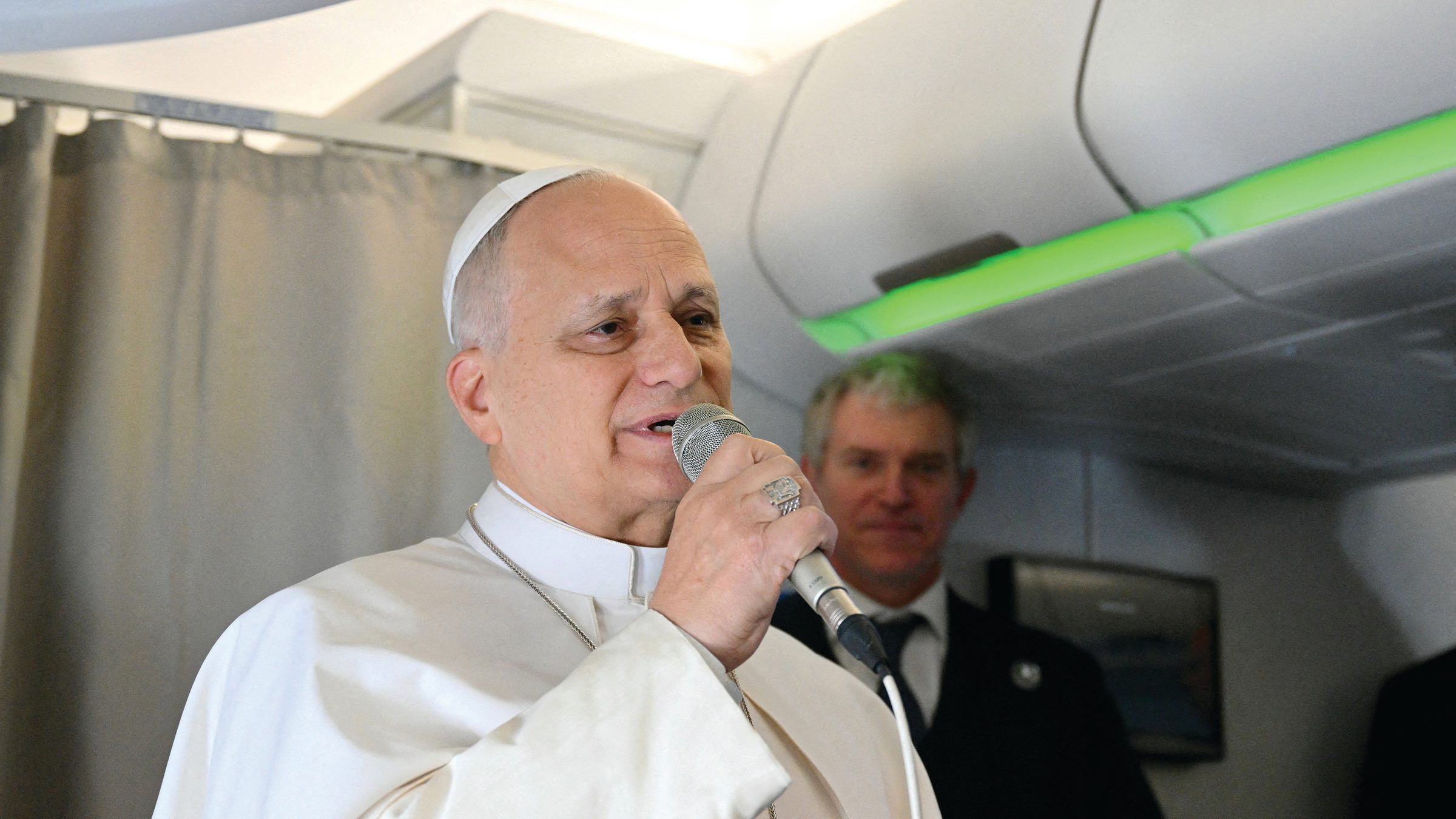

Catholic bishops and lay leaders across the political spectrum are expressing their shock and disapproval following President Donald Trump’s online screed against Pope Leo XIV.
Others have also voiced concern over an image which Trump posted within an hour of attacking the vicar of Christ that appeared to depict Trump as Jesus Christ himself.
Trump deleted the post of him looking like Christ the following day, after an uproar from Christians denouncing the depiction as blasphemous, but he refused to apologize to Pope Leo.
“Pope Leo said things that are wrong,” Trump said, doubling down on a 330-word condemnation of the pope April 12 as “WEAK on Crime, and terrible for Foreign Policy,” and taking credit for the U.S.-born pope’s election.
Archbishop Paul S. Coakley of Oklahoma City, president of the U.S. Conference of Catholic Bishops, issued a statement that evening, saying he was “disheartened that the President chose to write such disparaging words about the Holy Father.”
Archbishop Coakley said that the pope is not Trump’s “rival,” and “nor is the Pope a politician. He is the Vicar of Christ who speaks from the truth of the Gospel and for the care of souls.”
Cardinal Joseph W. Tobin of Newark, New Jersey, who was part of an interview on Pope Leo with CBS’ “60 Minutes” program that aired April 12, told OSV News in an April 13 statement that Trump’s “recent statements and actions ... convey a grave misunderstanding of the Holy Father’s ministry and a troubling lack of respect for the faith of millions.”
“Pope Leo serves a higher authority and desires to proclaim the Gospel faithfully and advance the Church’s peaceful mission in a world deeply in need of healing,” he said.
“He will continue to speak clearly against war and other offenses against human dignity and to call for authentic dialogue, because the Church’s witness is grounded in the peace of Christ, not in partisan interests,” Cardinal Tobin said.
Other fellow prelates rallied around the pope in the wake of Trump’s broadside.
Shortly after Trump’s post attacking Pope Leo, Ukrainian Greek Catholic Metropolitan Archbishop Borys A. Gudziak of Philadelphia issued a statement posted to his Facebook page, saying he was “most grateful” to the pope for his “personal integrity, spiritual serenity, ethical clarity and courageous and prophetic preaching of the Gospel and of the truth of God’s love at this time of great moral confusion.
“The world should listen carefully,” he said.
Archbishop Mark S. Rivituso of Mobile, Alabama, backed Archbishop Coakley’s statement, adding in an April 13 message that he affirmed “the Holy Father’s role as a spiritual leader who speaks from the Gospel and for the care of souls.” He encouraged “all the faithful to be one with the Holy Father in praying for and witnessing to the Gospel of Christ’s peace and care for all peoples.”
In an April 13 post on X, Bishop Robert E. Barron of Winona-Rochester, Minnesota, called Trump’s statements about the pope “entirely inappropriate and disrespectful.”
“It is the Pope’s prerogative to articulate Catholic doctrine and the principles that govern the moral life,” he said. “In regard to the concrete application of those principles, people of good will can and do disagree.”
Bishop Barron praised the Trump administration’s engagement with Catholics, noting his membership on the president’s Religious Liberty Commission, and encouraged “serious Catholics within the Trump administration” to meet with Vatican officials “so that a real dialogue can take place.”
“No President in my lifetime has shown a greater dedication to defending our first liberty,” said Bishop Barron, adding, “All that said, I think the President owes the Pope an apology.”
But when reporters at the White House asked about Bishop Barron’s statement April 13, Trump said he had “nothing to apologize for.”
“Pope Leo said things that are wrong, he was very much against what I’m doing with regard to Iran, and you could not have a nuclear Iran, Pope Leo would not be happy with the end result,” Trump said.
Speaking to Fox News April 13, Vice President JD Vance, a Catholic, addressed Trump’s social media post, saying, “We can respect the pope, we certainly have a good relationship with the Vatican, but we’re also going to disagree on substantive questions from time to time. I think it’s a totally reasonable thing and isn’t particularly newsworthy.”
Regarding the AI-generated image of Trump looking like Christ, Vance said he believed it was “a joke” and that the president took it down after recognizing “a lot of people weren’t understanding his humor.”
“I think the president likes to mix it up over social media, and that’s one of the good things about this president,” Vance said.
Archbishop George Leo Thomas of Las Vegas said in an April 12 statement that he was “grateful to God for sending us Pope Leo XIV, who is willing to speak truth to power just when we need him the most.”
“Pope Leo is calling for dialogue over diatribe, prayer over politics, and diplomacy above destruction,” said Archbishop Thomas. “We know that he will be unfazed by the President’s ad hominem attacks and sophomoric rhetoric.”
The archbishop said the pope is “doing what every spiritual leader is called to do – to pray for peace, to call for the protection of helpless civilians, and to plead for world leaders to end mass destruction and armed conflict in every part of the world.
“God bless you, Pope Leo,” he said. “We stand with you in prayer and offer you our loving support.”
Archbishop Nelson J. Pérez of Philadelphia said in an April 13 statement that the pope and his message “deserve respect and admiration.”
“His continued calls for peace, hope, diplomacy, and the conversion of hearts should be heeded by all,” said Archbishop Pérez, pointing out how Pope Leo “has consistently spoken with clarity and compassion” to promote “peaceful resolutions to complex challenges” that uphold human dignity.
Joining the bishops in protesting Trump’s post was Ashley McGuire, senior fellow at The Catholic Association, an organization dedicated to defending religious liberty and the Church in the public square.
In an April 13 statement to OSV News, McGuire said the association “laments President Trump’s disparaging and disrespectful remarks about Pope Leo.”
“The Catholic Church does not in any way fit into American political boxes. It will always prioritize the protection of innocent life in all its stages as well as the cause of the poor and marginalized,” said McGuire. “Insulting the Pope, and all Catholics by extension, with the hope of making the Church bend to American political agendas, is discouraging and counterproductive.”
The Council on American-Islamic Relations also offered an April 13 message of support, saying, “We stand in solidarity with the Catholic community in the wake of President Trump’s attack on Pope Leo.”
CAIR referenced an earlier post Trump made, in which he threatened to annihilate Iran while “sarcastically praising Allah,” and said that “the president’s mockery of religion is both deranged and insulting.”
Kelsey Reinhardt, CEO of the political lobbying organization Catholic Vote, said in a lengthy post on X April 13 that Trump’s post “insulting Pope Leo” had “crossed, again, a line of decorum” and that “calls for an apology are well founded.”
However, Reinhardt said that “the Pope also needs to understand that many Americans view his interventions as overtly political and aligned with one side of the political spectrum.”
Reinhardt, whose organization is publicly aligned with Trump’s agenda, particularly on immigration policy, and is not formally authorized by any Catholic bishop to use Catholic in its name, blamed “parts of the media” and “identifiable bad actors” for manufacturing “a large-scale confrontation between the Vatican and the United States, between Pope Leo and President Trump, or between fidelity to the Holy Father and love of country.”
Trump’s social media tirade against Pope Leo was also compounded by a Truth Social post – delivered 46 minutes later – showing a Christ-like rendering of Trump in white and red robes, laying one glowing hand on a man on a sickbed looking up at him, with Trump’s other hand holding an orb of light.
Surrounding the bed were at least four figures appearing to venerate Trump, who was framed by images of the Statue of Liberty, the Lincoln Memorial, the U.S. flag, warplanes, bald eagles, and five heavenly figures in military gear.
“The graphic exploitation of sacred imagery is deeply offensive and undermines the reverence owed to what believers hold most dear,” Cardinal Tobin told OSV News.
McGuire said Trump’s “use of imagery that mocks Jesus Christ is beyond the pale and is not just insulting to Catholics, but to all Christians.”
A number of prominent evangelical leaders and influencers – including Doug Wilson, pastor of U.S. Secretary of Defense Pete Hegseth, and podcast host Riley Gaines – also deplored the image as blasphemous.
Rev. Jim Wallis, founding director of Georgetown University’s Center on Faith and Justice, told OSV News the image is “the epitome of Christian nationalism,” as well as “stark heresy and a pure blasphemy.”
“Donald Trump has a dangerous messianic complex,” Rev. Wallis said.
Matthew D. Taylor, visiting scholar at the Georgetown center and an expert on Christian nationalist ideology, agreed, adding that the image is “typical of the quasi-messianic status he has recently started to claim for himself.”
“I don’t see how that could possibly end well,” he said.
Amid the outrage, the AI-generated image was removed from Trump’s Truth Social feed on April 13. The president told reporters the same day that he thought the depiction had been of him “as a doctor making people better and I do make people better. I make people a lot better.”
“I did post it,” he said, “and I thought it was me as a doctor and had to do with the Red Cross.”