
As Pope Leo XIV prepares to visit Monaco March 28, Americans will no doubt be reminded of another U.S.-born Catholic monarch – the actress-made-princess Grace Kelly, who lived in Monaco following her marriage to its Sovereign Prince Rainier III in April 1956 until her untimely death in 1982.
A picture of class and composure, Princess Grace was also a faithful Catholic. Here are six ways she put her faith at the fore while princess of the world’s second smallest country (after Vatican City, of course!).
1. Big Catholic wedding. On April 19, 1956, the 26-year-old movie star knelt next to Prince Rainier to receive holy Communion during their televised nuptial Mass in Monaco’s cathedral before more than 600 guests. Princess Grace carried a small posy of lilies of the valley on top of a gilt-edged missal titled “Bride’s Manual: A Manual of Catholic Devotion with Mass for the Marriage Ceremony and the Nuptial Blessing,” which she later gave to the the Philadelphia Museum of Art, along with her silk and lace wedding gown. The wedding Mass followed a day after a civil ceremony, as required by the Napoleonic Code.
The couple was married by Bishop Gilles Barthe of Monaco, and Pope Pius XII sent his blessings via his nuncio in Paris. During the ceremony, Father John Carton, pastor of the Kelly family’s Philadelphia parish, “asked each of them to make sacrifices ‘generously’ to preserve their union,” The New York Times reported.
After the ceremony, the prince and princess drove through Monaco’s streets, stopping at the Sainte-Dévote Chapel, where Princess Grace left her bouquet as a sign of devotion to the fourth-century martyr and patroness of Monaco, Saint Devota. The couple left that evening for their Mediterranean honeymoon on a yacht named with a motto from the prince’s family: “Deo Juvante,” Latin for “With the help of God.”
2. Model of motherhood. The royal couple had three children, Princess Caroline (born 1957), Prince Albert II (born 1958) and Princess Stéphanie (born 1965). Princess Grace was known to be a loving and attentive mother. At a La Leche League convention in 1971 in Chicago, Princess Grace championed breastfeeding and the primacy of the mother-child relationship over other obligations. “In the beginning, when they needed me, and I, them, there were no compromises. State had to wait upon mother,” she said.
In August 1976, Princess Grace and Prince Rainier spoke about marriage and family during the 41st International Eucharistic Congress in Philadelphia. “The role of the wife and mother in the family structure is probably more difficult today than ever before,” Princess Grace told a crowd of thousands. “With more and more women working out of necessity or desire … her role is more complex though essentially the same as it always has been – namely, to keep the family together, husband and children as a harmonious unit and to provide a link between generations.”
When she died, Saint John Paul II said he was “profoundly grieved at the death of Princess Grace, who always carried out her mission as a sovereign and as a mother of a family with a great spirit of faith and in a manner which gained her the respect and sympathy of all.”
3. Devotional film participation. The Oscar-winning actress retired from Hollywood after her marriage, but she did participate in three faith-based films shortly before her death. Her friendship with Holy Cross Father Patrick Peyton, founder of the Family Rosary Crusade, led to her collaboration with his Family Theater Productions ministry. In an Easter production, she prayed the rosary alongside Father Peyton, and in others, she narrated reflections on the life of Christ.
In a 1981 interview, Father Peyton said that Princess Grace “always had a yearning to do something for the rosary.” “At first, she had the idea of building a rose garden in honor of the rosary on the grounds of the royal palace in Monaco,” he said. While filming the rosary-based films, he told her, “This is really your rose garden.”
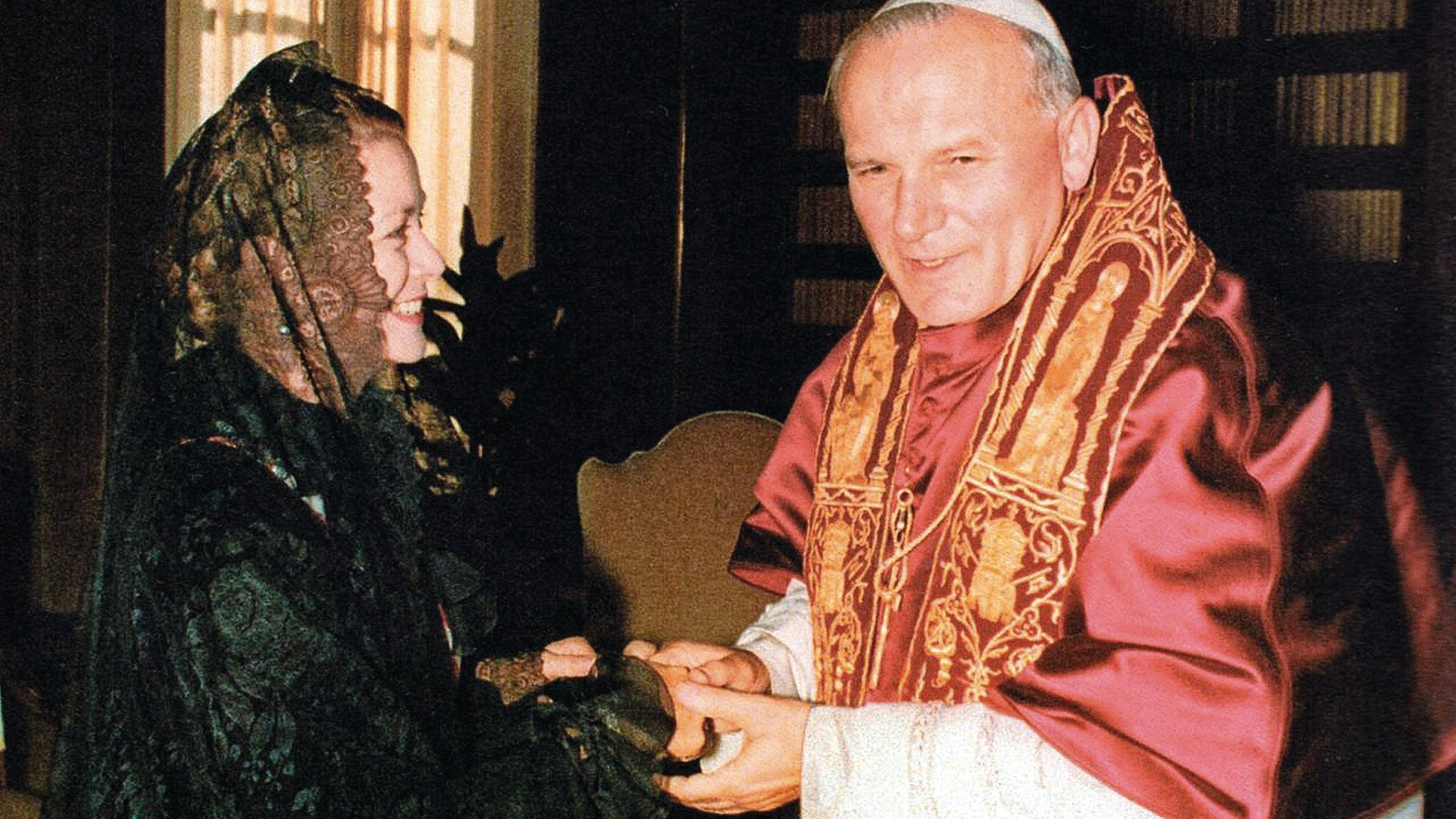
4. Papal encounters. Princess Grace met with five popes. In April 1957, Pope Pius XII received the princess and the prince in a state visit. He expressed the hope that “one may always admire in you the splendor of Christian faith.” The couple also made state visits to Saint John XXIII in 1959, Saint Paul VI in 1974, and Pope John Paul I and Saint John Paul II, both in 1978. However, none of those popes visited Monaco, a Catholic principality; Pope Leo’s visit is the first papal trip to the principality in the modern era.
5. Refugee humanitarianism. Princess Grace used her platform to urge action in addressing the international refugee problem. In 1958, writing in America, the Jesuit magazine, she said the problem is not “complicated beyond solution.” As an obituary recounted, that essay highlighted the successful resettlement of Hungarian refugees uprooted by the aborted 1956 revolution in that country, saying, “When we really make up our minds to provide a solution to the tragic problem of homelessness, a solution can be found.”
She continued: “As individuals, we feel powerless to help these unfortunate people, but this is a mistake, as tragic for our own souls as for the lives of our fellow men. The actions of governments and private organizations must find their origin in the hearts and minds of each of us.” She also dedicated her time to other charitable organizations and humanitarian causes.
6. Cathedral burial. When Princess Grace died at age 52 following a car accident caused by her having a stroke, she was entombed in the Grimaldi family crypt in the Cathedral of Our Lady Immaculate, also known as Saint Nicholas Cathedral, where she had been married and her children baptized. In the homily of her funeral Mass, Archbishop Charles Brand of Monaco called her a “humanly exceptional, religiously exceptional person.” In Philadelphia, about 2,000 mourners attended a memorial Mass at the Cathedral Basilica of Saints Peter and Paul celebrated by Cardinal John J. Krol of Philadelphia. Prince Rainier was buried alongside her after his death in 2005.