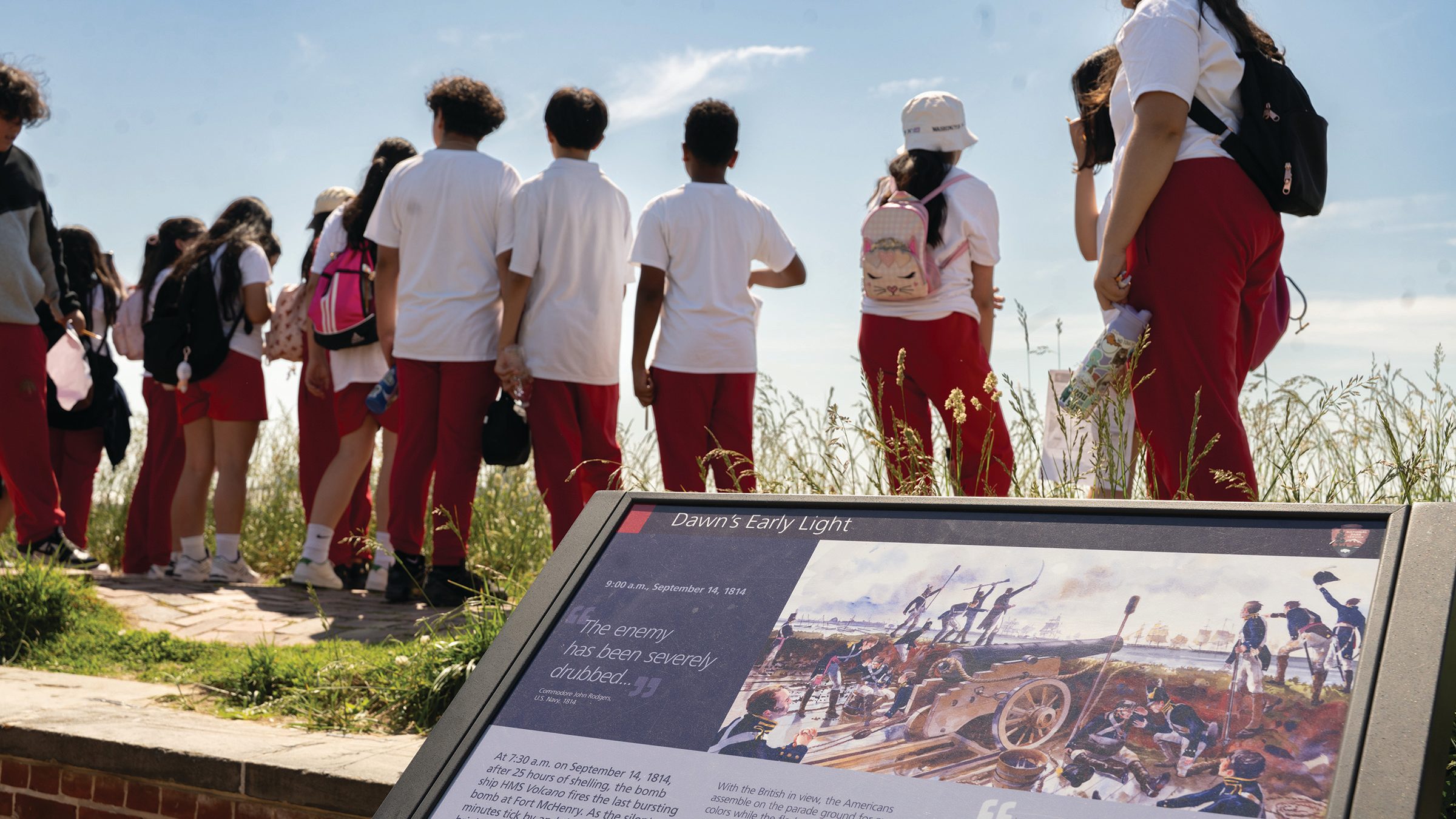

As sixth grader Reese Paolucci bent down to pick up a discarded Capri Sun pouch from the grounds of Fort McHenry, she wasn't trying to draw attention to herself. She glanced toward the stone walls of the historic fort and explained why she stopped.
"People fought here and died here," Paolucci said. "I don't want people disrespecting it."
For Ellen Lafferty, moments like that are exactly why she wanted to bring her students to Fort McHenry.
This spring, fifth and sixth grade students from Sacred Heart Bilingual Catholic School in Washington visited the historic site after Lafferty received a competitive History Field Trip Grant from the American Battlefield Trust. The grant helps K-12 teachers bring students to Revolutionary War, War of 1812 and Civil War battlefields and related historic sites.
"I visited the site over Christmas break and immediately realized how engaging and meaningful this experience would be for students," Lafferty said. "Its proximity to Washington also makes it practical because we can travel there and return within the school day."
Located in Washington's Mount Pleasant neighborhood, Sacred Heart Bilingual Catholic School is the Archdiocese of Washington's only two-way dual-language Catholic school. Students learn in English and Spanish while the school emphasizes faith formation, academic excellence and service to the common good.

Before the trip, students learned about the causes of the War of 1812, why Francis Scott Key found himself aboard a ship in Baltimore Harbor during the British bombardment of Fort McHenry, and how the fort's distinctive star-shaped design strengthened its defenses.
Then they walked the same grounds where those events unfolded.
"It means the world to me to take students to these places and immerse them in history firsthand," said Lafferty, who teaches art and technology at Sacred Heart. "Experiences like these bring learning to life in a way that textbooks simply cannot."
Lafferty said she has seen students grow more curious and confident through experiences like these. Last year, she took seventh and eighth grade students to Gettysburg National Military Park, and many of those students still talk about the trip and the impact it had on them.
She encourages students to see themselves as part of the nation's story by connecting classroom lessons to real people, places and events. Through hands-on projects, art and discussion, students explore themes of community, responsibility and freedom while learning that American history includes many voices.

As students explored the fort, they reflected on the meaning of freedom, citizenship and responsibility.
Asked what freedom means to her, sixth grader Helen Pengelly answered simply.
"Because you have the right to make your own choices for yourself, live the life you want, and just be happy," she said.
Pengelly said conversations in her classroom have shaped the way she thinks about those freedoms.
"I want my friends to stay," she said, explaining that many of her classmates come from immigrant families. "I think the freedom and the right to live in America is definitely something we would fight for."
For sixth grader Jackie Cárdenas, whose parents immigrated from El Salvador, the visit prompted her to reflect on the sacrifices families make in pursuit of a better future.
"I think they came here because they wanted a better place to live and a better life," she said.
Cárdenas said learning about American history also shaped the way she thinks about citizenship.
"If you think this country is a good place, then you should protect it because it's your country now."
Classmate Samantha Reyes thought about the ways immigrant families help shape the country they now call home.
"We bring our cultures," she said. "We share traditions, dances, food and celebrations that make other people happy."
Paolucci's thoughts turned toward another phrase familiar to many students.
"I would probably fight for justice for all," she said, recalling the words of the Pledge of Allegiance.
As she spoke, the discarded juice pouch she had picked up earlier rested in a nearby trash can. The gesture echoed the respect she said she felt for those who had defended the fort.


Lafferty said those connections are what students remember long after the bus ride home.
"When students can walk through a place where history actually happened, they gain a better understanding of the people, events and challenges of the past," she said.
She sees those experiences as part of the broader mission of Catholic education.
"Forming informed and engaged citizens is an important part of Catholic education because it teaches students to live out values such as compassion, justice, service and respect for others," Lafferty said. "Catholic schools encourage students to think critically, care for their communities and use their talents to serve the common good as thoughtful and responsible citizens."
As the giant American flag waved above Fort McHenry, the students who had traveled there from Washington were learning about more than a battle fought more than 200 years ago.
They were discovering that history is carried forward by ordinary people, by children asking thoughtful questions, honoring the sacrifices of those who came before them and beginning to imagine the role they will one day play in the story of their own country.
Lafferty hopes the experience will stay with her students long after they return to the classroom.
"For many students, these opportunities may be rare," she said. "Visiting historic sites allows them to make personal connections to the past, deepen their understanding and see themselves as part of a larger story."