
In his seven visits to America during his papacy, St. John Paul II often shared his mastery of the nation’s foundational documents – the Declaration of Independence, the Constitution and the Bill of Rights.
“(He) really was a genius at researching and understanding,” Grattan Brown, the director of mission and ministry at the St. John Paul II National Shrine, told OSV News.
The message, reaffirmed in several ways, was that Americans are blessed to have the freedoms they have. And this merged with the pontiff’s promotion of human rights.
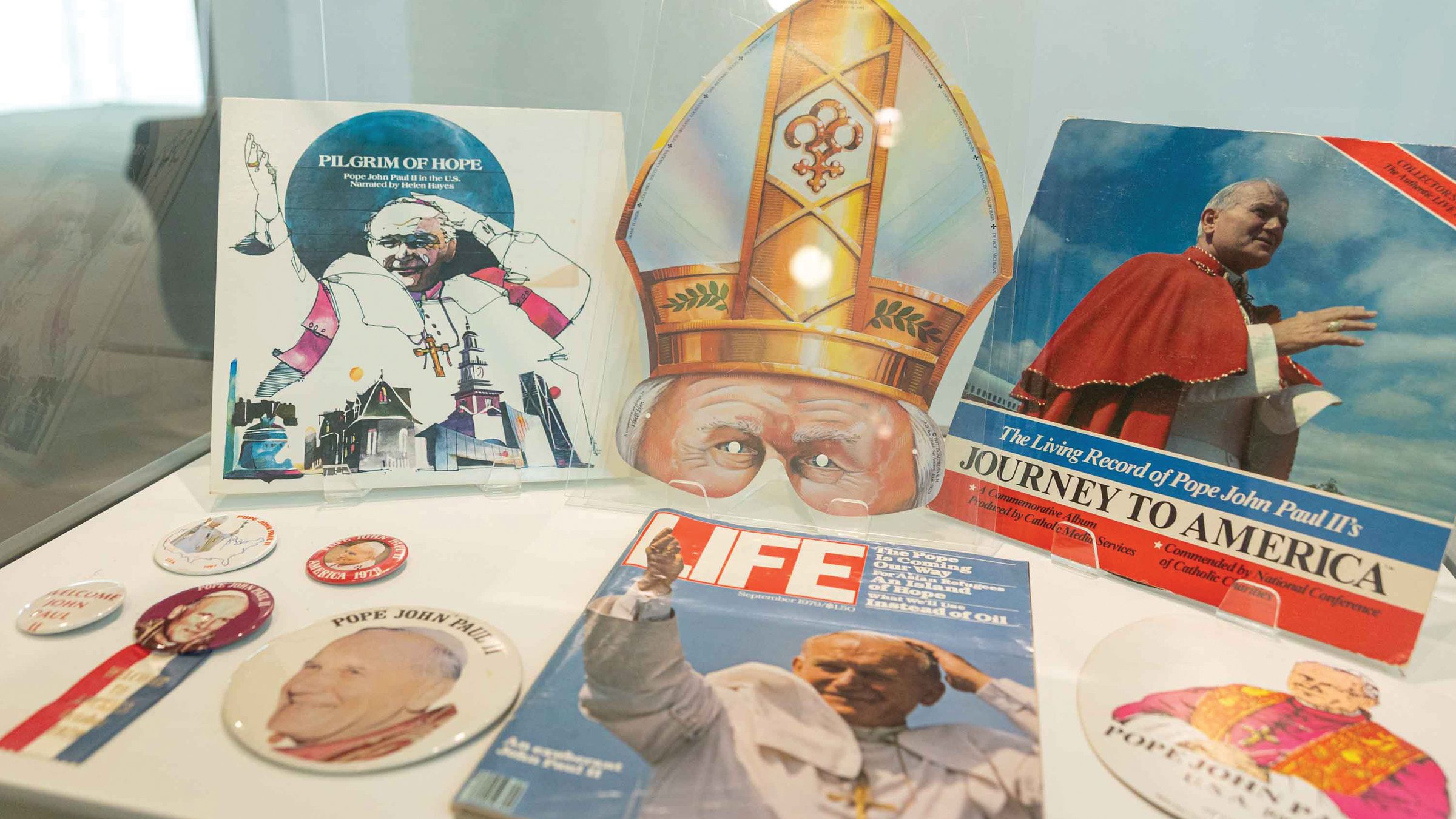
The shrine, through Sept. 9, has an exhibit dedicated to those papal messages to commemorate the 250th anniversary of the United States.
Titled “A New Birth of Freedom,” the exhibit includes audio and video, photos and artifacts from his visits, including the future pope’s trip to America for its bicentennial in 1976. Two years later, Polish Cardinal Karol Wojtyla was elected the successor to Peter – on Oct. 16, 1978.
As pope, his visits to the U.S. were: 1979, Boston, New York, Philadelphia, Chicago, Des Moines and Washington; 1981, brief stopover in Anchorage, Alaska; 1984: brief stopover in Fairbanks, Alaska; 1987, Miami, Columbia, South Carolina, New Orleans, San Antonio, Phoenix, Los Angeles, Monterey, California, San Francisco and Detroit; 1993, World Youth Day in Denver; 1995, Newark and East Rutherford, New Jersey, New York and Baltimore; and 1999, St. Louis.
Some elements in the shrine’s exhibit were loaned by the archdioceses of Miami, Denver, St. Louis, Chicago and Philadelphia as well as Xavier University of Louisiana and The Catholic University of America. Brown curated the exhibit with contributions from Bethany Bromwell, collections curator, and Victoria Gallegos, curatorial assistant.
The pontiff’s eager embrace of American principles was obvious in his 1979 visit, when he celebrated a Mass, which drew 350,000, at Living History Farms in Urbandale, Iowa, simply because Joe Hayes, a farmer from nearby Truro, wrote him a letter inviting him to come to Iowa.
In April 1984, when St. John Paul accepted the credentials of William A. Wilson, the first U.S. ambassador to the Holy See, the pope referenced the Declaration of Independence and the Constitution.
“Certainly the recognition of God and the defense of human dignity, and therefore of human life, are a most precious part of your national heritage,” the pope said. “Your Declaration of Independence speaks to the whole world about the ‘Laws of Nature and of Nature’s God,’ and with great wisdom it recognizes inalienable rights for man. Your Constitution for its part sees the need to ‘establish justice ... and secure the blessings of liberty.’”
Accepting Wilson’s credentials as ambassador was historic – it established full formal diplomatic relations between the U.S. and the Vatican.
In September 1987, he easily quoted Abraham Lincoln, citing “a new birth of freedom,” which is in Lincoln’s Gettysburg Address. (The pope also invoked Lincoln’s address on Oct. 8, 1995, during his homily at Camden Yards in Baltimore.)
Arguing that freedom must be renewed by each generation, he addressed his 1987 remarks directly to President Ronald Reagan in Miami, saying, “A new birth of freedom is repeatedly necessary. Freedom to exercise responsibility and generosity, freedom to meet the challenge of serving humanity.”
Reagan welcomed the pope at Miami’s Vizcaya Museum, on Sept. 10, 1987, for the start of his U.S. tour. The two leaders discussed human freedom, democracy and Central American peace, according to the Reagan Library.
In his farewell address to the United States on the final day of his 1987 visit, the phrase “America the beautiful” echoed through his remarks as he challenged the country to defend human dignity, family values and the right to life.
“America the beautiful!” he said in Detroit on Sept. 19, 1987. “Yes, America you are beautiful indeed, and blessed in so many ways. ... But your greatest beauty and your richest blessing is found in the human person: in each man, woman and child, in every immigrant, in every native-born son and daughter. ... The ultimate test of your greatness in the way you treat every human being, but especially the weakest and most defenseless ones.”
“If you want equal justice for all, and true freedom and lasting peace, then, America, defend life!” he said.
Grattan encountered the pope three times, the first at World Youth Day in 1993 in Denver and the last time in 1997 in Rome when he was a theology student at the Pontifical Lateran University, and was able to introduce his mother, Elizabeth, after an early-morning Mass. The pontiff’s heavily accented “God bless your mother!” is a cherished memory.
He also warmly recalled being part of a group of aspiring seminarians addressed by St. John Paul II in 1995 at St. Joseph’s Seminary in Yonkers, New York. To encourage them, he said, “I come to you as a friend in Christ and friends can talk about difficult things.”